How To Write a Freelance Project Brief That Gets Better Proposals
Use this freelance project brief template to get clearer pricing, stronger proposals, and better-fit freelancers for your project.
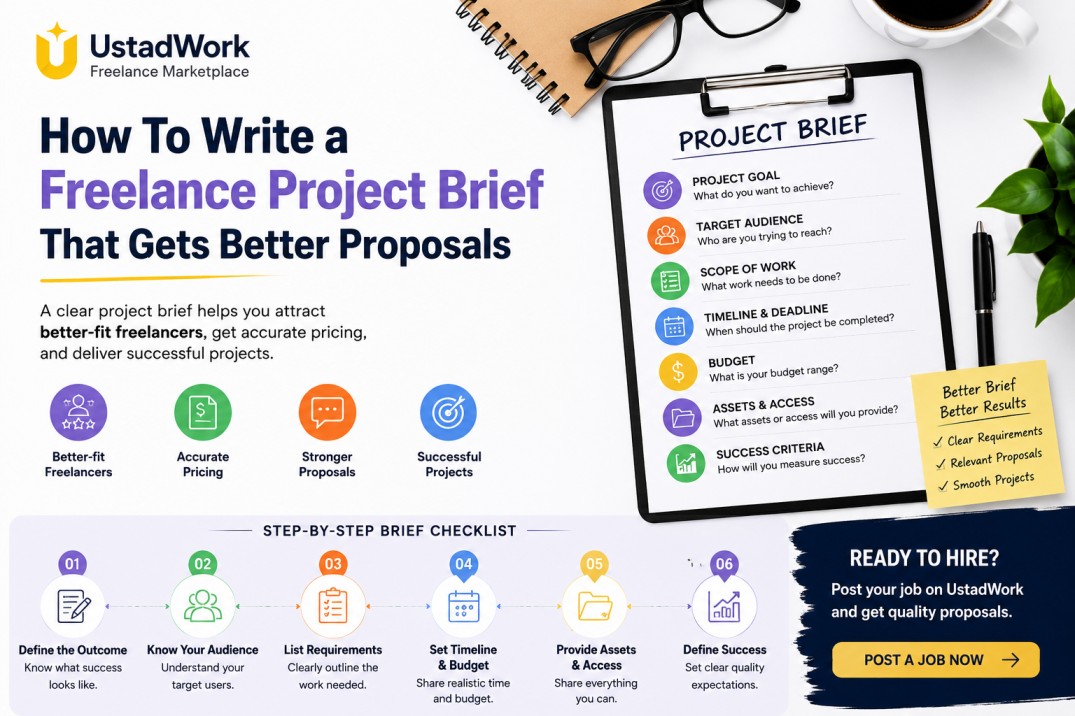
How To Write a Freelance Project Brief That Gets Better Proposals
A freelance project brief is the document or job description you give to freelancers before they send a proposal. A good brief helps the right people understand your goal, estimate the work correctly, and explain how they can help. A weak brief creates the opposite result: vague prices, generic proposals, missed requirements, and confusion after the project starts.
You do not need a long technical document to get better proposals. You only need enough clarity for a freelancer to understand your business goal, required work, timeline, budget expectations, available assets, and definition of success.
This guide explains how to write a freelance project brief that helps you compare proposals fairly and hire a better-fit freelancer. When your brief is ready, you can post a job on UstadWork and receive proposals based on your exact requirements.
You do not need a long technical document to get better proposals. You only need enough clarity for a freelancer to understand your business goal, required work, timeline, budget expectations, available assets, and definition of success.
This guide explains how to write a freelance project brief that helps you compare proposals fairly and hire a better-fit freelancer. When your brief is ready, you can post a job on UstadWork and receive proposals based on your exact requirements.
Before You Begin: Define the Real Project Outcome
Before writing a brief, stop thinking only about the task. Think about the outcome you need. For example, do not write: I need a website. Write: I need a mobile-friendly service website that helps customers request quotes. Do not write: I need SEO. Write: I need an SEO audit and content plan to improve qualified traffic for my main service pages.
A clear outcome helps freelancers recommend the right solution. It also helps you avoid paying for work that looks good but does not solve the actual business problem.
Start by answering these questions:
What business result do I want?
Who is the target customer or user?
What problem should this project solve?
What should visitors, customers, or users be able to do after the work is complete?
How will I know the project was successful?
For example, a better outcome could be: Increase booking enquiries from mobile visitors. Improve product page trust before running ads. Create a professional brand identity for a new service. Build a dashboard for customers to track orders.
A clear outcome helps freelancers recommend the right solution. It also helps you avoid paying for work that looks good but does not solve the actual business problem.
Start by answering these questions:
What business result do I want?
Who is the target customer or user?
What problem should this project solve?
What should visitors, customers, or users be able to do after the work is complete?
How will I know the project was successful?
For example, a better outcome could be: Increase booking enquiries from mobile visitors. Improve product page trust before running ads. Create a professional brand identity for a new service. Build a dashboard for customers to track orders.
Step 1: Explain Your Business and Target Audience
Freelancers can give stronger recommendations when they understand your business context. Include a short introduction about your company, what you sell, who you serve, and what makes your offer different.
You do not need to share private information. A few useful details are enough:
Business name and website: Share your current website or social pages if available.
What you sell: Products, services, software, courses, consulting, local services, or another offer.
Target audience: Who should buy from you or use the project?
Target location: Local, national, international, or a specific city or country.
Current challenge: Low conversions, outdated design, no website, weak traffic, unclear branding, slow website, or manual workflow.
This information helps a freelancer understand whether your project needs design, development, SEO, copywriting, ecommerce support, automation, or a combination of services.
You do not need to share private information. A few useful details are enough:
Business name and website: Share your current website or social pages if available.
What you sell: Products, services, software, courses, consulting, local services, or another offer.
Target audience: Who should buy from you or use the project?
Target location: Local, national, international, or a specific city or country.
Current challenge: Low conversions, outdated design, no website, weak traffic, unclear branding, slow website, or manual workflow.
This information helps a freelancer understand whether your project needs design, development, SEO, copywriting, ecommerce support, automation, or a combination of services.
Step 2: Describe Exactly What You Need
This is the most important part of your freelance project brief. List the work you expect the freelancer to complete. Be specific enough to explain the project, but do not pretend to know every technical solution. You can describe the business need and let qualified freelancers recommend the best approach.
For a website project, include pages, forms, integrations, mobile requirements, content needs, and launch expectations. For design work, include required designs, sizes, brand style, platforms, editable files, and revision needs. For SEO, include the website URL, target services, locations, competitors, current traffic situation, and whether you need an audit, content strategy, technical work, or monthly support.
Use an in scope and out of scope list. In scope includes work that must be delivered. Out of scope includes work that is not part of the current project. This protects both you and the freelancer from confusion.
Example:
In scope: Homepage, services page, contact form, mobile optimization, basic SEO setup, and launch support.
Out of scope: Copywriting, paid ads, multilingual pages, advanced CRM automation, and extra landing pages requested after approval.
For a website project, include pages, forms, integrations, mobile requirements, content needs, and launch expectations. For design work, include required designs, sizes, brand style, platforms, editable files, and revision needs. For SEO, include the website URL, target services, locations, competitors, current traffic situation, and whether you need an audit, content strategy, technical work, or monthly support.
Use an in scope and out of scope list. In scope includes work that must be delivered. Out of scope includes work that is not part of the current project. This protects both you and the freelancer from confusion.
Example:
In scope: Homepage, services page, contact form, mobile optimization, basic SEO setup, and launch support.
Out of scope: Copywriting, paid ads, multilingual pages, advanced CRM automation, and extra landing pages requested after approval.
Step 4: Provide Tools, Assets, and Access Information
A freelancer can work faster and give a more accurate quote when they know what assets already exist. Mention what you can provide at the beginning of the project.
Useful assets may include:
Brand logo, colors, and fonts
Product photos or service images
Website copy or product descriptions
Competitor links or inspiration examples
Existing website login or staging access
Hosting, domain, CMS, analytics, or Search Console access
API documentation or technical requirements
Design files, wireframes, or previous project files
Do not share passwords publicly in a job post. Tell freelancers that access can be provided after hiring. In the brief, simply mention which systems are available and which information still needs to be prepared.
Useful assets may include:
Brand logo, colors, and fonts
Product photos or service images
Website copy or product descriptions
Competitor links or inspiration examples
Existing website login or staging access
Hosting, domain, CMS, analytics, or Search Console access
API documentation or technical requirements
Design files, wireframes, or previous project files
Do not share passwords publicly in a job post. Tell freelancers that access can be provided after hiring. In the brief, simply mention which systems are available and which information still needs to be prepared.
Step 5: Add Quality Checks and Definition of Done
A project is not complete only because the freelancer says it is complete. Your brief should define how you will check the work before approving it. This is called a definition of done.
For a website, quality checks may include mobile responsiveness, working contact forms, correct links, fast loading, browser testing, SEO basics, analytics setup, and admin access. For design, quality checks may include correct dimensions, editable source files, brand consistency, readable text, and platform-ready exports. For SEO, quality checks may include an audit report, keyword map, optimized pages, internal links, tracking setup, and monthly reporting.
You should also explain how feedback will work. For example: The client will provide one combined feedback document within two business days. The freelancer will complete revisions that are included in the approved scope. New requests outside the scope will be quoted separately.
This prevents an endless revision cycle and gives both sides a fair approval process.
For a website, quality checks may include mobile responsiveness, working contact forms, correct links, fast loading, browser testing, SEO basics, analytics setup, and admin access. For design, quality checks may include correct dimensions, editable source files, brand consistency, readable text, and platform-ready exports. For SEO, quality checks may include an audit report, keyword map, optimized pages, internal links, tracking setup, and monthly reporting.
You should also explain how feedback will work. For example: The client will provide one combined feedback document within two business days. The freelancer will complete revisions that are included in the approved scope. New requests outside the scope will be quoted separately.
This prevents an endless revision cycle and gives both sides a fair approval process.
Copy and Paste Freelance Project Brief Template
PROJECT TITLE:
Write a clear title, for example: Build a Mobile-Friendly WordPress Website for a Cleaning Business.
ABOUT MY BUSINESS:
Explain what you sell, who you serve, and your target market.
PROJECT GOAL:
Explain the result you want. Example: Generate more quote requests from mobile visitors.
WHAT I NEED:
List pages, designs, features, deliverables, integrations, or tasks.
TARGET AUDIENCE:
Describe the customer, user, or client you want to reach.
ASSETS I CAN PROVIDE:
Logo, brand guide, copy, images, product data, website access, examples, or technical files.
IN SCOPE:
List the work that must be completed.
OUT OF SCOPE:
List work that is not included in this project.
TIMELINE:
State your preferred start date, deadline, and any fixed launch date.
BUDGET:
Share a budget range or say whether you want fixed-price, hourly, or monthly support.
SUCCESS CRITERIA:
Explain what must be true before you approve the work.
WHAT TO INCLUDE IN YOUR PROPOSAL:
Ask freelancers to share relevant experience, approach, estimated timeline, milestones, questions, and examples of similar work.
Write a clear title, for example: Build a Mobile-Friendly WordPress Website for a Cleaning Business.
ABOUT MY BUSINESS:
Explain what you sell, who you serve, and your target market.
PROJECT GOAL:
Explain the result you want. Example: Generate more quote requests from mobile visitors.
WHAT I NEED:
List pages, designs, features, deliverables, integrations, or tasks.
TARGET AUDIENCE:
Describe the customer, user, or client you want to reach.
ASSETS I CAN PROVIDE:
Logo, brand guide, copy, images, product data, website access, examples, or technical files.
IN SCOPE:
List the work that must be completed.
OUT OF SCOPE:
List work that is not included in this project.
TIMELINE:
State your preferred start date, deadline, and any fixed launch date.
BUDGET:
Share a budget range or say whether you want fixed-price, hourly, or monthly support.
SUCCESS CRITERIA:
Explain what must be true before you approve the work.
WHAT TO INCLUDE IN YOUR PROPOSAL:
Ask freelancers to share relevant experience, approach, estimated timeline, milestones, questions, and examples of similar work.
Example: Weak Brief vs Strong Brief
Weak brief:
I need someone to make my website professional. Send your best price.
This brief does not explain the business, pages, goals, content, budget, deadline, or expected quality. It will attract many generic proposals because freelancers must guess what you need.
Strong brief:
I run a home cleaning business in Lahore. I need a mobile-friendly website that helps customers request a quote. The project includes a homepage, services page, about page, contact page, quote form, WhatsApp button, and basic SEO setup. I will provide the logo, service list, photos, and competitor examples. I need the first version within three weeks. Please include your recommended approach, fixed-price quote, milestone plan, examples of similar service websites, and any questions you need answered.
The strong brief gives freelancers enough information to create focused proposals. It also makes it easier for you to compare candidates because they are responding to the same goals.
I need someone to make my website professional. Send your best price.
This brief does not explain the business, pages, goals, content, budget, deadline, or expected quality. It will attract many generic proposals because freelancers must guess what you need.
Strong brief:
I run a home cleaning business in Lahore. I need a mobile-friendly website that helps customers request a quote. The project includes a homepage, services page, about page, contact page, quote form, WhatsApp button, and basic SEO setup. I will provide the logo, service list, photos, and competitor examples. I need the first version within three weeks. Please include your recommended approach, fixed-price quote, milestone plan, examples of similar service websites, and any questions you need answered.
The strong brief gives freelancers enough information to create focused proposals. It also makes it easier for you to compare candidates because they are responding to the same goals.
How To Compare Freelance Proposals
Do not choose only by the lowest price. Compare proposals using the same criteria. A strong proposal should show that the freelancer understood your goal, reviewed the scope, identified key questions, explained their approach, and gave a realistic timeline.
Compare proposals based on:
Relevant experience: Have they completed similar work?
Understanding: Did they mention your business goal and requirements?
Approach: Did they explain how they will complete the work?
Timeline: Is the delivery schedule realistic?
Milestones: Are deliverables and approval stages clear?
Communication: Did they ask useful questions and reply professionally?
Ownership: Will you receive source files, access, documentation, and handoff?
Price: Does the price match the scope and expected quality?
A freelancer who asks thoughtful questions before giving a final quote is often safer than someone who gives an instant low price without reviewing your needs.
Compare proposals based on:
Relevant experience: Have they completed similar work?
Understanding: Did they mention your business goal and requirements?
Approach: Did they explain how they will complete the work?
Timeline: Is the delivery schedule realistic?
Milestones: Are deliverables and approval stages clear?
Communication: Did they ask useful questions and reply professionally?
Ownership: Will you receive source files, access, documentation, and handoff?
Price: Does the price match the scope and expected quality?
A freelancer who asks thoughtful questions before giving a final quote is often safer than someone who gives an instant low price without reviewing your needs.
When To Post a Job vs Buy a Fixed Service
Use a fixed service when the work is clear, small, and easy to define. Examples include logo design, a landing page, a short video edit, a website speed check, a basic SEO audit, or a social-media design package. You can browse available services on UstadWork when you know exactly what you need.
Use a job post when your project is custom, larger, ongoing, or needs multiple skills. Examples include a custom website, SaaS product, ecommerce build, SEO content strategy, branding project, automation workflow, or long-term marketing support. In these cases, a detailed freelance project brief helps freelancers send more relevant proposals.
When you are ready, post your project on UstadWork with the template from this guide. You can also review the UstadWork FAQ before hiring.
Use a job post when your project is custom, larger, ongoing, or needs multiple skills. Examples include a custom website, SaaS product, ecommerce build, SEO content strategy, branding project, automation workflow, or long-term marketing support. In these cases, a detailed freelance project brief helps freelancers send more relevant proposals.
When you are ready, post your project on UstadWork with the template from this guide. You can also review the UstadWork FAQ before hiring.
Write a Better Brief and Hire With Confidence
A strong freelance project brief does not need complicated language. It needs clarity. Explain your business goal, required work, target audience, budget expectations, timeline, assets, quality checks, and approval process. The clearer your brief is, the easier it becomes to receive useful proposals and choose the right freelancer.
Use the copy-paste template above, compare proposals based on value instead of price alone, and keep all important decisions in writing. That process helps you reduce confusion, avoid scope creep, and start projects with stronger expectations.
Ready to begin? Post a job on UstadWork or browse freelance services for focused, fixed-scope work.
Use the copy-paste template above, compare proposals based on value instead of price alone, and keep all important decisions in writing. That process helps you reduce confusion, avoid scope creep, and start projects with stronger expectations.
Ready to begin? Post a job on UstadWork or browse freelance services for focused, fixed-scope work.
Frequently asked questions
What is a freelance project brief?
A freelance project brief is a document or job description that explains your business goal, required work, target audience, timeline, budget expectations, available assets, and approval requirements before hiring a freelancer.
How long should a freelance project brief be?
A brief should be long enough to explain the project clearly but short enough to be easy to review. One to two pages is often enough for a focused project, while larger technical projects may need a longer scope document.
Should I include my budget in a freelancer job post?
Sharing a realistic budget range usually helps attract better-fit freelancers and reduces irrelevant proposals. You can also state whether you prefer fixed-price, hourly, or monthly support.
What should I ask freelancers to include in their proposal?
Ask for relevant experience, their recommended approach, estimated timeline, milestones, questions about your scope, examples of similar work, and details about what is included or excluded.
How do I avoid scope creep with freelancers?
Use a written scope, define what is included and excluded, set milestone approval points, keep feedback in writing, and agree that new work outside the approved project requires a separate estimate.