How To Turn One Service Into a Repeatable Freelance Offer
Turn one skill into a clearer freelance offer with service packaging, scope boundaries, and CTAs that convert.
How To Turn One Service Into a Repeatable Freelance Offer
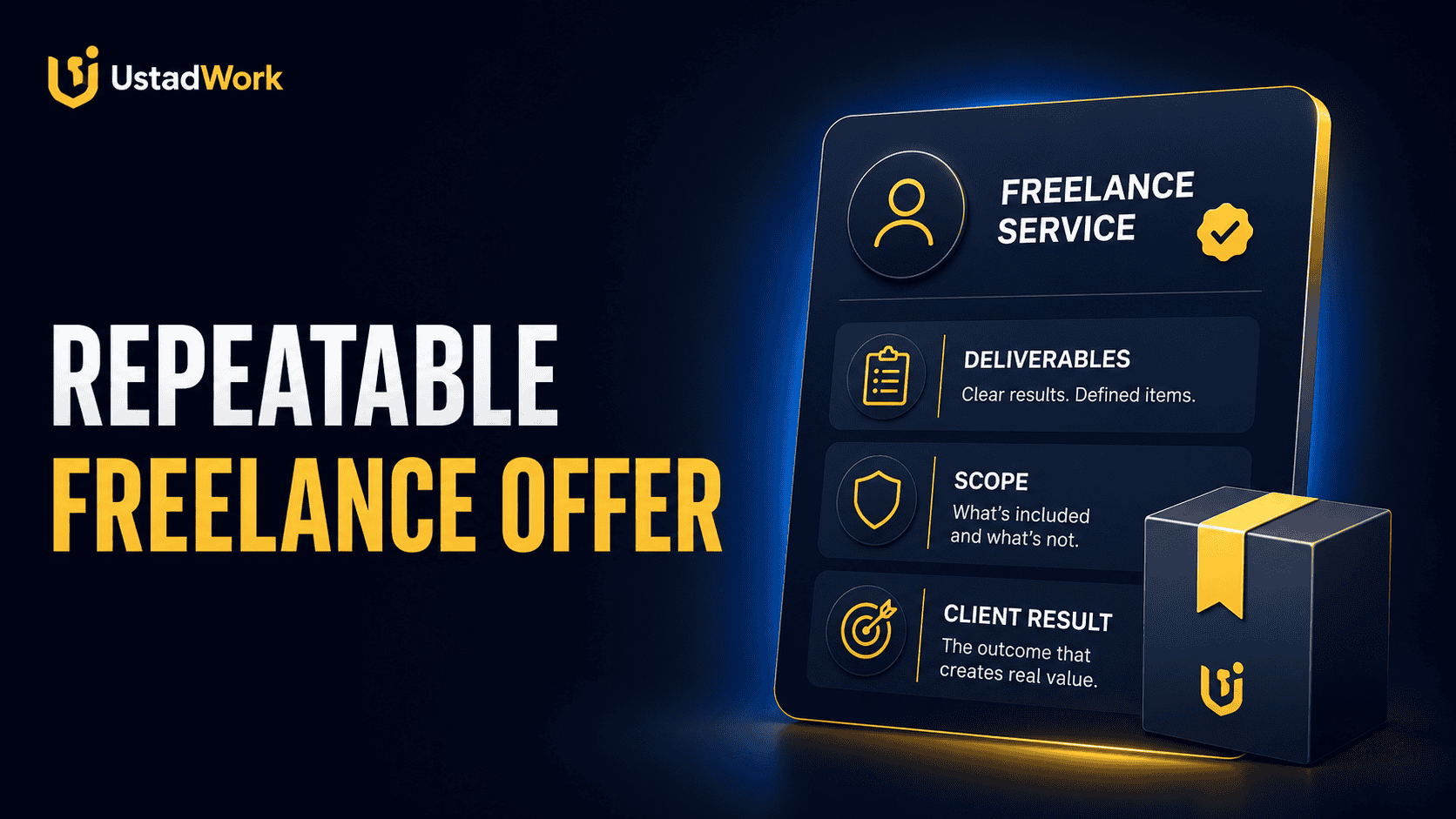
A repeatable freelance offer turns one skill into a clear service that clients can understand and buy. Instead of saying I can do anything related to design, websites, SEO, writing, or video editing, you explain exactly what you deliver, who it is for, what is included, and what happens next.
This does not mean every project must be identical. It means you create a useful structure that makes your work easier to explain, price, sell, and deliver. A client should not need to guess what they will receive or whether your service fits their project.
A strong repeatable freelance offer helps you attract better-fit clients, avoid unclear scope, and create more confident proposals. When your offer is ready, you can publish it as a service on UstadWork or use the same structure when applying for freelance jobs.
This does not mean every project must be identical. It means you create a useful structure that makes your work easier to explain, price, sell, and deliver. A client should not need to guess what they will receive or whether your service fits their project.
A strong repeatable freelance offer helps you attract better-fit clients, avoid unclear scope, and create more confident proposals. When your offer is ready, you can publish it as a service on UstadWork or use the same structure when applying for freelance jobs.
What Buyers Want From a Freelance Offer
Clients usually want clarity before they hire. They want to know what problem you solve, what they will receive, how long the work may take, what information you need, and whether the service matches their budget and project goals.
A vague offer creates hesitation. For example, I do web development, I provide SEO, or I make social-media designs does not tell a client what is actually included. A clearer offer might be: I will build a mobile-friendly WordPress landing page for your service business, or I will create a 30-day social-media design kit for your brand.
Clients do not always need a long explanation. They need a clear outcome, understandable deliverables, realistic boundaries, and an easy next step.
A vague offer creates hesitation. For example, I do web development, I provide SEO, or I make social-media designs does not tell a client what is actually included. A clearer offer might be: I will build a mobile-friendly WordPress landing page for your service business, or I will create a 30-day social-media design kit for your brand.
Clients do not always need a long explanation. They need a clear outcome, understandable deliverables, realistic boundaries, and an easy next step.
Step 1: Start With One Skill and One Clear Outcome
Choose one skill you already use and connect it to one useful client outcome. Your offer should not begin with every service you can possibly provide. Start with the work you want more of and the type of result you can deliver well.
Examples:
Web Development: Build a mobile-friendly business website that helps clients collect leads.
Graphic Design: Create a brand identity kit for a new business.
SEO: Deliver a keyword research and on-page SEO action plan.
Video Editing: Edit short-form videos for Reels, TikTok, and product ads.
Content Writing: Write SEO-focused blog content for service businesses.
A focused offer is easier for clients to understand and easier for you to improve over time. You can still offer other services later, but one strong offer is better than many unclear ones.
Examples:
Web Development: Build a mobile-friendly business website that helps clients collect leads.
Graphic Design: Create a brand identity kit for a new business.
SEO: Deliver a keyword research and on-page SEO action plan.
Video Editing: Edit short-form videos for Reels, TikTok, and product ads.
Content Writing: Write SEO-focused blog content for service businesses.
A focused offer is easier for clients to understand and easier for you to improve over time. You can still offer other services later, but one strong offer is better than many unclear ones.
Step 2: Define the Exact Deliverables
Deliverables are the items a client will receive. They protect both sides because they turn a vague request into something practical and measurable.
For example, a website offer could include:
One landing page
Mobile responsive layout
Contact or quote form
Basic call-to-action sections
Two revision rounds
Final website handoff
An SEO offer could include keyword research, a page audit, a content map, on-page recommendations, and an internal-linking plan. A graphic-design offer could include a logo concept, color palette, font recommendations, profile image, and social-media templates.
Write deliverables in simple language. Avoid hiding important details behind broad words such as complete, full, premium, or unlimited.
For example, a website offer could include:
One landing page
Mobile responsive layout
Contact or quote form
Basic call-to-action sections
Two revision rounds
Final website handoff
An SEO offer could include keyword research, a page audit, a content map, on-page recommendations, and an internal-linking plan. A graphic-design offer could include a logo concept, color palette, font recommendations, profile image, and social-media templates.
Write deliverables in simple language. Avoid hiding important details behind broad words such as complete, full, premium, or unlimited.
Step 3: Set Scope Boundaries Before Problems Start
Scope boundaries explain what is not included unless the client requests it separately. This is one of the most important parts of service packaging because it reduces misunderstanding, unlimited revision requests, last-minute additions, and unpaid extra work.
For a website package, scope boundaries may include:
Client provides logo, copy, and images unless content creation is added.
Package includes one landing page, not a full multi-page website.
Two revision rounds are included.
Custom integrations, paid plugins, and advanced functionality are quoted separately.
Hosting, domain, and third-party subscription fees are not included.
Scope boundaries are not rude. They help clients understand what they are buying and help you deliver the work properly.
For a website package, scope boundaries may include:
Client provides logo, copy, and images unless content creation is added.
Package includes one landing page, not a full multi-page website.
Two revision rounds are included.
Custom integrations, paid plugins, and advanced functionality are quoted separately.
Hosting, domain, and third-party subscription fees are not included.
Scope boundaries are not rude. They help clients understand what they are buying and help you deliver the work properly.
Step 4: Create a Simple Service Package Structure
A useful package structure gives clients choices without making them confused. You can use a simple three-level model: Starter, Growth, and Advanced. The goal is not to force every client into a higher package. The goal is to match the amount of work to the right level of scope.
Starter: A focused result for a smaller need. Example: one landing page, one logo concept, five social posts, one SEO audit, or three edited videos.
Growth: More deliverables, planning, revisions, or customization. Example: a five-page business website, brand kit, 30-post design pack, keyword strategy, or monthly video package.
Advanced: Custom or business-critical work. Example: ecommerce website, full brand system, complete SEO implementation, advanced automation, or a larger video campaign.
Price should reflect time, skill, complexity, revisions, urgency, and business risk. Do not use a package title alone to decide price.
Starter: A focused result for a smaller need. Example: one landing page, one logo concept, five social posts, one SEO audit, or three edited videos.
Growth: More deliverables, planning, revisions, or customization. Example: a five-page business website, brand kit, 30-post design pack, keyword strategy, or monthly video package.
Advanced: Custom or business-critical work. Example: ecommerce website, full brand system, complete SEO implementation, advanced automation, or a larger video campaign.
Price should reflect time, skill, complexity, revisions, urgency, and business risk. Do not use a package title alone to decide price.
Copy and Paste Repeatable Freelance Offer Template
Service Title:
I will [deliverable] for [target client or project type].
Who This Is For:
This service is for [type of client] who need [specific outcome].
What You Will Receive:
List the exact deliverables.
What I Need From You:
Ask for project goals, brand assets, examples, content, access, deadlines, or technical details.
What Is Included:
State pages, designs, videos, revisions, reports, files, or support clearly.
What Is Not Included:
Explain custom work, paid tools, extra revisions, advanced features, third-party fees, or future additions.
Timeline:
Give a realistic estimated timeline after receiving all required information.
Call To Action:
Send your requirements, timeline, and examples so I can confirm the best package for your project.
I will [deliverable] for [target client or project type].
Who This Is For:
This service is for [type of client] who need [specific outcome].
What You Will Receive:
List the exact deliverables.
What I Need From You:
Ask for project goals, brand assets, examples, content, access, deadlines, or technical details.
What Is Included:
State pages, designs, videos, revisions, reports, files, or support clearly.
What Is Not Included:
Explain custom work, paid tools, extra revisions, advanced features, third-party fees, or future additions.
Timeline:
Give a realistic estimated timeline after receiving all required information.
Call To Action:
Send your requirements, timeline, and examples so I can confirm the best package for your project.
Repeatable Freelance Offer Examples
WordPress Offer:
I will build a mobile-friendly WordPress landing page for your service business. Includes one custom landing page, quote form, mobile layout, basic SEO headings, two revision rounds, and final handoff.
SEO Offer:
I will create a keyword research and on-page SEO action plan for your website. Includes keyword research, page priority list, content opportunities, on-page recommendations, and a practical next-step checklist.
Graphic Design Offer:
I will create a social-media design kit for your business. Includes 10 branded post templates, editable Canva files, color direction, typography guidance, and two revision rounds.
Video Editing Offer:
I will edit five short-form videos for Reels or product ads. Includes clean cuts, captions, basic transitions, branded text, and exports sized for social media.
These offers work because they explain the result, deliverables, and limits without making unrealistic promises.
I will build a mobile-friendly WordPress landing page for your service business. Includes one custom landing page, quote form, mobile layout, basic SEO headings, two revision rounds, and final handoff.
SEO Offer:
I will create a keyword research and on-page SEO action plan for your website. Includes keyword research, page priority list, content opportunities, on-page recommendations, and a practical next-step checklist.
Graphic Design Offer:
I will create a social-media design kit for your business. Includes 10 branded post templates, editable Canva files, color direction, typography guidance, and two revision rounds.
Video Editing Offer:
I will edit five short-form videos for Reels or product ads. Includes clean cuts, captions, basic transitions, branded text, and exports sized for social media.
These offers work because they explain the result, deliverables, and limits without making unrealistic promises.
Step 5: Add a Call To Action That Helps Clients Decide
A good offer should end with a clear next step. Do not leave clients wondering whether they should message you, send a brief, choose a package, or request a quote.
Useful calls to action include:
Send your project details and I will confirm the right package.
Share your website, examples, and deadline before ordering.
Message me with your requirements for a custom quote.
Choose this package if your project fits the listed scope.
Keep the call to action simple. It should help clients take the next step without pressure or confusion. When you are ready, you can publish your service package on UstadWork.
Useful calls to action include:
Send your project details and I will confirm the right package.
Share your website, examples, and deadline before ordering.
Message me with your requirements for a custom quote.
Choose this package if your project fits the listed scope.
Keep the call to action simple. It should help clients take the next step without pressure or confusion. When you are ready, you can publish your service package on UstadWork.
Use Your Profile and Portfolio To Support the Offer
Your freelance offer works better when it matches your profile and portfolio. Your headline, overview, skills, portfolio samples, and service title should all support the same direction.
For example, if your offer is about WordPress landing pages, show WordPress landing-page samples. If your offer is about SEO audits, show sample audits, keyword maps, or content plans. If your offer is about social-media design, show relevant social posts and branded visuals.
A client should see the same message across your profile, portfolio, and service package. This builds trust because your work looks focused instead of random. Use the UstadWork FAQ section if you need help understanding how the marketplace works before publishing.
For example, if your offer is about WordPress landing pages, show WordPress landing-page samples. If your offer is about SEO audits, show sample audits, keyword maps, or content plans. If your offer is about social-media design, show relevant social posts and branded visuals.
A client should see the same message across your profile, portfolio, and service package. This builds trust because your work looks focused instead of random. Use the UstadWork FAQ section if you need help understanding how the marketplace works before publishing.
Common Service Packaging Mistakes
Many freelancers create offers that are either too vague or too complicated. Avoid these common mistakes:
Trying to include everything: One package cannot realistically include unlimited pages, unlimited revisions, custom integrations, strategy, copywriting, design, development, and support.
Using unclear deliverables: Words like full website or complete SEO do not explain what a client receives.
Ignoring scope boundaries: Without boundaries, small requests can become large unpaid work.
Adding fake urgency or guarantees: Avoid promises such as guaranteed sales, guaranteed ranking, or instant growth.
Using the same offer for every client: A repeatable structure is useful, but some clients may need a custom quote.
Hiding important exclusions: Be clear about paid tools, third-party fees, content, access, and advanced features.
Your offer should make clients feel informed, not trapped or confused.
Trying to include everything: One package cannot realistically include unlimited pages, unlimited revisions, custom integrations, strategy, copywriting, design, development, and support.
Using unclear deliverables: Words like full website or complete SEO do not explain what a client receives.
Ignoring scope boundaries: Without boundaries, small requests can become large unpaid work.
Adding fake urgency or guarantees: Avoid promises such as guaranteed sales, guaranteed ranking, or instant growth.
Using the same offer for every client: A repeatable structure is useful, but some clients may need a custom quote.
Hiding important exclusions: Be clear about paid tools, third-party fees, content, access, and advanced features.
Your offer should make clients feel informed, not trapped or confused.
Repeatable Freelance Offer Action Checklist
Before publishing your offer, check these points:
Choose one main skill and client outcome.
Write a clear service title.
List exact deliverables.
State what information you need from the client.
Set realistic timeline expectations.
Add revision limits.
Write scope boundaries and exclusions.
Create Starter, Growth, or Advanced levels where useful.
Use portfolio samples that support the offer.
Remove vague claims and unrealistic guarantees.
Add one simple call to action.
Check spelling, links, package details, and visual examples.
When your offer is ready, publish it as a gig on UstadWork, explore projects that match your skill, or read the UstadWork FAQ before you begin.
Choose one main skill and client outcome.
Write a clear service title.
List exact deliverables.
State what information you need from the client.
Set realistic timeline expectations.
Add revision limits.
Write scope boundaries and exclusions.
Create Starter, Growth, or Advanced levels where useful.
Use portfolio samples that support the offer.
Remove vague claims and unrealistic guarantees.
Add one simple call to action.
Check spelling, links, package details, and visual examples.
When your offer is ready, publish it as a gig on UstadWork, explore projects that match your skill, or read the UstadWork FAQ before you begin.
Build an Offer Clients Can Understand and Buy
A repeatable freelance offer is not about making your work robotic. It is about making your value clear. When you define the outcome, deliverables, scope boundaries, package level, and next step, clients can understand your service faster and you can protect your time better.
Start with one focused offer. Improve it as you learn which questions clients ask, which deliverables take more time, and which projects are the best fit for your skills. A clear offer can become the foundation for stronger proposals, better portfolio samples, and more confident client conversations.
Ready to begin? publish a focused service on UstadWork, find freelance jobs that match your offer, or review the UstadWork FAQ before getting started.
Start with one focused offer. Improve it as you learn which questions clients ask, which deliverables take more time, and which projects are the best fit for your skills. A clear offer can become the foundation for stronger proposals, better portfolio samples, and more confident client conversations.
Ready to begin? publish a focused service on UstadWork, find freelance jobs that match your offer, or review the UstadWork FAQ before getting started.
Frequently asked questions
What is a repeatable freelance offer?
A repeatable freelance offer is a clearly defined service with a specific outcome, deliverables, scope boundaries, timeline expectations, and call to action. It helps clients understand what they can hire you for.
Can I offer more than one freelance service?
Yes, but start with one focused service offer first. Once it is clear and working well, you can create separate offers for related services.
What should I include in a freelance service package?
Include the client outcome, exact deliverables, what you need from the client, revision limits, timeline expectations, exclusions, and a clear next step.
How do I set scope boundaries for a freelance offer?
State what is included and what requires a separate quote. Examples include extra pages, additional revisions, paid tools, custom integrations, content creation, advanced features, and third-party fees.
Should I offer fixed packages or custom quotes?
Use fixed packages for clear and repeatable work. Use custom quotes when the project has unusual requirements, technical complexity, larger scope, or unclear deliverables.