ChatGPT Deep Research Tutorial: How to Research With Reliable Sources
Learn how to use ChatGPT Deep Research for market studies, competitor analysis, document research, source verification, and cited reports.
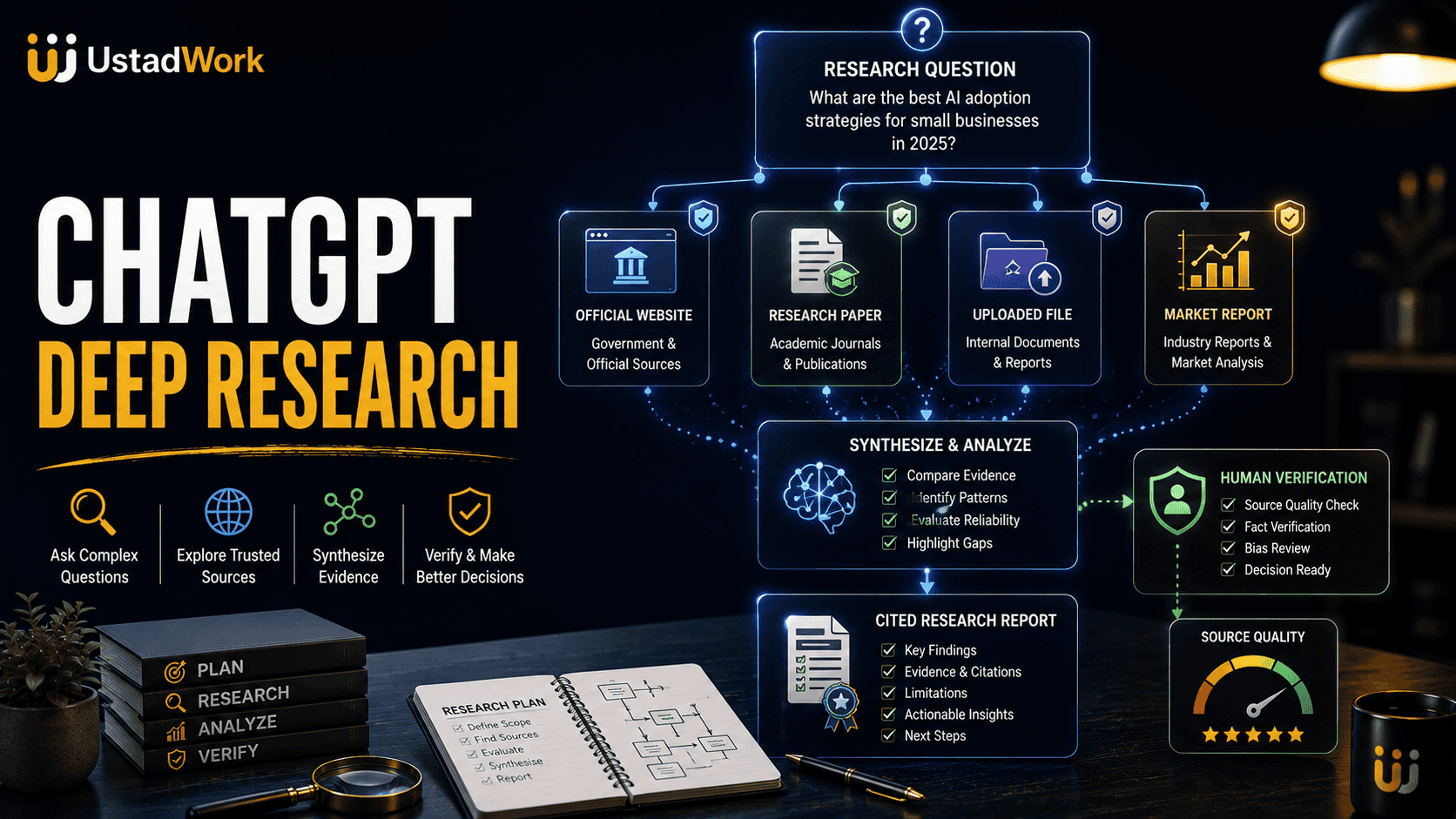
ChatGPT Deep Research Tutorial: How to Research With Reliable Sources
Complex research normally requires more than opening the first few search results. You may need to break one question into several smaller questions, search different types of sources, compare conflicting evidence, verify dates, identify limitations, and turn the findings into a useful decision document.
ChatGPT Deep Research can assist with this multi-step process. It can work across the public web, uploaded files, selected websites, and supported connected sources, then produce a structured report containing citations or source links.
The result still requires human review. A cited statement may use a weak source, misunderstand the original evidence, omit an important viewpoint, or present an uncertain estimate too confidently.
This ChatGPT Deep Research tutorial explains how to define a strong research question, control the scope, select reliable sources, inspect citations, compare contradictory claims, and create a report that supports a real decision.
You can also read how to use ChatGPT for work or explore ChatGPT workflows for small businesses.
ChatGPT Deep Research can assist with this multi-step process. It can work across the public web, uploaded files, selected websites, and supported connected sources, then produce a structured report containing citations or source links.
The result still requires human review. A cited statement may use a weak source, misunderstand the original evidence, omit an important viewpoint, or present an uncertain estimate too confidently.
This ChatGPT Deep Research tutorial explains how to define a strong research question, control the scope, select reliable sources, inspect citations, compare contradictory claims, and create a report that supports a real decision.
You can also read how to use ChatGPT for work or explore ChatGPT workflows for small businesses.
Quick Answer: How Do You Use Deep Research?
A reliable Deep Research workflow has eight stages:
1. Define the decision: Explain what the research will help someone decide or understand.
2. Set the scope: Specify the audience, geography, timeframe, industries, exclusions, and required depth.
3. Choose sources: Decide whether the research may use the open web, selected websites, uploaded files, or supported apps.
4. Request a plan: Review the proposed sub-questions, source strategy, and evaluation criteria.
5. Run the research: Follow progress and clarify or narrow the task when necessary.
6. Inspect the report: Review findings, evidence, assumptions, contradictions, and limitations.
7. Verify important claims: Open the strongest citations and compare them with the original sources.
8. Convert the findings: Create a decision memo, market brief, comparison table, content plan, or action checklist.
1. Define the decision: Explain what the research will help someone decide or understand.
2. Set the scope: Specify the audience, geography, timeframe, industries, exclusions, and required depth.
3. Choose sources: Decide whether the research may use the open web, selected websites, uploaded files, or supported apps.
4. Request a plan: Review the proposed sub-questions, source strategy, and evaluation criteria.
5. Run the research: Follow progress and clarify or narrow the task when necessary.
6. Inspect the report: Review findings, evidence, assumptions, contradictions, and limitations.
7. Verify important claims: Open the strongest citations and compare them with the original sources.
8. Convert the findings: Create a decision memo, market brief, comparison table, content plan, or action checklist.
What Is ChatGPT Deep Research?
Deep Research is a research workflow for questions that require planning, several searches, source evaluation, synthesis, and a documented final report.
Unlike a basic response generated from the information already available in the conversation, it can actively investigate relevant sources and refine the research process across several steps.
Depending on your available ChatGPT tools and workspace, the research may use:
The public web.
Specific websites or domains.
Uploaded documents and files.
Supported connected apps and internal sources.
The final output may contain structured findings, citations, source links, tables, risks, trade-offs, and unanswered questions.
Official reference: OpenAI Deep Research help guide.
Unlike a basic response generated from the information already available in the conversation, it can actively investigate relevant sources and refine the research process across several steps.
Depending on your available ChatGPT tools and workspace, the research may use:
The public web.
Specific websites or domains.
Uploaded documents and files.
Supported connected apps and internal sources.
The final output may contain structured findings, citations, source links, tables, risks, trade-offs, and unanswered questions.
Official reference: OpenAI Deep Research help guide.
Search vs Deep Research
ChatGPT Search and Deep Research solve different problems.
Use Search when:
You need a recent fact, one official document, a product specification, a company announcement, a current event, or a quick orientation.
Use Deep Research when:
You need to investigate a broad question, compare many sources, evaluate trade-offs, understand conflicting evidence, review a market, or create a documented report.
Example Search request:
Example Deep Research request:
Use the simpler option when it can answer the question reliably.
Use Search when:
You need a recent fact, one official document, a product specification, a company announcement, a current event, or a quick orientation.
Use Deep Research when:
You need to investigate a broad question, compare many sources, evaluate trade-offs, understand conflicting evidence, review a market, or create a documented report.
Example Search request:
Find the latest official U.S. Small Business Administration guidance on using AI in a small business.Example Deep Research request:
Research how U.S. small businesses are adopting AI for customer support, sales, marketing, and operations. Compare benefits, implementation barriers, security risks, and credible adoption evidence. Produce a decision brief for a 20-person service business.Use the simpler option when it can answer the question reliably.
When Deep Research Is Useful
Deep Research is useful when the answer depends on information distributed across many sources.
Examples include:
Market research.
Competitor analysis.
Vendor comparison.
Industry trend analysis.
Policy or regulatory scanning.
Literature reviews.
Product and technology evaluation.
Customer and audience research.
Content research.
Business-location analysis.
Investment background research for later professional review.
Historical and current document comparison.
The research should support a clear objective. A long report without a defined reader or decision may provide information but still fail to create value.
Examples include:
Market research.
Competitor analysis.
Vendor comparison.
Industry trend analysis.
Policy or regulatory scanning.
Literature reviews.
Product and technology evaluation.
Customer and audience research.
Content research.
Business-location analysis.
Investment background research for later professional review.
Historical and current document comparison.
The research should support a clear objective. A long report without a defined reader or decision may provide information but still fail to create value.
When Not to Use Deep Research
Do not use a long research process when a simpler method is enough.
A normal search, database lookup, spreadsheet calculation, or direct professional consultation may be better when:
You need one straightforward fact.
You already know the exact official source.
The answer exists in one supplied document.
The task is a simple calculation.
The decision requires confidential professional advice.
The source material is private and not approved for external processing.
The information must come from a regulated database that is not available to the research tool.
The question depends on interviews, physical inspection, or original experiments.
Deep Research can organise and analyse evidence, but it cannot replace missing primary research or professional responsibility.
A normal search, database lookup, spreadsheet calculation, or direct professional consultation may be better when:
You need one straightforward fact.
You already know the exact official source.
The answer exists in one supplied document.
The task is a simple calculation.
The decision requires confidential professional advice.
The source material is private and not approved for external processing.
The information must come from a regulated database that is not available to the research tool.
The question depends on interviews, physical inspection, or original experiments.
Deep Research can organise and analyse evidence, but it cannot replace missing primary research or professional responsibility.
Step 1: Define the Decision Before the Topic
A broad topic does not automatically create a useful research question.
Weak request:
Stronger request:
The stronger version explains:
Who needs the research.
Which decision it supports.
The type of business involved.
The specific workflow under consideration.
The comparisons required.
The risks that matter.
Begin every project by writing one sentence describing the decision the final report must support.
Weak request:
Research AI automation.Stronger request:
Research whether a five-person U.S. home-services company should automate missed-call follow-up using an AI voice agent. Compare practical use cases, setup requirements, integration options, risks, likely cost categories, human-approval needs, and alternatives.The stronger version explains:
Who needs the research.
Which decision it supports.
The type of business involved.
The specific workflow under consideration.
The comparisons required.
The risks that matter.
Begin every project by writing one sentence describing the decision the final report must support.
Step 2: Define the Audience
The same evidence should be presented differently for different readers.
A report may be written for:
A small-business owner.
A marketing director.
A technical development team.
An investor.
A freelance client.
A university researcher.
A policy team.
A customer-support manager.
Specify what the reader already understands, what decisions they control, and which details they need.
Example:
A report may be written for:
A small-business owner.
A marketing director.
A technical development team.
An investor.
A freelance client.
A university researcher.
A policy team.
A customer-support manager.
Specify what the reader already understands, what decisions they control, and which details they need.
Example:
Write for a non-technical U.S. business owner. Explain technical terms briefly, prioritise implementation decisions, and separate required controls from optional improvements.Step 3: Control the Scope
Scope prevents the report from becoming too broad or mixing unrelated evidence.
Define where relevant:
Geography: United States, one state, North America, or global.
Timeframe: Current year, last twelve months, five-year trend, or historical period.
Industry: Healthcare, ecommerce, SaaS, professional services, or another sector.
Business size: Solopreneurs, small businesses, mid-market, or enterprise.
Topics included: The questions the report must answer.
Topics excluded: Areas that would distract from the decision.
Output depth: Executive brief, detailed report, comparison table, or literature review.
When recency matters, include an exact date range instead of using words such as recently or currently.
Define where relevant:
Geography: United States, one state, North America, or global.
Timeframe: Current year, last twelve months, five-year trend, or historical period.
Industry: Healthcare, ecommerce, SaaS, professional services, or another sector.
Business size: Solopreneurs, small businesses, mid-market, or enterprise.
Topics included: The questions the report must answer.
Topics excluded: Areas that would distract from the decision.
Output depth: Executive brief, detailed report, comparison table, or literature review.
When recency matters, include an exact date range instead of using words such as recently or currently.
Step 4: Create Strong Research Questions
Break the main objective into specific sub-questions.
For a software-vendor evaluation, useful questions may include:
What problem does each product solve?
Which customer type does it target?
Which required features are supported?
What are the integration requirements?
Which security and privacy controls are documented?
What pricing structure is publicly available?
What implementation work remains the buyer's responsibility?
Which credible customer examples exist?
What limitations or complaints appear consistently?
Which claims cannot be verified?
Requesting sub-questions before the research begins makes the process easier to review and reduces the chance that an important area is missed.
For a software-vendor evaluation, useful questions may include:
What problem does each product solve?
Which customer type does it target?
Which required features are supported?
What are the integration requirements?
Which security and privacy controls are documented?
What pricing structure is publicly available?
What implementation work remains the buyer's responsibility?
Which credible customer examples exist?
What limitations or complaints appear consistently?
Which claims cannot be verified?
Requesting sub-questions before the research begins makes the process easier to review and reduces the chance that an important area is missed.
Step 5: Build a Source Strategy
Not every source should receive equal weight.
A practical source hierarchy may include:
Primary sources:
Government data, official company documentation, original research papers, regulatory filings, court documents, technical standards, and direct datasets.
High-quality secondary sources:
Recognised journalism, established research organisations, professional associations, and expert analysis that clearly identifies its evidence.
Trade and specialist sources:
Useful for industry context, implementation experiences, and emerging signals.
Community sources:
Useful for discovering user problems and practical experiences, but weaker for confirming general facts.
Marketing material:
Useful for understanding what a company claims, but not independent proof that the claim is accurate.
Ask the report to distinguish source types and explain why the most important evidence is credible.
A practical source hierarchy may include:
Primary sources:
Government data, official company documentation, original research papers, regulatory filings, court documents, technical standards, and direct datasets.
High-quality secondary sources:
Recognised journalism, established research organisations, professional associations, and expert analysis that clearly identifies its evidence.
Trade and specialist sources:
Useful for industry context, implementation experiences, and emerging signals.
Community sources:
Useful for discovering user problems and practical experiences, but weaker for confirming general facts.
Marketing material:
Useful for understanding what a company claims, but not independent proof that the claim is accurate.
Ask the report to distinguish source types and explain why the most important evidence is credible.
Step 6: Select or Restrict Websites
For source-sensitive research, specify which domains should be used or prioritised.
Examples include:
Government websites for regulations and official statistics.
Company documentation for product capabilities.
Research-paper databases for scientific evidence.
Recognised industry associations for standards.
Investor-relations pages for financial disclosures.
Example prompt:
Where supported, you may restrict research to selected domains or prioritise them while still allowing broader web research.
Examples include:
Government websites for regulations and official statistics.
Company documentation for product capabilities.
Research-paper databases for scientific evidence.
Recognised industry associations for standards.
Investor-relations pages for financial disclosures.
Example prompt:
Use U.S. government sources, original research, official company documentation, and recognised business publications. Do not rely on anonymous blogs or automatically generated comparison sites for major claims.Where supported, you may restrict research to selected domains or prioritise them while still allowing broader web research.
Step 7: Add Uploaded Files
Uploaded files can provide internal or project-specific context that public websites do not contain.
Useful files may include:
Previous research reports.
Customer interviews.
Internal policies.
Survey data.
Product documentation.
Competitor notes.
Meeting transcripts.
Financial models prepared for review.
Academic papers.
Vendor proposals.
Explain how each file should be used.
Example:
Do not upload confidential information unless your organisation, account settings, contracts, and privacy requirements permit it.
Useful files may include:
Previous research reports.
Customer interviews.
Internal policies.
Survey data.
Product documentation.
Competitor notes.
Meeting transcripts.
Financial models prepared for review.
Academic papers.
Vendor proposals.
Explain how each file should be used.
Example:
Use the uploaded customer-interview notes as primary evidence about our users. Use the uploaded strategy deck only as background because some assumptions have not been validated.Do not upload confidential information unless your organisation, account settings, contracts, and privacy requirements permit it.
Step 8: Use Connected Sources Carefully
Supported ChatGPT apps may allow Deep Research to search approved information from connected services or specialist data providers.
Connected sources can be useful for combining internal documents with external evidence. For example, a team may compare customer notes from its document system with current public market research.
Before using a connected source, confirm:
Which account is connected.
Which folders or records are available.
Who has permission to access them.
Whether sensitive information should be excluded.
How citations will point back to internal material.
Whether the final report may be shared outside the organisation.
Access and supported app capabilities vary by workspace, plan, administrator settings, and region.
Connected sources can be useful for combining internal documents with external evidence. For example, a team may compare customer notes from its document system with current public market research.
Before using a connected source, confirm:
Which account is connected.
Which folders or records are available.
Who has permission to access them.
Whether sensitive information should be excluded.
How citations will point back to internal material.
Whether the final report may be shared outside the organisation.
Access and supported app capabilities vary by workspace, plan, administrator settings, and region.
Step 9: Review the Proposed Research Plan
Do not treat the proposed plan as a formality.
Review whether it includes:
The main decision.
The correct audience.
All required sub-questions.
The right geography and timeframe.
A suitable source hierarchy.
Important opposing viewpoints.
Methods for comparing evidence.
Known exclusions.
The final output format.
Remove questions that do not support the decision and add missing areas before the main research begins.
A strong plan saves time by preventing an impressive but irrelevant report.
Review whether it includes:
The main decision.
The correct audience.
All required sub-questions.
The right geography and timeframe.
A suitable source hierarchy.
Important opposing viewpoints.
Methods for comparing evidence.
Known exclusions.
The final output format.
Remove questions that do not support the decision and add missing areas before the main research begins.
A strong plan saves time by preventing an impressive but irrelevant report.
Step 10: Follow Progress and Refine the Scope
During the research process, review the visible plan and progress where the interface allows it.
Intervene when:
The research is following the wrong interpretation.
An important source has been missed.
The scope has become too broad.
The report is focusing on background rather than the decision.
A new fact changes the original question.
A region, date, industry, or customer segment needs clarification.
Useful instructions include:
Intervene when:
The research is following the wrong interpretation.
An important source has been missed.
The scope has become too broad.
The report is focusing on background rather than the decision.
A new fact changes the original question.
A region, date, industry, or customer segment needs clarification.
Useful instructions include:
Prioritise U.S. small businesses rather than enterprise examples.Use official documentation for product capabilities.Go deeper on implementation risks and reduce the market-history section.Add evidence that challenges the current conclusion.Step 11: Inspect the Final Report Structure
A useful research report should make its logic easy to follow.
Recommended sections include:
Executive summary.
Research question and scope.
Method and source strategy.
Key findings.
Evidence supporting each finding.
Contradictory or uncertain evidence.
Risks and limitations.
Implications for the reader.
Recommended next actions.
Source list.
The executive summary should not introduce claims or recommendations that are unsupported by the main report.
Recommended sections include:
Executive summary.
Research question and scope.
Method and source strategy.
Key findings.
Evidence supporting each finding.
Contradictory or uncertain evidence.
Risks and limitations.
Implications for the reader.
Recommended next actions.
Source list.
The executive summary should not introduce claims or recommendations that are unsupported by the main report.
Step 12: Open and Verify Important Citations
Citations make checking easier, but their presence does not prove that every statement is correct.
Open citations supporting:
The main conclusion.
Important statistics.
Current laws or policies.
Pricing and product capabilities.
Health, financial, legal, or safety information.
Statements that influence a major decision.
Claims that appear surprising or unusually precise.
Check whether the source actually says what the report claims, whether the information is current, and whether important conditions or limitations were omitted.
Open citations supporting:
The main conclusion.
Important statistics.
Current laws or policies.
Pricing and product capabilities.
Health, financial, legal, or safety information.
Statements that influence a major decision.
Claims that appear surprising or unusually precise.
Check whether the source actually says what the report claims, whether the information is current, and whether important conditions or limitations were omitted.
Use a Source Quality Scorecard
Score important sources from 1 to 5 across these criteria:
Authority: Who created the source, and what expertise or responsibility do they have?
Directness: Is it original evidence or a summary of another source?
Recency: Is it current enough for the question?
Method: Does it explain how the evidence was collected?
Relevance: Does it apply to the correct geography, industry, audience, and timeframe?
Transparency: Are assumptions, limitations, funding, and conflicts visible?
Consistency: Does other credible evidence support or challenge it?
Do not average all sources equally. One relevant primary source may be more valuable than several weak summaries.
Authority: Who created the source, and what expertise or responsibility do they have?
Directness: Is it original evidence or a summary of another source?
Recency: Is it current enough for the question?
Method: Does it explain how the evidence was collected?
Relevance: Does it apply to the correct geography, industry, audience, and timeframe?
Transparency: Are assumptions, limitations, funding, and conflicts visible?
Consistency: Does other credible evidence support or challenge it?
Do not average all sources equally. One relevant primary source may be more valuable than several weak summaries.
Separate Facts, Estimates, Opinions, and Inferences
A strong report should show the status of each important statement.
Verified fact:
Directly supported by reliable evidence.
Estimate:
A calculated or modelled value that depends on assumptions.
Reported claim:
A statement made by a company, person, or organisation that may not be independently verified.
Expert opinion:
An informed interpretation rather than an established fact.
Inference:
A conclusion drawn from several pieces of evidence.
Unknown:
Information that could not be confirmed.
Ask ChatGPT to label these categories instead of presenting every sentence with the same level of certainty.
Verified fact:
Directly supported by reliable evidence.
Estimate:
A calculated or modelled value that depends on assumptions.
Reported claim:
A statement made by a company, person, or organisation that may not be independently verified.
Expert opinion:
An informed interpretation rather than an established fact.
Inference:
A conclusion drawn from several pieces of evidence.
Unknown:
Information that could not be confirmed.
Ask ChatGPT to label these categories instead of presenting every sentence with the same level of certainty.
Handle Conflicting Sources
Credible sources may disagree because they use different definitions, samples, dates, methods, or incentives.
When evidence conflicts, ask:
Are the sources measuring the same thing?
Do they cover the same geography and timeframe?
How were the samples selected?
Are the definitions consistent?
Does one source have a commercial interest?
Is one source newer but less rigorous?
Could both claims be correct under different conditions?
Request a comparison table showing each position, evidence, method, strengths, limitations, and what additional information could resolve the disagreement.
When evidence conflicts, ask:
Are the sources measuring the same thing?
Do they cover the same geography and timeframe?
How were the samples selected?
Are the definitions consistent?
Does one source have a commercial interest?
Is one source newer but less rigorous?
Could both claims be correct under different conditions?
Request a comparison table showing each position, evidence, method, strengths, limitations, and what additional information could resolve the disagreement.
Request a What's Missing Section
Every research report has limits.
Ask the final report to identify:
Questions that could not be answered.
Data that was unavailable.
Sources that could not be verified.
Important evidence behind paywalls or restricted systems.
Regions or audiences not covered.
Potentially outdated information.
Conflicting definitions.
Assumptions that affect the conclusion.
Primary research still required.
This section prevents the report from creating false confidence and helps plan the next research stage.
Ask the final report to identify:
Questions that could not be answered.
Data that was unavailable.
Sources that could not be verified.
Important evidence behind paywalls or restricted systems.
Regions or audiences not covered.
Potentially outdated information.
Conflicting definitions.
Assumptions that affect the conclusion.
Primary research still required.
This section prevents the report from creating false confidence and helps plan the next research stage.
Master Deep Research Prompt
Conduct deep research on [topic] to support [specific decision] for [audience or organisation].

Research objective:
[Explain the exact question and why the answer matters.]

Scope:
- Geography: [location]
- Timeframe: [dates]
- Industry or audience: [details]
- Include: [topics]
- Exclude: [topics]

Sources:
- Prioritise primary sources, official documentation, original research, government data, and recognised expert organisations.
- Use secondary reporting to provide context or compare viewpoints.
- Clearly label company claims, estimates, opinions, and inferences.
- Do not use anonymous or low-quality sources for important conclusions.

Required analysis:
[List the questions the report must answer.]

Output:
- Executive summary
- Research method and source strategy
- Key findings with citations
- Comparison table where useful
- Conflicting evidence
- Risks and limitations
- What's missing
- Practical implications
- Recommended next actions

Before beginning, propose a research plan with sub-questions, source types, evaluation criteria, and any clarification questions.
Prompt 1: Market Research
Research the U.S. market for [service or product] for a small business considering entry during the next 12 months.

Analyse customer segments, demand signals, major competitors, pricing models, buying criteria, implementation barriers, regulatory considerations, and market risks.

Prioritise government data, original industry research, company filings, official product information, and recognised business publications.

Separate verified findings from directional signals and explain where primary customer interviews are still required.
Prompt 2: Competitor Analysis
Compare the following competitors for [target customer and use case]: [list companies].

Evaluate positioning, target customer, main product or service, pricing structure, important features, customer proof, distribution, strengths, limitations, and recent strategic changes.

Use official company sources for what each competitor claims, then use independent evidence to test those claims.

End with market gaps, unresolved questions, and opportunities that remain assumptions rather than verified findings.
Prompt 3: Vendor Evaluation
Evaluate [vendor category] options for a [business type and size].

Required capabilities: [list].
Required integrations: [list].
Security or compliance needs: [list].
Budget considerations: [details].

Compare product fit, implementation requirements, documentation, security information, support, pricing model, limitations, and switching risk.

Do not recommend a vendor solely from review-site scores. Prioritise official documentation and clearly identify information that requires a sales demonstration or contract review.
Prompt 4: Literature Review
Using the uploaded papers and relevant current research, prepare a literature review on [topic].

For each study, record the research question, sample, method, main findings, limitations, and publication date.

Synthesise shared themes, disagreements, methodological weaknesses, evidence gaps, and open questions.

Do not treat correlation as confirmed causation. Distinguish peer-reviewed research, preprints, reviews, and commentary.
Prompt 5: Content Research
Research [topic] for a people-first article aimed at [audience].

Identify the reader's main questions, current authoritative evidence, common misunderstandings, practical examples, risks, limitations, and useful next actions.

Prioritise original and official sources. Do not create a structure by copying competing articles.

Recommend where first-hand testing, expert review, screenshots, templates, or original examples are needed to add value beyond existing search results.
Convert Research Into Useful Deliverables
One research report can support several deliverables.
Ask ChatGPT to convert verified findings into:
An executive brief.
A one-page decision memo.
A competitor table.
A slide outline.
A project brief.
A vendor-evaluation scorecard.
A content brief.
A risk register.
An annotated bibliography.
A list of customer-interview questions.
A source-backed FAQ.
A monitoring plan.
The converted document should preserve citations and uncertainty instead of turning cautious findings into confident marketing claims.
Ask ChatGPT to convert verified findings into:
An executive brief.
A one-page decision memo.
A competitor table.
A slide outline.
A project brief.
A vendor-evaluation scorecard.
A content brief.
A risk register.
An annotated bibliography.
A list of customer-interview questions.
A source-backed FAQ.
A monitoring plan.
The converted document should preserve citations and uncertainty instead of turning cautious findings into confident marketing claims.
Research High-Stakes Topics Carefully
Legal, medical, financial, tax, safety, employment, and regulatory topics require additional care.
Use Deep Research to:
Locate official material.
Organise relevant documents.
Compare requirements.
Prepare questions.
Identify potential issues.
Create a briefing for a qualified professional.
Do not use the report as a substitute for licensed professional advice, diagnosis, formal legal interpretation, investment decisions, or regulatory approval.
Verify current requirements directly with the relevant professional or authority.
Use Deep Research to:
Locate official material.
Organise relevant documents.
Compare requirements.
Prepare questions.
Identify potential issues.
Create a briefing for a qualified professional.
Do not use the report as a substitute for licensed professional advice, diagnosis, formal legal interpretation, investment decisions, or regulatory approval.
Verify current requirements directly with the relevant professional or authority.
Protect Private and Confidential Information
Before using uploaded files or connected sources, remove unnecessary sensitive information.
Do not include without appropriate authorisation and controls:
Passwords and API keys.
Banking details.
Government identification numbers.
Private health information.
Customer records.
Payroll information.
Confidential legal communications.
Unreleased product plans.
Production credentials.
Restricted research data.
Review your account settings, workspace policies, contracts, retention rules, administrator controls, and applicable law before conducting research with business information.
Do not include without appropriate authorisation and controls:
Passwords and API keys.
Banking details.
Government identification numbers.
Private health information.
Customer records.
Payroll information.
Confidential legal communications.
Unreleased product plans.
Production credentials.
Restricted research data.
Review your account settings, workspace policies, contracts, retention rules, administrator controls, and applicable law before conducting research with business information.
Common Deep Research Mistakes
Avoid these problems:
Beginning with a broad topic: The report lacks a clear purpose.
Leaving the timeframe undefined: Old and current evidence are mixed.
Accepting every source equally: Weak commentary receives the same weight as primary evidence.
Ignoring the research plan: Important questions are missed before the run begins.
Trusting citations automatically: Sources may not fully support the associated claim.
Requesting only supporting evidence: Contradictions and risks remain hidden.
Confusing company claims with independent proof: Marketing statements become reported as facts.
Hiding uncertainty: Estimates and assumptions appear confirmed.
Sharing confidential files without review: Privacy and contractual risks increase.
Publishing the report without adding original value: The article becomes a summary rather than useful expert content.
Beginning with a broad topic: The report lacks a clear purpose.
Leaving the timeframe undefined: Old and current evidence are mixed.
Accepting every source equally: Weak commentary receives the same weight as primary evidence.
Ignoring the research plan: Important questions are missed before the run begins.
Trusting citations automatically: Sources may not fully support the associated claim.
Requesting only supporting evidence: Contradictions and risks remain hidden.
Confusing company claims with independent proof: Marketing statements become reported as facts.
Hiding uncertainty: Estimates and assumptions appear confirmed.
Sharing confidential files without review: Privacy and contractual risks increase.
Publishing the report without adding original value: The article becomes a summary rather than useful expert content.
A Practical Research Verification Checklist
Before using the report, confirm that:
The research decision is clearly stated.
The audience, geography, and timeframe are correct.
The report answers the required sub-questions.
Primary sources support the most important claims.
Company claims are labelled appropriately.
Important statistics were checked against original sources.
Dates and definitions are consistent.
Conflicting evidence is represented fairly.
Facts, estimates, opinions, and inferences are separated.
The report explains its limitations.
Private information was handled appropriately.
A responsible person has reviewed the final conclusion.
When external research support is needed, post a research project on UstadWork or browse research, data, writing, and business-analysis services.
The research decision is clearly stated.
The audience, geography, and timeframe are correct.
The report answers the required sub-questions.
Primary sources support the most important claims.
Company claims are labelled appropriately.
Important statistics were checked against original sources.
Dates and definitions are consistent.
Conflicting evidence is represented fairly.
Facts, estimates, opinions, and inferences are separated.
The report explains its limitations.
Private information was handled appropriately.
A responsible person has reviewed the final conclusion.
When external research support is needed, post a research project on UstadWork or browse research, data, writing, and business-analysis services.
Official Deep Research Resources
Product features, source options, supported apps, and plan access can change. Review the latest official documentation when exact capabilities matter.
OpenAI Help: Deep Research in ChatGPT
OpenAI Academy: Search and Deep Research
OpenAI Academy: ChatGPT for Research
OpenAI Help: Apps in ChatGPT
OpenAI Help: Deep Research in ChatGPT
OpenAI Academy: Search and Deep Research
OpenAI Academy: ChatGPT for Research
OpenAI Help: Apps in ChatGPT
Use Deep Research to Support Better Decisions
Deep Research is most valuable when it supports a defined decision, uses an appropriate source strategy, and produces evidence that another person can inspect.
Begin with a clear objective. Control the geography, timeframe, source types, and output format. Review the proposed plan, challenge the findings, open important citations, and document what remains unknown.
The strongest approach to ChatGPT Deep Research combines AI-assisted discovery and synthesis with source verification, subject expertise, privacy controls, and accountable human judgement.
Continue with ChatGPT for Work, explore ChatGPT for Small Business, compare Claude vs ChatGPT, or post your research requirements on UstadWork.
Begin with a clear objective. Control the geography, timeframe, source types, and output format. Review the proposed plan, challenge the findings, open important citations, and document what remains unknown.
The strongest approach to ChatGPT Deep Research combines AI-assisted discovery and synthesis with source verification, subject expertise, privacy controls, and accountable human judgement.
Continue with ChatGPT for Work, explore ChatGPT for Small Business, compare Claude vs ChatGPT, or post your research requirements on UstadWork.
Frequently asked questions
What is ChatGPT Deep Research?
ChatGPT Deep Research is a workflow for investigating complex questions across sources such as the public web, uploaded files, selected websites, and supported connected apps, then producing a structured report with citations or source links.
What is the difference between ChatGPT Search and Deep Research?
Search is better for quick, specific, and current questions. Deep Research is better for broader questions requiring several research steps, source comparison, synthesis, trade-offs, and a detailed report.
Can ChatGPT Deep Research use uploaded files?
Yes, it can use supported uploaded files as research inputs. Explain which files are authoritative, which are background material, and how they should be combined with external evidence.
Can I control which websites Deep Research uses?
Where the feature is available, you can specify or manage websites and domains, either restricting research to selected sites or prioritising them while allowing broader web research.
Are Deep Research citations always accurate?
No research system is error-free. Open important citations to confirm that the source supports the claim, is current, uses relevant definitions, and has not been represented without necessary context.
Can Deep Research replace a professional researcher?
It can accelerate source discovery, comparison, synthesis, and report preparation. Human expertise remains necessary for research design, source judgement, primary research, high-stakes interpretation, and final approval.