How to Localize a B2B Landing Page for France
Localize a B2B landing page for France with better copy, SEO, proof, CTA language, and quality assurance.
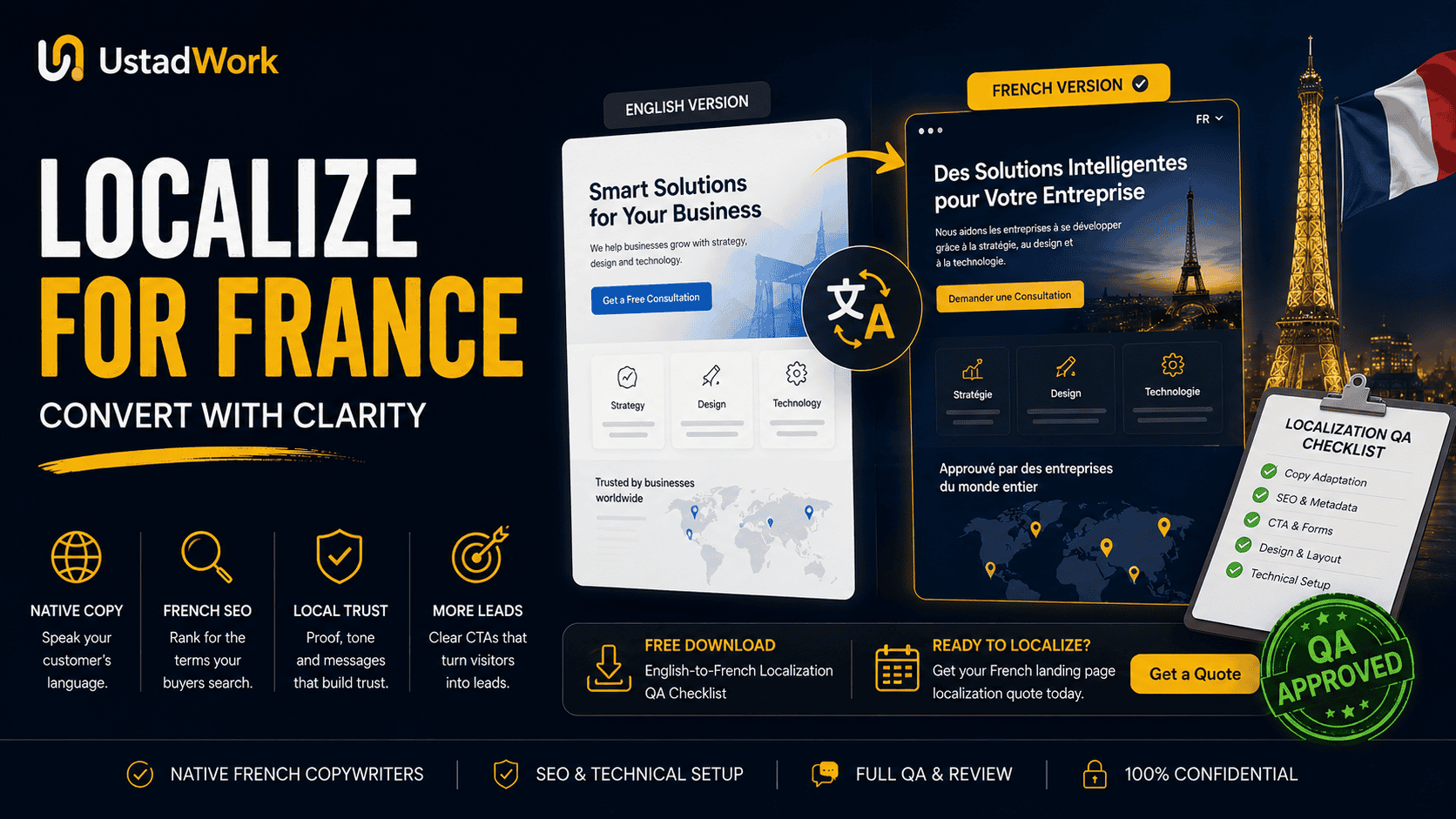
How to Localize a B2B Landing Page for France
Localizing a B2B landing page for France means adapting the page so French prospects can understand the offer, trust the business, and take the next step without feeling that the page was copied directly from an English version.
A literal translation may preserve the words but weaken the message. Headlines may sound unnatural, calls to action may feel too aggressive, examples may not match the market, and translated keywords may not reflect how French buyers actually search.
A strong B2B landing page localization France project combines translation, copy adaptation, search research, design review, technical setup, and quality assurance. When your page and source content are ready, you can post a French localization project on UstadWork or browse localization and copy services.
A literal translation may preserve the words but weaken the message. Headlines may sound unnatural, calls to action may feel too aggressive, examples may not match the market, and translated keywords may not reflect how French buyers actually search.
A strong B2B landing page localization France project combines translation, copy adaptation, search research, design review, technical setup, and quality assurance. When your page and source content are ready, you can post a French localization project on UstadWork or browse localization and copy services.
Translation and Localization Are Not the Same
Translation changes text from one language into another. Localization checks whether the entire page works for the intended market.
A translator may accurately translate a sentence while a localization specialist asks deeper questions:
Does this value proposition sound natural in French?
Is the level of formality appropriate for the audience?
Does the proof feel relevant to buyers in France?
Does the call to action match the buyer's stage?
Are the forms, dates, numbers, currencies, and legal references appropriate?
Are the target search phrases based on French demand rather than translated English keywords?
A localized landing page should feel like it was planned for the French audience from the beginning, not translated at the final stage.
A translator may accurately translate a sentence while a localization specialist asks deeper questions:
Does this value proposition sound natural in French?
Is the level of formality appropriate for the audience?
Does the proof feel relevant to buyers in France?
Does the call to action match the buyer's stage?
Are the forms, dates, numbers, currencies, and legal references appropriate?
Are the target search phrases based on French demand rather than translated English keywords?
A localized landing page should feel like it was planned for the French audience from the beginning, not translated at the final stage.
Define the French B2B Audience First
Do not localize for an entire country without deciding who the page is meant to convert. A software buyer, marketing director, ecommerce manager, local business owner, and enterprise procurement team may respond to different proof, terminology, and calls to action.
Before adapting the page, define:
Target company type: Startup, small business, agency, ecommerce brand, manufacturer, professional-services company, or enterprise.
Decision-maker: Founder, marketing manager, operations lead, technical director, procurement team, or department head.
Primary problem: What business issue brings them to the page?
Expected outcome: What result do they want?
Buying stage: Are they researching, comparing vendors, requesting a quote, or ready for a consultation?
This audience definition guides every localization decision, including vocabulary, page length, proof, CTA strength, and form requirements.
Before adapting the page, define:
Target company type: Startup, small business, agency, ecommerce brand, manufacturer, professional-services company, or enterprise.
Decision-maker: Founder, marketing manager, operations lead, technical director, procurement team, or department head.
Primary problem: What business issue brings them to the page?
Expected outcome: What result do they want?
Buying stage: Are they researching, comparing vendors, requesting a quote, or ready for a consultation?
This audience definition guides every localization decision, including vocabulary, page length, proof, CTA strength, and form requirements.
Research French Search Intent Instead of Translating Keywords
An English keyword should not automatically become the French target keyword. Search behaviour, terminology, word order, and commercial intent can differ between languages.
Start with the business problem and research how French prospects describe it. Compare service phrases, problem-based searches, solution terms, industry language, and questions used during the buying process.
For example, a direct translation may be technically correct but less common than another phrase used by French businesses. The page may also need separate terms for the service, provider, audit, quote, consultancy, or implementation.
Create a keyword map before rewriting the page:
Primary commercial phrase
Supporting service terms
Problem-based phrases
Industry terminology
Questions and objections
Internal-link anchor opportunities
Use the keyword map to guide the page naturally. Do not repeat the same phrase in every heading or paragraph.
Start with the business problem and research how French prospects describe it. Compare service phrases, problem-based searches, solution terms, industry language, and questions used during the buying process.
For example, a direct translation may be technically correct but less common than another phrase used by French businesses. The page may also need separate terms for the service, provider, audit, quote, consultancy, or implementation.
Create a keyword map before rewriting the page:
Primary commercial phrase
Supporting service terms
Problem-based phrases
Industry terminology
Questions and objections
Internal-link anchor opportunities
Use the keyword map to guide the page naturally. Do not repeat the same phrase in every heading or paragraph.
Localize the Headline and Value Proposition
The headline is usually the most important localization decision because it determines whether the visitor understands the offer quickly.
Do not translate the English headline word for word if the result feels awkward or unclear. Preserve the business meaning instead.
A useful localized headline should communicate:
Who the service is for
What problem it solves
What result it supports
Why the business may be credible
Example English direction:
Build a faster sales pipeline with AI-powered lead qualification.
A localization specialist should not only translate this sentence. They should decide whether the French page should lead with the business result, the process, the audience, or the service category.
The subheading can then explain the offer, delivery model, relevant market, and next step in clearer detail.
Do not translate the English headline word for word if the result feels awkward or unclear. Preserve the business meaning instead.
A useful localized headline should communicate:
Who the service is for
What problem it solves
What result it supports
Why the business may be credible
Example English direction:
Build a faster sales pipeline with AI-powered lead qualification.
A localization specialist should not only translate this sentence. They should decide whether the French page should lead with the business result, the process, the audience, or the service category.
The subheading can then explain the offer, delivery model, relevant market, and next step in clearer detail.
Choose Formality and Brand Voice Consistently
French copy requires a deliberate decision about tone and formality. The page should not switch inconsistently between formal and informal language.
Decide whether the brand will use vous or tu, then apply that choice across headlines, buttons, forms, confirmation messages, emails, error states, and support content.
The right choice depends on the brand, industry, target company, and buyer relationship. A professional-services company may use a different tone from a creative startup or consumer-led technology brand.
Create a short localization style guide covering:
Preferred form of address.
Brand personality.
Approved service terminology.
Words to avoid.
Capitalization rules.
Punctuation and number formatting.
Preferred CTA style.
Product and feature names that should remain in English.
This guide helps keep the landing page, emails, ads, and future content consistent.
Decide whether the brand will use vous or tu, then apply that choice across headlines, buttons, forms, confirmation messages, emails, error states, and support content.
The right choice depends on the brand, industry, target company, and buyer relationship. A professional-services company may use a different tone from a creative startup or consumer-led technology brand.
Create a short localization style guide covering:
Preferred form of address.
Brand personality.
Approved service terminology.
Words to avoid.
Capitalization rules.
Punctuation and number formatting.
Preferred CTA style.
Product and feature names that should remain in English.
This guide helps keep the landing page, emails, ads, and future content consistent.
Adapt Calls to Action and Forms
A call to action should match the visitor's level of intent. A prospect who is still researching may prefer a checklist, audit, example, or consultation rather than a direct sales request.
Possible B2B actions include:
Request a quote
Book a consultation
Request a landing-page review
Download a checklist
See a case study
Discuss the project
Localize the entire conversion path, not only the button. This includes the form title, field labels, privacy message, error text, success confirmation, follow-up email, and calendar instructions.
Keep forms proportional to the offer. A low-commitment checklist should not require a long qualification form. A complex localization quote may need the source URL, target audience, page count, CMS, deadline, and available brand guidelines.
Possible B2B actions include:
Request a quote
Book a consultation
Request a landing-page review
Download a checklist
See a case study
Discuss the project
Localize the entire conversion path, not only the button. This includes the form title, field labels, privacy message, error text, success confirmation, follow-up email, and calendar instructions.
Keep forms proportional to the offer. A low-commitment checklist should not require a long qualification form. A complex localization quote may need the source URL, target audience, page count, CMS, deadline, and available brand guidelines.
Localize Proof and Trust Signals
A B2B buyer may understand your offer but still hesitate because the page does not provide enough proof. Localization should review whether the existing proof is understandable and relevant in the French market.
Useful trust signals include:
Relevant case studies
Client testimonials
Before-and-after examples
Industry experience
Clear delivery process
Team expertise
Security or quality processes
Support and handoff details
If the original case study uses unfamiliar abbreviations, business context, or results, add enough explanation for a French reader to understand its relevance.
Do not invent French clients, local offices, certifications, or results. Honest international proof with clear context is stronger than false local credibility.
Useful trust signals include:
Relevant case studies
Client testimonials
Before-and-after examples
Industry experience
Clear delivery process
Team expertise
Security or quality processes
Support and handoff details
If the original case study uses unfamiliar abbreviations, business context, or results, add enough explanation for a French reader to understand its relevance.
Do not invent French clients, local offices, certifications, or results. Honest international proof with clear context is stronger than false local credibility.
Adapt the Landing Page Structure
Localization may require more than changing copy inside the existing layout. French text can be longer or shorter than the English source, which can affect cards, buttons, navigation, headings, and mobile layouts.
Review the page in this order:
Hero section: Clear audience, outcome, explanation, and primary CTA.
Problem section: Show that the business understands the buyer's situation.
Solution section: Explain what the service includes and how it works.
Proof section: Add case studies, examples, reviews, or process evidence.
Objection section: Answer questions about timeline, quality, communication, ownership, and support.
CTA section: Give the visitor a clear next action.
If the landing page platform or CMS is also being reviewed, connect the decision to our Webflow vs WordPress guide for B2B lead generation after that article is published.
Review the page in this order:
Hero section: Clear audience, outcome, explanation, and primary CTA.
Problem section: Show that the business understands the buyer's situation.
Solution section: Explain what the service includes and how it works.
Proof section: Add case studies, examples, reviews, or process evidence.
Objection section: Answer questions about timeline, quality, communication, ownership, and support.
CTA section: Give the visitor a clear next action.
If the landing page platform or CMS is also being reviewed, connect the decision to our Webflow vs WordPress guide for B2B lead generation after that article is published.
Set Up French SEO Correctly
A French landing page needs its own SEO elements rather than copied English metadata.
Prepare unique French versions of:
Page title
Meta description
H1 and supporting headings
URL slug
Image alt text
Internal-link anchors
Social-sharing title and description
Structured data content where applicable
The page should answer one clear search intent. Avoid inserting several unrelated keyword variations simply because they appear in a research tool.
Review the page after publication in Search Console to confirm indexing, impressions, queries, and whether French users are reaching the intended version.
Prepare unique French versions of:
Page title
Meta description
H1 and supporting headings
URL slug
Image alt text
Internal-link anchors
Social-sharing title and description
Structured data content where applicable
The page should answer one clear search intent. Avoid inserting several unrelated keyword variations simply because they appear in a research tool.
Review the page after publication in Search Console to confirm indexing, impressions, queries, and whether French users are reaching the intended version.
Connect English and French Pages With Hreflang
When a website has English and French versions of the same landing page, the site should make the relationship between those URLs clear.
A common setup may use separate URLs such as:
English: example.com/services/localization/
French: example.com/fr/services/localisation/
Use the appropriate hreflang implementation so search engines can understand the language or regional alternatives. For a page specifically intended for French users in France, the implementation may use a language-and-region value such as fr-FR. A generic French version may use fr.
Each connected version should reference itself and the corresponding alternative versions. The language switcher should also be visible to users so they can choose their preferred page.
Have the implementation checked after launch because missing reciprocal references, incorrect URLs, or inconsistent language codes can prevent the setup from working as intended.
A common setup may use separate URLs such as:
English: example.com/services/localization/
French: example.com/fr/services/localisation/
Use the appropriate hreflang implementation so search engines can understand the language or regional alternatives. For a page specifically intended for French users in France, the implementation may use a language-and-region value such as fr-FR. A generic French version may use fr.
Each connected version should reference itself and the corresponding alternative versions. The language switcher should also be visible to users so they can choose their preferred page.
Have the implementation checked after launch because missing reciprocal references, incorrect URLs, or inconsistent language codes can prevent the setup from working as intended.
Use AI Translation as a Draft, Not Final Approval
AI translation tools can help create a first draft, extract terminology, compare versions, or identify missing strings. They should not be the only quality-control step for a commercial B2B landing page.
AI may miss brand context, product meaning, industry terminology, cultural nuance, formality, hidden interface text, or the difference between a literal sentence and persuasive copy.
A safer workflow is:
Step 1: Prepare the approved English source.
Step 2: Create the initial French draft.
Step 3: Review terminology and brand voice.
Step 4: Adapt headlines, proof, CTAs, and forms.
Step 5: Review the page inside the real design.
Step 6: Complete native-language QA before launch.
For high-value pages, use a qualified French-language reviewer who understands B2B copy and the relevant industry.
AI may miss brand context, product meaning, industry terminology, cultural nuance, formality, hidden interface text, or the difference between a literal sentence and persuasive copy.
A safer workflow is:
Step 1: Prepare the approved English source.
Step 2: Create the initial French draft.
Step 3: Review terminology and brand voice.
Step 4: Adapt headlines, proof, CTAs, and forms.
Step 5: Review the page inside the real design.
Step 6: Complete native-language QA before launch.
For high-value pages, use a qualified French-language reviewer who understands B2B copy and the relevant industry.
English-to-French Localization QA Checklist
Use this checklist before launch:
Confirm the target audience and buyer role.
Check that the value proposition is natural in French.
Review the use of vous or tu across the page.
Verify approved terminology and product names.
Check headings, body copy, buttons, forms, and error messages.
Review dates, numbers, currencies, units, and contact details.
Check testimonials, case studies, and proof context.
Confirm French title, meta description, URL, and alt text.
Review internal links and language-switcher behaviour.
Test the page on desktop and mobile.
Check for cut-off text, broken layouts, and untranslated strings.
Test every form, confirmation message, and follow-up email.
Verify the hreflang implementation.
Have privacy, cookie, and legal wording reviewed by an appropriate qualified specialist where required.
This checklist can also be offered as the article's downloadable lead magnet.
Confirm the target audience and buyer role.
Check that the value proposition is natural in French.
Review the use of vous or tu across the page.
Verify approved terminology and product names.
Check headings, body copy, buttons, forms, and error messages.
Review dates, numbers, currencies, units, and contact details.
Check testimonials, case studies, and proof context.
Confirm French title, meta description, URL, and alt text.
Review internal links and language-switcher behaviour.
Test the page on desktop and mobile.
Check for cut-off text, broken layouts, and untranslated strings.
Test every form, confirmation message, and follow-up email.
Verify the hreflang implementation.
Have privacy, cookie, and legal wording reviewed by an appropriate qualified specialist where required.
This checklist can also be offered as the article's downloadable lead magnet.
Common French Localization Mistakes
Avoid these common mistakes:
Translating only visible paragraphs: Buttons, menus, metadata, forms, emails, and error messages also need localization.
Translating keywords directly: French search intent should be researched separately.
Ignoring layout expansion: Translated text may break cards, buttons, and mobile designs.
Using inconsistent terminology: Different words for the same service reduce clarity.
Mixing vous and tu: Inconsistent formality weakens the brand voice.
Keeping irrelevant proof: Case studies may need more context for a French buyer.
Publishing without native review: Grammatically correct copy can still sound unnatural.
Forgetting technical SEO: The French page needs proper metadata, indexability, internal links, and localized-version signals.
A final review should cover the copy, design, technical setup, and full conversion journey.
Translating only visible paragraphs: Buttons, menus, metadata, forms, emails, and error messages also need localization.
Translating keywords directly: French search intent should be researched separately.
Ignoring layout expansion: Translated text may break cards, buttons, and mobile designs.
Using inconsistent terminology: Different words for the same service reduce clarity.
Mixing vous and tu: Inconsistent formality weakens the brand voice.
Keeping irrelevant proof: Case studies may need more context for a French buyer.
Publishing without native review: Grammatically correct copy can still sound unnatural.
Forgetting technical SEO: The French page needs proper metadata, indexability, internal links, and localized-version signals.
A final review should cover the copy, design, technical setup, and full conversion journey.
French Localization Project Brief Template
Business and Offer:
Explain what the business sells and the result it delivers.
Target Audience:
Describe the French buyer, company type, industry, and decision-maker.
Source Page:
Share the approved English URL or source document.
Conversion Goal:
Quote request, consultation, audit, download, demo, or another action.
Scope:
List pages, forms, metadata, emails, ads, downloadable files, and interface strings.
Keyword Research:
State whether French keyword and competitor research is required.
Brand Voice:
Provide tone guidelines, approved terminology, and formality preference.
Technical Setup:
List the CMS, URL structure, language switcher, and hreflang responsibility.
Review Process:
Confirm who approves copy, design, technical changes, and legal wording.
Deadline:
Include time for translation, adaptation, implementation, testing, and final QA.
For a more general project structure, use our freelance project brief guide after it is live.
Explain what the business sells and the result it delivers.
Target Audience:
Describe the French buyer, company type, industry, and decision-maker.
Source Page:
Share the approved English URL or source document.
Conversion Goal:
Quote request, consultation, audit, download, demo, or another action.
Scope:
List pages, forms, metadata, emails, ads, downloadable files, and interface strings.
Keyword Research:
State whether French keyword and competitor research is required.
Brand Voice:
Provide tone guidelines, approved terminology, and formality preference.
Technical Setup:
List the CMS, URL structure, language switcher, and hreflang responsibility.
Review Process:
Confirm who approves copy, design, technical changes, and legal wording.
Deadline:
Include time for translation, adaptation, implementation, testing, and final QA.
For a more general project structure, use our freelance project brief guide after it is live.
When to Hire a French Localization Specialist
Simple internal content may be manageable with translation tools and a native review. A professional localization specialist becomes more valuable when the page affects paid traffic, organic search, lead generation, product positioning, or high-value sales conversations.
Hire specialist help when:
The page is a major acquisition landing page.
The industry uses technical or regulated terminology.
The copy must persuade rather than only inform.
French keyword research is required.
The page includes multiple forms, emails, or interface messages.
The design needs to be adjusted for translated text.
The website requires hreflang or multilingual technical setup.
The team does not have a native French reviewer.
Use our freelancer hiring guide to evaluate candidates, then post your French localization project or browse relevant services.
Hire specialist help when:
The page is a major acquisition landing page.
The industry uses technical or regulated terminology.
The copy must persuade rather than only inform.
French keyword research is required.
The page includes multiple forms, emails, or interface messages.
The design needs to be adjusted for translated text.
The website requires hreflang or multilingual technical setup.
The team does not have a native French reviewer.
Use our freelancer hiring guide to evaluate candidates, then post your French localization project or browse relevant services.
Launch a French Page That Feels Native
A successful French landing page should preserve the original business strategy while adapting the language, proof, search intent, tone, design, and conversion path for the local audience.
Start with a clear buyer, research French terminology, rewrite the value proposition, localize the full user journey, and complete native-language and technical QA before launch.
Ready to localize your page? post a localization project on UstadWork, explore French copy and localization services, or review the UstadWork FAQ before hiring.
Start with a clear buyer, research French terminology, rewrite the value proposition, localize the full user journey, and complete native-language and technical QA before launch.
Ready to localize your page? post a localization project on UstadWork, explore French copy and localization services, or review the UstadWork FAQ before hiring.
Frequently asked questions
What is B2B landing page localization?
B2B landing page localization adapts the language, value proposition, proof, calls to action, forms, SEO elements, design, and technical setup for a specific business market.
Is English-to-French translation enough for a landing page?
Usually not. A commercial landing page also needs copy adaptation, terminology review, French keyword research, form and CTA localization, layout testing, and native-language quality assurance.
Should I translate English SEO keywords directly into French?
No. Research how French prospects describe the service, problem, and desired result. A direct translation may not match actual French search intent.
Should a French business landing page use vous or tu?
The decision depends on the brand, audience, and industry. Choose one form deliberately and use it consistently across the page, forms, buttons, emails, and support content.
Does a French localized page need hreflang?
If corresponding English and French page versions exist, hreflang can help search engines understand their relationship and show the appropriate version to users.
Can AI translate a French landing page?
AI can support the first draft and terminology work, but a high-value B2B page should receive native-language review, brand adaptation, design testing, SEO review, and final quality assurance.