How to Create a Freelance Gig That Converts in 2026
Create a clearer freelance gig with better packages, proof, and scope.
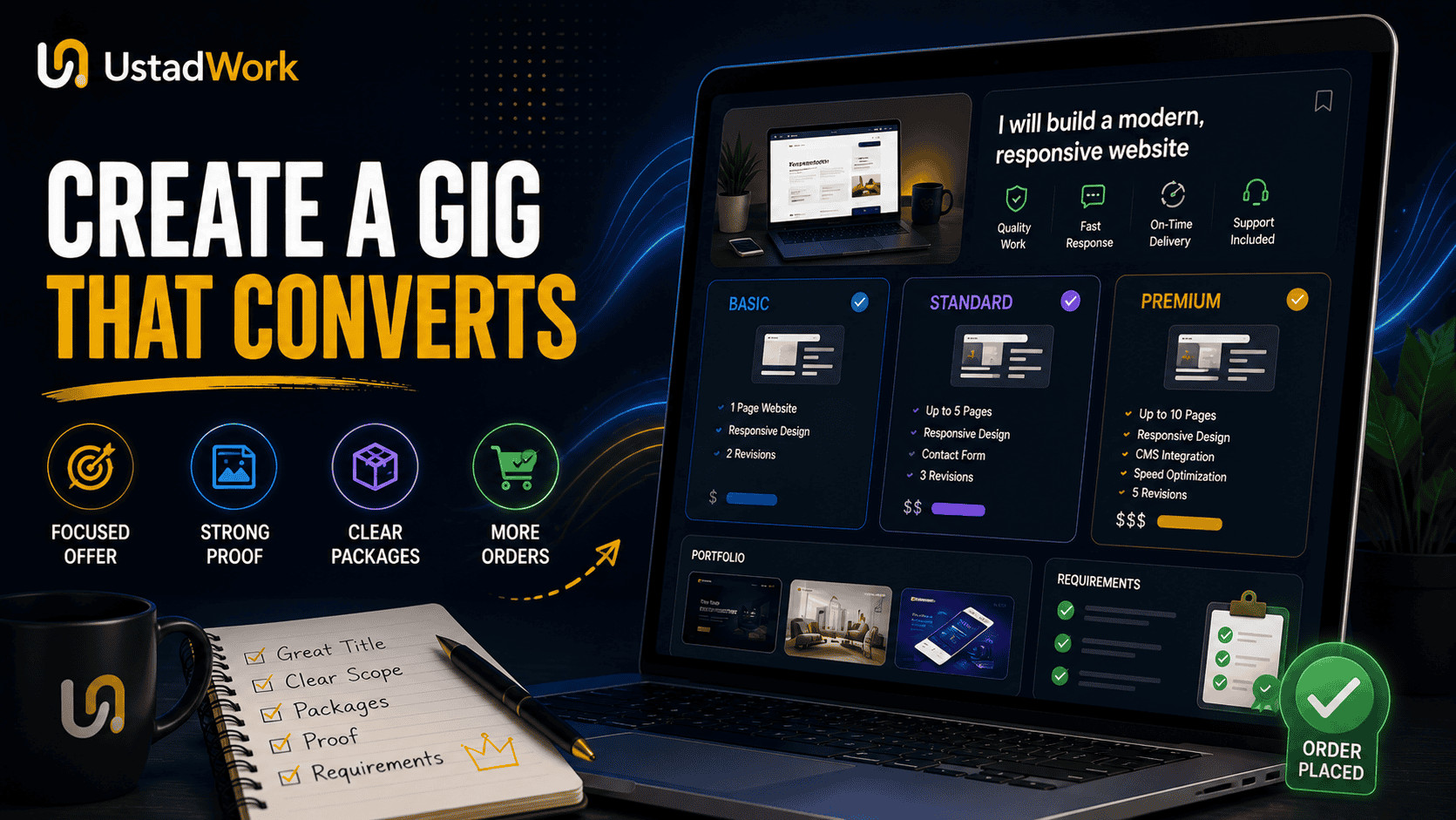
How to Create a Freelance Gig That Converts in 2026
A freelance gig is more than a short description of your skill. It is a service page that should help a potential client understand what you offer, who it is for, what is included, how much work is involved, and what they need to provide before the project begins.
A weak listing often uses a broad title, unclear packages, generic images, and promises that could apply to almost any freelancer. A stronger listing focuses on one useful client result and removes uncertainty from the buying decision.
This guide explains how to create a gig that converts without fake urgency, copied portfolio work, unrealistic guarantees, or keyword stuffing. When your service is ready, you can publish your gig on UstadWork and review open jobs to understand what clients currently request.
A weak listing often uses a broad title, unclear packages, generic images, and promises that could apply to almost any freelancer. A stronger listing focuses on one useful client result and removes uncertainty from the buying decision.
This guide explains how to create a gig that converts without fake urgency, copied portfolio work, unrealistic guarantees, or keyword stuffing. When your service is ready, you can publish your gig on UstadWork and review open jobs to understand what clients currently request.
Quick Answer: What Makes a Freelance Gig Convert?
A strong gig usually combines seven elements:
A specific service: The client immediately understands what you do.
A clear buyer: The offer is relevant to a particular problem or client type.
Useful proof: Samples demonstrate that you can complete the work.
Defined packages: Deliverables, revisions, timing, and boundaries are easy to compare.
Realistic expectations: The listing does not promise outcomes outside your control.
Organised requirements: The client knows what information or assets to provide.
One next step: The client can order, share requirements, or contact you for a custom scope.
Your gig should answer important questions before the client needs to send a message.
A specific service: The client immediately understands what you do.
A clear buyer: The offer is relevant to a particular problem or client type.
Useful proof: Samples demonstrate that you can complete the work.
Defined packages: Deliverables, revisions, timing, and boundaries are easy to compare.
Realistic expectations: The listing does not promise outcomes outside your control.
Organised requirements: The client knows what information or assets to provide.
One next step: The client can order, share requirements, or contact you for a custom scope.
Your gig should answer important questions before the client needs to send a message.
Start With One Specific Client Result
Do not begin with a broad statement such as I offer web development, I do digital marketing, or I can design anything. These statements describe a skill category but not a clear service.
Connect your skill to a deliverable and result:
Broad: I offer WordPress development.
Focused: I will build a mobile-friendly WordPress landing page for a service business.
Broad: I provide video editing.
Focused: I will edit three short-form product videos with captions and clean branding.
Broad: I do SEO.
Focused: I will create keyword research and an on-page SEO plan for five service pages.
A focused service is easier to title, price, demonstrate, deliver, and review.
Connect your skill to a deliverable and result:
Broad: I offer WordPress development.
Focused: I will build a mobile-friendly WordPress landing page for a service business.
Broad: I provide video editing.
Focused: I will edit three short-form product videos with captions and clean branding.
Broad: I do SEO.
Focused: I will create keyword research and an on-page SEO plan for five service pages.
A focused service is easier to title, price, demonstrate, deliver, and review.
Choose a Buyer and Problem
A gig becomes more persuasive when it speaks to a recognisable client problem. You do not need to restrict your entire freelance career to one industry, but the individual listing should have a clear use case.
Ask:
Who needs this service?
What problem are they trying to solve?
What deliverable can I complete confidently?
What information will I need from them?
What is outside the service scope?
Use this offer formula:
I help [type of client] achieve [useful outcome] through [specific deliverable].
Example: I help ecommerce brands present their products more clearly through clean Shopify product-page sections.
Ask:
Who needs this service?
What problem are they trying to solve?
What deliverable can I complete confidently?
What information will I need from them?
What is outside the service scope?
Use this offer formula:
I help [type of client] achieve [useful outcome] through [specific deliverable].
Example: I help ecommerce brands present their products more clearly through clean Shopify product-page sections.
Research What Clients Actually Request
Before publishing, review relevant marketplace jobs, client questions, competitor offers, business communities, and your previous conversations. Look for repeated requirements rather than copying another freelancer's wording.
Record patterns such as:
Common deliverables.
Platforms and tools clients mention.
Typical deadlines.
Questions clients ask before hiring.
Assets they already have.
Problems that delay projects.
Features frequently requested as extras.
Words clients use to describe the result.
This research helps you create a service around real demand. It can also reveal that one broad skill should become several separate gigs with different scopes.
Record patterns such as:
Common deliverables.
Platforms and tools clients mention.
Typical deadlines.
Questions clients ask before hiring.
Assets they already have.
Problems that delay projects.
Features frequently requested as extras.
Words clients use to describe the result.
This research helps you create a service around real demand. It can also reveal that one broad skill should become several separate gigs with different scopes.
Write a Clear Gig Title
The title should explain the service quickly. Use natural client language and make the main deliverable obvious.
A useful title often follows one of these formats:
I will [complete a specific deliverable].
I will [complete a service] for [specific audience or platform].
I will [solve a defined problem] using [relevant skill].
Examples:
I will build a responsive WordPress landing page.
I will edit branded YouTube Shorts for your service business.
I will design a Shopify product-page image set.
I will create an SEO content brief for your business blog.
I will automate lead follow-up using your CRM and email tools.
Avoid filling the title with repeated keywords, unnecessary adjectives, unsupported claims, or several unrelated services.
A useful title often follows one of these formats:
I will [complete a specific deliverable].
I will [complete a service] for [specific audience or platform].
I will [solve a defined problem] using [relevant skill].
Examples:
I will build a responsive WordPress landing page.
I will edit branded YouTube Shorts for your service business.
I will design a Shopify product-page image set.
I will create an SEO content brief for your business blog.
I will automate lead follow-up using your CRM and email tools.
Avoid filling the title with repeated keywords, unnecessary adjectives, unsupported claims, or several unrelated services.
Create Packages With Meaningful Differences
Packages should help clients choose the right scope. Do not create three tiers where the only difference is a higher price or a shorter delivery time.
A simple structure is:
Starter: A focused deliverable for a small requirement.
Growth: A larger scope with additional useful work.
Advanced: A more complete or customised solution.
Example for short-form video editing:
Starter: One edited vertical video with captions.
Growth: Three edited videos with captions and branded text.
Advanced: Five videos with captions, B-roll, branded graphics, and platform-ready exports.
Each package should clearly state quantity, duration, file type, revisions, delivery time, and anything the client must supply.
A simple structure is:
Starter: A focused deliverable for a small requirement.
Growth: A larger scope with additional useful work.
Advanced: A more complete or customised solution.
Example for short-form video editing:
Starter: One edited vertical video with captions.
Growth: Three edited videos with captions and branded text.
Advanced: Five videos with captions, B-roll, branded graphics, and platform-ready exports.
Each package should clearly state quantity, duration, file type, revisions, delivery time, and anything the client must supply.
Do Not Use Artificial Package Differences
A client should understand why one tier costs more. Weak differences create confusion and make the advanced package look inflated.
Avoid package structures based only on:
Basic quality versus high quality.
Professional work versus premium professional work.
Good communication versus better communication.
Normal effort versus full effort.
Quality, communication, and professionalism should be consistent across every package.
Increase the scope through measurable differences such as additional pages, videos, concepts, integrations, research, file formats, revision rounds, strategy, or post-delivery support.
Avoid package structures based only on:
Basic quality versus high quality.
Professional work versus premium professional work.
Good communication versus better communication.
Normal effort versus full effort.
Quality, communication, and professionalism should be consistent across every package.
Increase the scope through measurable differences such as additional pages, videos, concepts, integrations, research, file formats, revision rounds, strategy, or post-delivery support.
Set a Price Based on Scope
Your price should account for the complete work required—not only the visible final file.
Consider:
Research and planning.
Production or development time.
Client communication.
Revisions.
Testing and quality assurance.
Software or tool costs.
File preparation and handoff.
Post-delivery support.
Marketplace or payment costs where applicable.
A starter package can make the first decision easier, but it should still have a clear boundary. Do not offer unlimited work simply to appear cheaper.
For a more detailed framework, read how to price a freelance project.
Consider:
Research and planning.
Production or development time.
Client communication.
Revisions.
Testing and quality assurance.
Software or tool costs.
File preparation and handoff.
Post-delivery support.
Marketplace or payment costs where applicable.
A starter package can make the first decision easier, but it should still have a clear boundary. Do not offer unlimited work simply to appear cheaper.
For a more detailed framework, read how to price a freelance project.
Write a Gig Description That Answers Buyer Questions
The description should help the client decide whether your service fits their requirement. Begin with the buyer's problem instead of a long personal introduction.
Use this structure:
Opening: State who the service is for and what it delivers.
Problem: Explain the situation the service helps improve.
Deliverables: List what the client receives.
Process: Explain how the work moves from requirements to delivery.
Boundaries: State important exclusions or limitations.
Proof: Mention relevant experience or samples honestly.
CTA: Ask the client to order the right package or share requirements for a custom scope.
Use short paragraphs and readable formatting. Avoid filling the description with repeated keywords or vague claims.
Use this structure:
Opening: State who the service is for and what it delivers.
Problem: Explain the situation the service helps improve.
Deliverables: List what the client receives.
Process: Explain how the work moves from requirements to delivery.
Boundaries: State important exclusions or limitations.
Proof: Mention relevant experience or samples honestly.
CTA: Ask the client to order the right package or share requirements for a custom scope.
Use short paragraphs and readable formatting. Avoid filling the description with repeated keywords or vague claims.
Copy-and-Paste Gig Description Template
Are you looking for [specific deliverable] for [type of client or project]?
I help [target client] with [specific service and useful outcome]. This gig is suitable for [main use cases].
What you can receive:
[Deliverable 1]
[Deliverable 2]
[Deliverable 3]
[Relevant file or handoff]
[Included revision allowance]
How the process works:
1. You submit the required information and assets.
2. I review the scope and confirm any missing details.
3. I complete the agreed work.
4. You review the delivery and request included revisions.
5. I provide the approved final files or handoff.
Please note:
[Important exclusion or scope boundary].
Select the package that matches your requirements or send the project details for a custom scope.
I help [target client] with [specific service and useful outcome]. This gig is suitable for [main use cases].
What you can receive:
[Deliverable 1]
[Deliverable 2]
[Deliverable 3]
[Relevant file or handoff]
[Included revision allowance]
How the process works:
1. You submit the required information and assets.
2. I review the scope and confirm any missing details.
3. I complete the agreed work.
4. You review the delivery and request included revisions.
5. I provide the approved final files or handoff.
Please note:
[Important exclusion or scope boundary].
Select the package that matches your requirements or send the project details for a custom scope.
Use Gallery Images That Explain the Service
Your gig image should do more than display a decorative title. It should visually communicate the service and help the client understand the quality or style of the expected work.
Useful gallery content includes:
Strong portfolio samples.
Before-and-after examples.
A clean package or process overview.
Website, design, video, report, or dashboard mockups.
Short case-study pages.
Relevant deliverable previews.
Keep headline text short and readable. Do not overcrowd the image with every feature from the description.
Use only work and visual assets you are authorised to display. Clearly label demonstration concepts so they are not mistaken for paid client projects.
Useful gallery content includes:
Strong portfolio samples.
Before-and-after examples.
A clean package or process overview.
Website, design, video, report, or dashboard mockups.
Short case-study pages.
Relevant deliverable previews.
Keep headline text short and readable. Do not overcrowd the image with every feature from the description.
Use only work and visual assets you are authorised to display. Clearly label demonstration concepts so they are not mistaken for paid client projects.
Add a Short Gig Video When It Helps
A short video can help explain services that benefit from demonstration, personality, process, or before-and-after proof.
A simple gig video can include:
Opening: State the service and target client.
Problem: Mention the issue you help solve.
Proof: Show relevant samples or a process demonstration.
Deliverables: Summarise what the client receives.
CTA: Ask the client to select a package or share the requirement.
Do not spend most of the video on a long logo animation or generic introduction. The buyer should understand the service quickly.
A simple gig video can include:
Opening: State the service and target client.
Problem: Mention the issue you help solve.
Proof: Show relevant samples or a process demonstration.
Deliverables: Summarise what the client receives.
CTA: Ask the client to select a package or share the requirement.
Do not spend most of the video on a long logo animation or generic introduction. The buyer should understand the service quickly.
Collect the Right Client Requirements
A service can become difficult to deliver when the project begins without the information, content, or access you need.
Ask only relevant questions, such as:
What is the project goal?
Who is the target audience?
Which package or deliverable is required?
What deadline matters?
Which platform or tool is being used?
Are the copy, images, files, or credentials available?
Which references or examples do they prefer?
Are there brand guidelines?
Who will approve the work?
Are there technical limitations or existing problems?
Mark essential information as required. Organised requirements reduce delays and unnecessary message exchanges.
Ask only relevant questions, such as:
What is the project goal?
Who is the target audience?
Which package or deliverable is required?
What deadline matters?
Which platform or tool is being used?
Are the copy, images, files, or credentials available?
Which references or examples do they prefer?
Are there brand guidelines?
Who will approve the work?
Are there technical limitations or existing problems?
Mark essential information as required. Organised requirements reduce delays and unnecessary message exchanges.
Add FAQs That Remove Buying Friction
FAQs should answer questions that regularly prevent clients from ordering or selecting the correct package.
Useful FAQ topics include:
What is included in each package?
What counts as a revision?
What information must the client provide?
Are source or editable files included?
Does the service include copywriting, hosting, licences, or paid tools?
Can the work be completed faster?
What happens if the scope changes?
Is ongoing support included?
Can the freelancer handle a custom project?
Avoid adding FAQs that simply repeat promotional claims. Each answer should reduce uncertainty.
Useful FAQ topics include:
What is included in each package?
What counts as a revision?
What information must the client provide?
Are source or editable files included?
Does the service include copywriting, hosting, licences, or paid tools?
Can the work be completed faster?
What happens if the scope changes?
Is ongoing support included?
Can the freelancer handle a custom project?
Avoid adding FAQs that simply repeat promotional claims. Each answer should reduce uncertainty.
Explain Your Delivery Process
Clients feel more confident when they understand what happens after ordering. Use a short, realistic process rather than presenting unnecessary complexity.
Example:
Step 1: Requirements review
I review your information, files, and project goal.
Step 2: Initial work
I create the first agreed version, draft, structure, or implementation.
Step 3: Client review
You review the work and submit organised feedback.
Step 4: Included revisions
I complete the agreed changes within the service scope.
Step 5: Final delivery
You receive the final approved files, links, documentation, or handoff.
Example:
Step 1: Requirements review
I review your information, files, and project goal.
Step 2: Initial work
I create the first agreed version, draft, structure, or implementation.
Step 3: Client review
You review the work and submit organised feedback.
Step 4: Included revisions
I complete the agreed changes within the service scope.
Step 5: Final delivery
You receive the final approved files, links, documentation, or handoff.
Use Proof Instead of Unsupported Promises
Avoid promising guaranteed sales, first-page rankings, viral views, instant growth, perfect conversion rates, or outcomes controlled by several business factors.
Use proof such as:
Relevant work samples.
Clear before-and-after examples.
An explanation of your process.
Demonstration projects.
Genuine client feedback.
Relevant qualifications or practical experience.
Specific deliverables and quality checks.
Clients can evaluate clear evidence more easily than claims such as best seller, number-one expert, or guaranteed success.
Use proof such as:
Relevant work samples.
Clear before-and-after examples.
An explanation of your process.
Demonstration projects.
Genuine client feedback.
Relevant qualifications or practical experience.
Specific deliverables and quality checks.
Clients can evaluate clear evidence more easily than claims such as best seller, number-one expert, or guaranteed success.
Create Separate Gigs for Different Buyer Intents
Do not force several unrelated services into one listing. A client looking for a full WordPress website has different requirements from someone needing one bug fix. A business requesting an SEO audit has a different goal from one hiring monthly content support.
Create separate gigs when the service has a different:
Buyer problem.
Primary deliverable.
Pricing model.
Required proof.
Project process.
Client requirements.
Search intent.
For example, a WordPress freelancer may create different listings for landing pages, speed optimisation, bug fixes, migrations, and complete business websites.
Create separate gigs when the service has a different:
Buyer problem.
Primary deliverable.
Pricing model.
Required proof.
Project process.
Client requirements.
Search intent.
For example, a WordPress freelancer may create different listings for landing pages, speed optimisation, bug fixes, migrations, and complete business websites.
Improve the Gig Without Rewriting It Every Day
Allow enough time to observe performance before repeatedly changing the listing. Keep a simple record of the date and reason for every meaningful update.
Review:
Low impressions: Check category fit, tags, service demand, and title relevance.
Impressions but few clicks: Review the main image, title, and offer clarity.
Clicks but few orders: Review proof, packages, pricing, description, FAQs, and trust.
Messages but no purchase: Record repeated objections or missing package options.
Orders with confusion: Improve requirements, scope boundaries, and FAQs.
Change one meaningful area or batch related improvements together, then monitor the result.
Review:
Low impressions: Check category fit, tags, service demand, and title relevance.
Impressions but few clicks: Review the main image, title, and offer clarity.
Clicks but few orders: Review proof, packages, pricing, description, FAQs, and trust.
Messages but no purchase: Record repeated objections or missing package options.
Orders with confusion: Improve requirements, scope boundaries, and FAQs.
Change one meaningful area or batch related improvements together, then monitor the result.
Track the Full Gig Conversion Path
Do not measure success only by the number of orders. Different signals reveal different problems.
Track where available:
Marketplace impressions.
Listing clicks.
Profile visits.
Messages or enquiries.
Orders or project starts.
Average order value.
Package selected.
Revision requests.
Delivery delays.
Repeat customers.
Common buyer questions.
If the listing receives clicks but no enquiries, the offer may be unclear or weak. If it receives orders but projects become difficult, the scope or requirements may need improvement.
Track where available:
Marketplace impressions.
Listing clicks.
Profile visits.
Messages or enquiries.
Orders or project starts.
Average order value.
Package selected.
Revision requests.
Delivery delays.
Repeat customers.
Common buyer questions.
If the listing receives clicks but no enquiries, the offer may be unclear or weak. If it receives orders but projects become difficult, the scope or requirements may need improvement.
Freelance Gig Example: WordPress Landing Page
Title:
I will build a responsive WordPress landing page for your service business.
Starter:
One landing page using supplied copy and brand assets.
Growth:
One landing page with custom sections, form setup, and mobile optimisation.
Advanced:
Landing page, copy structure support, integrations, speed checks, and handoff guidance.
Requirements:
Website access, logo, brand colours, page copy, preferred examples, form destination, and deadline.
Primary CTA:
Choose the package that fits your page or share the current website for a custom review.
I will build a responsive WordPress landing page for your service business.
Starter:
One landing page using supplied copy and brand assets.
Growth:
One landing page with custom sections, form setup, and mobile optimisation.
Advanced:
Landing page, copy structure support, integrations, speed checks, and handoff guidance.
Requirements:
Website access, logo, brand colours, page copy, preferred examples, form destination, and deadline.
Primary CTA:
Choose the package that fits your page or share the current website for a custom review.
Freelance Gig Example: Short-Form Video Editing
Title:
I will edit branded short-form videos with captions.
Starter:
One vertical video from supplied footage.
Growth:
Three edited videos with captions, music, and branded text.
Advanced:
Five videos with captions, B-roll, visual hooks, sound design, and platform-ready exports.
Requirements:
Raw footage, scripts, brand assets, reference style, target platforms, CTA, and required duration.
Primary CTA:
Send your raw clips and select the number of videos required.
I will edit branded short-form videos with captions.
Starter:
One vertical video from supplied footage.
Growth:
Three edited videos with captions, music, and branded text.
Advanced:
Five videos with captions, B-roll, visual hooks, sound design, and platform-ready exports.
Requirements:
Raw footage, scripts, brand assets, reference style, target platforms, CTA, and required duration.
Primary CTA:
Send your raw clips and select the number of videos required.
Freelance Gig Example: SEO Content Brief
Title:
I will create an SEO content brief for your business article.
Starter:
One keyword and intent-focused content brief.
Growth:
Three content briefs with competitor and internal-link direction.
Advanced:
Five briefs with topic cluster mapping, FAQs, supporting terms, and publishing priorities.
Requirements:
Website URL, target service, audience, country, current pages, competitor examples, and business goal.
Primary CTA:
Share your website and target topic before ordering a larger content batch.
I will create an SEO content brief for your business article.
Starter:
One keyword and intent-focused content brief.
Growth:
Three content briefs with competitor and internal-link direction.
Advanced:
Five briefs with topic cluster mapping, FAQs, supporting terms, and publishing priorities.
Requirements:
Website URL, target service, audience, country, current pages, competitor examples, and business goal.
Primary CTA:
Share your website and target topic before ordering a larger content batch.
Gig Conversion Checklist
Before publishing, confirm that:
The listing offers one focused service.
The title clearly states the deliverable.
The category matches the main service.
The tags are specific and relevant.
Package differences are measurable.
Pricing reflects the complete scope.
The description answers important buyer questions.
Gallery images show real or clearly labelled sample work.
The client requirements collect essential information.
Revision limits are defined.
Delivery times are realistic.
FAQs reduce common uncertainty.
The CTA explains the next step.
No fake guarantees, reviews, clients, or results are used.
When ready, publish your service on UstadWork, review client job posts, or read the UstadWork FAQ.
The listing offers one focused service.
The title clearly states the deliverable.
The category matches the main service.
The tags are specific and relevant.
Package differences are measurable.
Pricing reflects the complete scope.
The description answers important buyer questions.
Gallery images show real or clearly labelled sample work.
The client requirements collect essential information.
Revision limits are defined.
Delivery times are realistic.
FAQs reduce common uncertainty.
The CTA explains the next step.
No fake guarantees, reviews, clients, or results are used.
When ready, publish your service on UstadWork, review client job posts, or read the UstadWork FAQ.
Build a Service Clients Can Understand and Trust
A gig converts more effectively when it reduces uncertainty. The client should understand the service, package, proof, timeline, requirements, revisions, boundaries, and next step without reading vague promotional language.
Start with one buyer problem, package a clear result, show relevant samples, and improve the listing using real questions and performance signals.
Do not try to make one gig appeal to every client. A focused offer is easier to find, evaluate, order, and deliver successfully.
For the next step, build a repeatable freelance offer, improve your freelancer profile, or use your gig to pursue your first client.
Start with one buyer problem, package a clear result, show relevant samples, and improve the listing using real questions and performance signals.
Do not try to make one gig appeal to every client. A focused offer is easier to find, evaluate, order, and deliver successfully.
For the next step, build a repeatable freelance offer, improve your freelancer profile, or use your gig to pursue your first client.
Frequently asked questions
What makes a freelance gig convert?
A strong gig has a focused service, clear title, relevant proof, understandable packages, realistic delivery, organised client requirements, defined revisions, and one clear next step.
How should I write a freelance gig title?
State the specific deliverable in natural client language. Avoid broad skill labels, repeated keywords, unrelated services, and claims you cannot prove.
Should I offer three gig packages?
Use multiple packages when they help clients compare meaningful levels of scope. Every tier should have measurable differences in deliverables, quantity, features, research, revisions, or support.
What should I include in a gig description?
Explain who the service is for, the problem it addresses, deliverables, process, package boundaries, proof, client requirements, and the next step.
What images should I use for my freelance gig?
Use clear portfolio samples, relevant mockups, before-and-after examples, process visuals, or deliverable previews. Use only assets you own or are authorised to display.
Why is my gig getting clicks but no orders?
The offer may have unclear packages, weak proof, unsuitable pricing, vague descriptions, missing FAQs, or too much client uncertainty. Review buyer questions and improve the listing accordingly.