How to Get Your First Client as a Freelancer in 2026
Get your first freelance client with a clear offer, proof, and outreach.
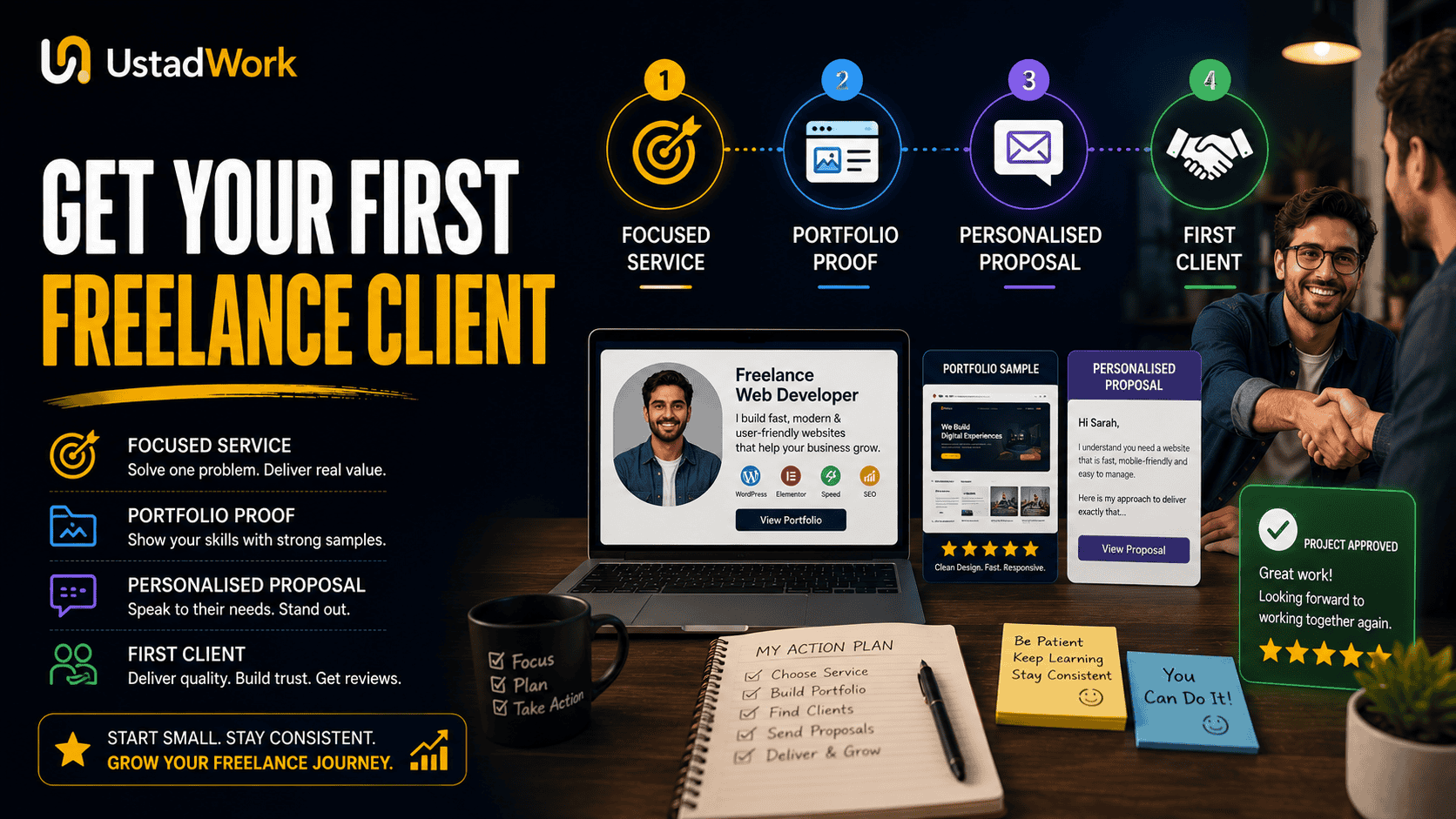
How to Get Your First Client as a Freelancer in 2026
Getting your first client is often the hardest stage of freelancing because you do not yet have reviews, paid case studies, or a strong professional reputation. That does not mean you have nothing valuable to show.
You can begin with one focused skill, a clear service offer, relevant sample work, professional communication, and consistent outreach. Clients do not always need the freelancer with the longest history. They need someone who understands the requirement, communicates clearly, and can deliver the agreed result.
This guide explains how to get your first client as a freelancer without fake reviews, copied portfolio work, or unrealistic promises. When your profile is ready, you can publish a service on UstadWork and explore freelance jobs that match your skill.
You can begin with one focused skill, a clear service offer, relevant sample work, professional communication, and consistent outreach. Clients do not always need the freelancer with the longest history. They need someone who understands the requirement, communicates clearly, and can deliver the agreed result.
This guide explains how to get your first client as a freelancer without fake reviews, copied portfolio work, or unrealistic promises. When your profile is ready, you can publish a service on UstadWork and explore freelance jobs that match your skill.
Quick Answer: What Is the Fastest Practical Route to a First Client?
The practical route is to combine five things:
One service: Choose a specific result you can deliver.
One target client: Decide who benefits from that service.
Three proof samples: Create relevant examples even if they are demonstration projects.
Personalised outreach: Contact people or apply to projects where your service is genuinely relevant.
A small starter offer: Make the first decision easier without undervaluing your work.
Do not wait for a perfect website, ten services, or a large audience. Build enough clarity and proof to start meaningful conversations, then improve your profile as you learn what clients ask.
One service: Choose a specific result you can deliver.
One target client: Decide who benefits from that service.
Three proof samples: Create relevant examples even if they are demonstration projects.
Personalised outreach: Contact people or apply to projects where your service is genuinely relevant.
A small starter offer: Make the first decision easier without undervaluing your work.
Do not wait for a perfect website, ten services, or a large audience. Build enough clarity and proof to start meaningful conversations, then improve your profile as you learn what clients ask.
Step 1: Choose One Service You Can Explain Clearly
New freelancers often create profiles containing every skill they have ever learned. This can make the profile look unfocused because clients cannot tell what they should hire the freelancer to do.
Choose one main service that connects your skill to a useful result.
Examples:
WordPress: Build a mobile-friendly landing page for a local service business.
Shopify: Improve product-page sections and mobile store layout.
Graphic design: Create a social-media design kit for a small brand.
Video editing: Edit short-form product videos with captions.
SEO: Create keyword research and an on-page action plan.
Content writing: Write service pages for B2B businesses.
Virtual assistance: Manage product uploads, customer records, and recurring admin tasks.
A specific offer is easier to understand, price, demonstrate, and recommend than a profile that simply says you can do everything.
Choose one main service that connects your skill to a useful result.
Examples:
WordPress: Build a mobile-friendly landing page for a local service business.
Shopify: Improve product-page sections and mobile store layout.
Graphic design: Create a social-media design kit for a small brand.
Video editing: Edit short-form product videos with captions.
SEO: Create keyword research and an on-page action plan.
Content writing: Write service pages for B2B businesses.
Virtual assistance: Manage product uploads, customer records, and recurring admin tasks.
A specific offer is easier to understand, price, demonstrate, and recommend than a profile that simply says you can do everything.
Step 2: Define the Client You Want to Help
Your service becomes clearer when it is connected to a type of client or business problem. You do not need to choose one industry forever. You need enough focus to make your first outreach relevant.
Ask:
Who has this problem?
What result do they need?
What usually stops them from achieving it?
What part can I complete confidently?
For example, instead of offering general graphic design, you might help ecommerce brands create product-launch social posts. Instead of offering all web development, you might build simple landing pages for consultants.
Use this positioning formula:
I help [type of client] achieve [result] through [specific service].
Example: I help local service businesses collect more quote requests through clear, mobile-friendly WordPress landing pages.
Ask:
Who has this problem?
What result do they need?
What usually stops them from achieving it?
What part can I complete confidently?
For example, instead of offering general graphic design, you might help ecommerce brands create product-launch social posts. Instead of offering all web development, you might build simple landing pages for consultants.
Use this positioning formula:
I help [type of client] achieve [result] through [specific service].
Example: I help local service businesses collect more quote requests through clear, mobile-friendly WordPress landing pages.
Step 3: Build a Profile Clients Can Understand Quickly
A client should be able to understand your service within a few seconds of viewing your profile. Your headline, overview, skills, portfolio, and service listing should support the same direction.
Use this profile structure:
Headline: State your main service and target result.
Opening: Explain the problem you help solve.
Deliverables: Describe what the client can receive.
Proof: Add relevant examples, tools, or experience.
Process: Briefly explain how you work.
Call to action: Ask the client to share their requirements.
Avoid long personal introductions that do not help the buyer evaluate your service. Focus first on the client problem and the work you can deliver.
For a complete profile structure, read how to build a freelancer profile that gets hired faster.
Use this profile structure:
Headline: State your main service and target result.
Opening: Explain the problem you help solve.
Deliverables: Describe what the client can receive.
Proof: Add relevant examples, tools, or experience.
Process: Briefly explain how you work.
Call to action: Ask the client to share their requirements.
Avoid long personal introductions that do not help the buyer evaluate your service. Focus first on the client problem and the work you can deliver.
For a complete profile structure, read how to build a freelancer profile that gets hired faster.
Step 4: Create Portfolio Proof Without Paid Clients
You do not need to invent clients or pretend demonstration work was paid work. You can create honest samples that show how you approach the service.
Portfolio options include:
Redesign sample: Improve a public page and clearly label it as an independent concept.
Demo business: Create a realistic fictional brand and complete the service for it.
Personal project: Build something useful for your own profile or business.
Volunteer project: Help a genuine organisation with a clearly agreed scope.
Process sample: Show an audit, content plan, wireframe, keyword map, or editing workflow.
Before-and-after example: Explain what was weak, what you changed, and why.
Every portfolio sample should explain the problem, your approach, the final deliverable, and the decisions you made. A screenshot without context provides less proof than a short case study.
Use our freelance portfolio guide to turn samples into clearer case studies.
Portfolio options include:
Redesign sample: Improve a public page and clearly label it as an independent concept.
Demo business: Create a realistic fictional brand and complete the service for it.
Personal project: Build something useful for your own profile or business.
Volunteer project: Help a genuine organisation with a clearly agreed scope.
Process sample: Show an audit, content plan, wireframe, keyword map, or editing workflow.
Before-and-after example: Explain what was weak, what you changed, and why.
Every portfolio sample should explain the problem, your approach, the final deliverable, and the decisions you made. A screenshot without context provides less proof than a short case study.
Use our freelance portfolio guide to turn samples into clearer case studies.
Step 5: Turn the Service Into a Starter Offer
Your first offer should be small enough for a new client to understand but valuable enough to demonstrate your real skill. This is sometimes called a starter offer or micro-offer.
Examples:
One landing page instead of a complete custom website.
Five social-media designs instead of ongoing monthly design.
Three edited Shorts instead of a full video campaign.
A keyword and page audit instead of a long SEO retainer.
Ten product uploads instead of complete ecommerce management.
One email automation workflow instead of full business automation.
The offer should define deliverables, timeline, revisions, client requirements, exclusions, and the next step.
A smaller offer reduces uncertainty; it should not mean unlimited work at an extremely low price. Learn how to package it through our repeatable freelance offer guide.
Examples:
One landing page instead of a complete custom website.
Five social-media designs instead of ongoing monthly design.
Three edited Shorts instead of a full video campaign.
A keyword and page audit instead of a long SEO retainer.
Ten product uploads instead of complete ecommerce management.
One email automation workflow instead of full business automation.
The offer should define deliverables, timeline, revisions, client requirements, exclusions, and the next step.
A smaller offer reduces uncertainty; it should not mean unlimited work at an extremely low price. Learn how to package it through our repeatable freelance offer guide.
Where to Find Your First Freelance Client
Do not depend on one channel only. Different services and personalities may perform better through different client-acquisition methods.
Useful starting channels include:
Freelance marketplaces: Publish a service and apply for relevant open projects.
Your existing network: Tell former colleagues, classmates, business contacts, and friends what service you now offer.
LinkedIn: Improve your profile, connect with relevant professionals, share useful work, and send personalised messages.
Local businesses: Identify businesses with a problem you can clearly help solve.
Professional communities: Join relevant groups and contribute useful answers before promoting your service.
Referrals: Ask people who understand your work to introduce you to a suitable business.
Choose two channels for the first month. Trying to maintain ten weak channels usually creates activity without a clear system.
Useful starting channels include:
Freelance marketplaces: Publish a service and apply for relevant open projects.
Your existing network: Tell former colleagues, classmates, business contacts, and friends what service you now offer.
LinkedIn: Improve your profile, connect with relevant professionals, share useful work, and send personalised messages.
Local businesses: Identify businesses with a problem you can clearly help solve.
Professional communities: Join relevant groups and contribute useful answers before promoting your service.
Referrals: Ask people who understand your work to introduce you to a suitable business.
Choose two channels for the first month. Trying to maintain ten weak channels usually creates activity without a clear system.
Use Your Existing Network Without Sounding Desperate
Warm contacts already know something about you, which can make it easier to begin a conversation. The message should be clear and respectful rather than asking everyone for any available work.
Use this template:
Hi [Name], I have started offering [specific service] for [type of client]. I am currently helping businesses with [specific result]. If you know someone who needs [deliverable or outcome], I would appreciate an introduction. Here is a short example of my work: [portfolio link].
Do not pressure the contact or send repeated messages. The goal is to make your service easy to remember and recommend.
You can also ask for feedback on your offer. A useful conversation may reveal clearer client language, common objections, or another person who needs the service.
Use this template:
Hi [Name], I have started offering [specific service] for [type of client]. I am currently helping businesses with [specific result]. If you know someone who needs [deliverable or outcome], I would appreciate an introduction. Here is a short example of my work: [portfolio link].
Do not pressure the contact or send repeated messages. The goal is to make your service easy to remember and recommend.
You can also ask for feedback on your offer. A useful conversation may reveal clearer client language, common objections, or another person who needs the service.
Apply for Jobs With a Personalised Proposal
A proposal should demonstrate that you read the project. Avoid opening with a long description of yourself or copying the same message into every application.
Use this structure:
1. Confirm the goal: Briefly restate what the client needs.
2. Show relevance: Mention a similar sample, skill, or problem you have handled.
3. Suggest an approach: Explain the first practical steps.
4. Ask one useful question: Identify information needed for a better estimate.
5. Give the next step: Invite the client to share details or schedule a discussion.
The proposal should be long enough to show understanding but short enough to read easily.
Use this structure:
1. Confirm the goal: Briefly restate what the client needs.
2. Show relevance: Mention a similar sample, skill, or problem you have handled.
3. Suggest an approach: Explain the first practical steps.
4. Ask one useful question: Identify information needed for a better estimate.
5. Give the next step: Invite the client to share details or schedule a discussion.
The proposal should be long enough to show understanding but short enough to read easily.
Freelance Proposal Example for a Beginner
Hi [Client Name],
I understand that you need a mobile-friendly WordPress landing page that clearly explains your service and helps visitors request a quote.
I would begin by reviewing your existing content, confirming the page sections, and creating a clear mobile layout around one primary call to action. The delivery can include the completed page, responsive testing, quote form, and two revision rounds.
I have attached a relevant demonstration project showing how I structure service-business landing pages.
Do you already have the page copy and brand assets, or should those be included in the scope?
I can review your requirements and confirm the timeline after seeing the current website.
Regards,
[Your Name]
Adapt this message to the real project. Do not claim experience, results, or deliverables you cannot prove.
I understand that you need a mobile-friendly WordPress landing page that clearly explains your service and helps visitors request a quote.
I would begin by reviewing your existing content, confirming the page sections, and creating a clear mobile layout around one primary call to action. The delivery can include the completed page, responsive testing, quote form, and two revision rounds.
I have attached a relevant demonstration project showing how I structure service-business landing pages.
Do you already have the page copy and brand assets, or should those be included in the scope?
I can review your requirements and confirm the timeline after seeing the current website.
Regards,
[Your Name]
Adapt this message to the real project. Do not claim experience, results, or deliverables you cannot prove.
Use Direct Outreach Without Sending Spam
Direct outreach can work when you identify a genuine problem and contact a business that is reasonably likely to need your service. It should not be a mass message sent to hundreds of unrelated people.
Before contacting the business:
Review its website, profile, content, or customer journey.
Identify one specific and meaningful issue.
Confirm that your service can help.
Prepare a relevant example.
Contact the appropriate person where possible.
Use this message structure:
Hi [Name], I noticed [specific observation] on [website/page/account]. I specialise in [service], and I recorded a short suggestion showing how [specific improvement] could make the experience clearer. I can send the example if it would be useful.
Keep the first message brief. Do not send a complete unpaid project, exaggerated criticism, or a fake urgency claim.
Before contacting the business:
Review its website, profile, content, or customer journey.
Identify one specific and meaningful issue.
Confirm that your service can help.
Prepare a relevant example.
Contact the appropriate person where possible.
Use this message structure:
Hi [Name], I noticed [specific observation] on [website/page/account]. I specialise in [service], and I recorded a short suggestion showing how [specific improvement] could make the experience clearer. I can send the example if it would be useful.
Keep the first message brief. Do not send a complete unpaid project, exaggerated criticism, or a fake urgency claim.
Create Useful Content That Supports Outreach
You do not need a large social-media audience to use content. A few focused posts can help potential clients understand how you think.
Create content around:
Common client mistakes.
Short before-and-after examples.
Answers to buyer questions.
Simple process explanations.
Project checklists.
Tool or platform comparisons.
Lessons from a demonstration project.
When sending a proposal or outreach message, you can link to the most relevant post or portfolio sample. This gives the client more context without adding a long explanation to the message.
Avoid publishing generic motivational content only. Show the practical knowledge connected to the service you want to sell.
Create content around:
Common client mistakes.
Short before-and-after examples.
Answers to buyer questions.
Simple process explanations.
Project checklists.
Tool or platform comparisons.
Lessons from a demonstration project.
When sending a proposal or outreach message, you can link to the most relevant post or portfolio sample. This gives the client more context without adding a long explanation to the message.
Avoid publishing generic motivational content only. Show the practical knowledge connected to the service you want to sell.
Prepare for the First Client Call
The first client conversation is not only a chance to impress the buyer. It is also your opportunity to determine whether the project is clear, realistic, and suitable.
Ask:
What result do you need?
Why is the project important now?
What deliverables are required?
What assets or access are available?
Who will approve the work?
What deadline or launch date matters?
What has already been attempted?
Which examples or competitors are relevant?
What is the expected budget range?
Take notes and summarise your understanding before discussing the final scope. Do not agree to unclear requirements simply because it is your first opportunity.
Ask:
What result do you need?
Why is the project important now?
What deliverables are required?
What assets or access are available?
Who will approve the work?
What deadline or launch date matters?
What has already been attempted?
Which examples or competitors are relevant?
What is the expected budget range?
Take notes and summarise your understanding before discussing the final scope. Do not agree to unclear requirements simply because it is your first opportunity.
Price the First Project Without Undervaluing Yourself
A first-client offer can be focused, but it should still account for your time, complexity, revisions, communication, tools, and delivery responsibilities.
Before quoting, list:
The exact deliverables.
Estimated work time.
Meetings and communication.
Revision limits.
Third-party costs.
Testing or quality checks.
File and account handoff.
Post-delivery support.
If the project is uncertain, offer a smaller discovery task or divide it into milestones. Avoid unlimited revisions and unclear promises such as complete support.
For a clearer budgeting framework, read how to price a freelance project.
Before quoting, list:
The exact deliverables.
Estimated work time.
Meetings and communication.
Revision limits.
Third-party costs.
Testing or quality checks.
File and account handoff.
Post-delivery support.
If the project is uncertain, offer a smaller discovery task or divide it into milestones. Avoid unlimited revisions and unclear promises such as complete support.
For a clearer budgeting framework, read how to price a freelance project.
Protect the First Project With Clear Scope
A client saying yes is only the beginning. Confirm the work before starting so the project does not grow without agreement.
Document:
The deliverables.
The client responsibilities.
The timeline.
The revision allowance.
The payment or marketplace process.
What is excluded.
How extra work will be approved.
What files or access are delivered at completion.
Keep important project communication organised. Submit work with a delivery note that explains what was completed and what the client should review.
Review how freelancers get paid on a marketplace for a clearer order, review, approval, and payout process.
Document:
The deliverables.
The client responsibilities.
The timeline.
The revision allowance.
The payment or marketplace process.
What is excluded.
How extra work will be approved.
What files or access are delivered at completion.
Keep important project communication organised. Submit work with a delivery note that explains what was completed and what the client should review.
Review how freelancers get paid on a marketplace for a clearer order, review, approval, and payout process.
Follow Up Without Chasing the Client
A client may be busy, comparing options, waiting for approval, or no longer ready to proceed. A polite follow-up can bring the conversation back without applying unnecessary pressure.
Use this template:
Hi [Name], I am following up on the [project/service] discussion. I am still available to review the requirements and confirm the next step. Please let me know if the project is moving forward or if the scope has changed.
One or two useful follow-ups are normally enough. If the client does not respond, return your attention to other opportunities.
Do not stop outreach because one promising conversation appears. Continue building a small pipeline until a project is clearly confirmed.
Use this template:
Hi [Name], I am following up on the [project/service] discussion. I am still available to review the requirements and confirm the next step. Please let me know if the project is moving forward or if the scope has changed.
One or two useful follow-ups are normally enough. If the client does not respond, return your attention to other opportunities.
Do not stop outreach because one promising conversation appears. Continue building a small pipeline until a project is clearly confirmed.
Common First-Client Mistakes
Avoid these common beginner mistakes:
Offering too many services: The client cannot understand your strongest offer.
Waiting for a perfect profile: You delay real feedback and conversations.
Using copied portfolio work: This destroys trust and creates ownership problems.
Sending generic proposals: The client cannot see why you fit the project.
Doing excessive free work: You provide the complete solution before agreement.
Charging without defining scope: Expectations become difficult to control.
Accepting every client: Some projects are unclear, unrealistic, or outside your skill.
Promising guaranteed results: You take responsibility for outcomes you cannot fully control.
Stopping after rejection: First-client acquisition normally requires repeated, organised effort.
Offering too many services: The client cannot understand your strongest offer.
Waiting for a perfect profile: You delay real feedback and conversations.
Using copied portfolio work: This destroys trust and creates ownership problems.
Sending generic proposals: The client cannot see why you fit the project.
Doing excessive free work: You provide the complete solution before agreement.
Charging without defining scope: Expectations become difficult to control.
Accepting every client: Some projects are unclear, unrealistic, or outside your skill.
Promising guaranteed results: You take responsibility for outcomes you cannot fully control.
Stopping after rejection: First-client acquisition normally requires repeated, organised effort.
A 14-Day First Freelance Client Plan
Day 1: Select one service and one target client.
Day 2: Write your positioning statement.
Day 3: Create the first portfolio sample.
Day 4: Create two more focused samples.
Day 5: Improve your profile headline and overview.
Day 6: Package a starter offer with clear boundaries.
Day 7: Publish the service on a marketplace.
Day 8: Contact five relevant warm connections.
Day 9: Apply for three closely matched jobs.
Day 10: Research five suitable businesses for outreach.
Day 11: Send personalised messages to those businesses.
Day 12: Publish one useful example or educational post.
Day 13: Follow up with interested contacts.
Day 14: Review responses and improve the offer, profile, samples, and messages.
The objective is not to guarantee a client in fourteen days. It is to create a complete and repeatable client-acquisition system.
Day 2: Write your positioning statement.
Day 3: Create the first portfolio sample.
Day 4: Create two more focused samples.
Day 5: Improve your profile headline and overview.
Day 6: Package a starter offer with clear boundaries.
Day 7: Publish the service on a marketplace.
Day 8: Contact five relevant warm connections.
Day 9: Apply for three closely matched jobs.
Day 10: Research five suitable businesses for outreach.
Day 11: Send personalised messages to those businesses.
Day 12: Publish one useful example or educational post.
Day 13: Follow up with interested contacts.
Day 14: Review responses and improve the offer, profile, samples, and messages.
The objective is not to guarantee a client in fourteen days. It is to create a complete and repeatable client-acquisition system.
First Client Action Checklist
Before starting outreach, check these points:
Choose one main service.
Define the target client and result.
Create three relevant portfolio examples.
Write a focused profile headline and overview.
Package one starter offer.
Publish the service listing.
Choose two client-acquisition channels.
Prepare a personalised proposal template.
Prepare a short outreach message.
Set a daily outreach target you can maintain.
Define your scope, revisions, and handoff process.
Track applications, replies, calls, proposals, and results.
When ready, publish your service on UstadWork, apply for relevant projects, or review the UstadWork FAQ before starting.
Choose one main service.
Define the target client and result.
Create three relevant portfolio examples.
Write a focused profile headline and overview.
Package one starter offer.
Publish the service listing.
Choose two client-acquisition channels.
Prepare a personalised proposal template.
Prepare a short outreach message.
Set a daily outreach target you can maintain.
Define your scope, revisions, and handoff process.
Track applications, replies, calls, proposals, and results.
When ready, publish your service on UstadWork, apply for relevant projects, or review the UstadWork FAQ before starting.
Your First Client Starts With Clarity and Consistency
You do not need a long client history to begin freelancing. You need a service clients can understand, honest proof that supports it, and a professional way to begin conversations.
Focus on one offer, create relevant samples, personalise your proposals, contact suitable businesses, and improve your approach after each response. Rejection does not always mean your skill is weak. The project may be paused, the budget may be different, or another freelancer may have been a closer fit.
A repeatable system is more useful than waiting for one lucky message. Build your profile, publish your service, apply selectively, and continue improving the proof behind your offer.
Ready to begin? create your service listing, explore freelance opportunities, or read the UstadWork FAQ.
Focus on one offer, create relevant samples, personalise your proposals, contact suitable businesses, and improve your approach after each response. Rejection does not always mean your skill is weak. The project may be paused, the budget may be different, or another freelancer may have been a closer fit.
A repeatable system is more useful than waiting for one lucky message. Build your profile, publish your service, apply selectively, and continue improving the proof behind your offer.
Ready to begin? create your service listing, explore freelance opportunities, or read the UstadWork FAQ.
Frequently asked questions
How do I get my first freelance client with no experience?
Choose one focused service, create honest demonstration projects, build a clear profile, package a starter offer, and contact or apply to clients whose requirements closely match your work.
Can I create a freelance portfolio without paid clients?
Yes. Use demo brands, personal projects, independent redesign concepts, process samples, or clearly labelled volunteer work. Never present fictional or unpaid work as a paid client project.
Where should beginners look for freelance clients?
Beginners can use freelance marketplaces, existing contacts, LinkedIn, local businesses, professional communities, referrals, and personalised direct outreach.
What should I write in my first freelance proposal?
Confirm the client goal, explain your relevant skill or sample, suggest a short approach, ask one important question, and provide a clear next step.
Should I work for free to get my first client?
Avoid completing large custom projects for free. A small sample, demonstration, or limited audit may help show your approach, but the complete deliverable should have a clear paid scope.
How long does it take to get a first freelance client?
There is no guaranteed timeline. It depends on your service clarity, portfolio relevance, platform fit, outreach quality, market demand, pricing, and consistency.