How Freelancers Get Paid on a Modern Marketplace
Understand order funding, delivery flow, review checkpoints, payouts, and payment safety on a modern marketplace.
How Freelancers Get Paid on a Modern Marketplace
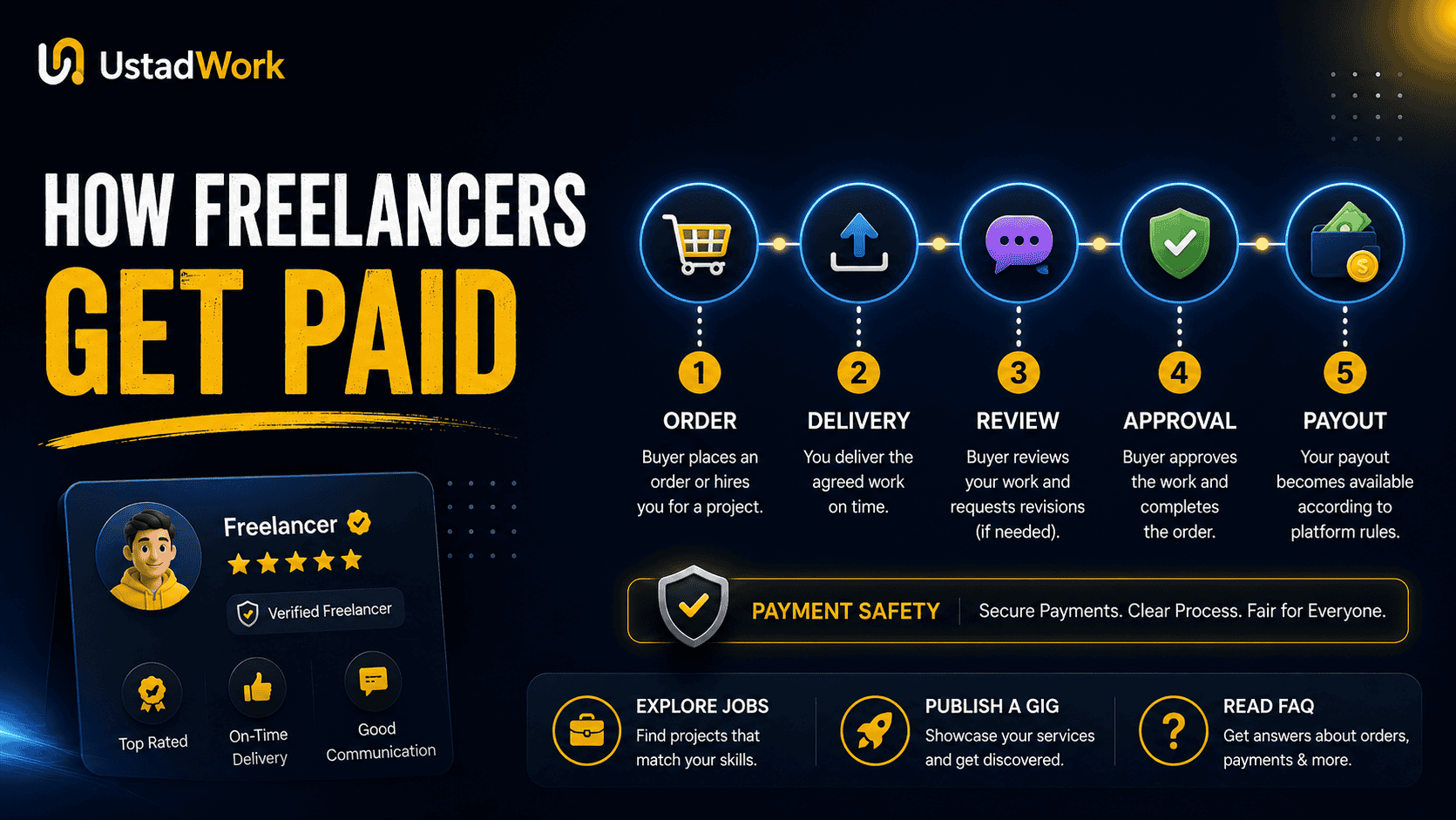
Freelancers get paid more confidently when the payment process is clear before work begins. A modern freelance marketplace usually gives buyers and freelancers a structured flow: the buyer places an order or posts a project, the work is delivered, the buyer reviews it, revisions are handled if needed, and the freelancer receives a payout according to the platform rules.
The exact timing, payout methods, fees, holds, dispute rules, and withdrawal options can vary by marketplace. Always check the official platform policy before accepting work or expecting a payout date.
This guide explains how freelancers get paid on a modern marketplace, what steps usually happen before payout, and how freelancers can protect their time by using clear scope, delivery records, and professional communication. You can also publish a service on UstadWork, explore open jobs, or read the UstadWork FAQ before getting started.
The exact timing, payout methods, fees, holds, dispute rules, and withdrawal options can vary by marketplace. Always check the official platform policy before accepting work or expecting a payout date.
This guide explains how freelancers get paid on a modern marketplace, what steps usually happen before payout, and how freelancers can protect their time by using clear scope, delivery records, and professional communication. You can also publish a service on UstadWork, explore open jobs, or read the UstadWork FAQ before getting started.
Quick Answer: How Do Freelance Marketplace Payments Usually Work?
A typical marketplace payment process has five main stages:
1. Order or project starts: The buyer chooses a service or hires a freelancer for a project.
2. Payment is funded or confirmed: The marketplace records payment according to its own rules before work moves forward.
3. Freelancer delivers the work: The freelancer submits the agreed deliverables through the platform or approved delivery method.
4. Buyer reviews and approves: The buyer checks the work, requests allowed revisions, or approves delivery.
5. Payout becomes available: After approval and any platform processing period, the freelancer can receive or withdraw earnings based on available payout methods.
This structure helps both sides. The buyer gets a review point before final approval, and the freelancer has a clearer record of scope, delivery, and communication.
1. Order or project starts: The buyer chooses a service or hires a freelancer for a project.
2. Payment is funded or confirmed: The marketplace records payment according to its own rules before work moves forward.
3. Freelancer delivers the work: The freelancer submits the agreed deliverables through the platform or approved delivery method.
4. Buyer reviews and approves: The buyer checks the work, requests allowed revisions, or approves delivery.
5. Payout becomes available: After approval and any platform processing period, the freelancer can receive or withdraw earnings based on available payout methods.
This structure helps both sides. The buyer gets a review point before final approval, and the freelancer has a clearer record of scope, delivery, and communication.
What Buyers Want Before Releasing Payment
Buyers usually want confidence that the freelancer delivered the work agreed in the original scope. They are not only checking whether something was submitted; they are checking whether it matches the brief, timeline, format, and quality expectations.
Before approving work, buyers may look for:
Completed deliverables: Files, pages, designs, videos, reports, code, setup, or tasks promised in the order.
Scope match: Work that matches what was agreed, not unrelated extras or missing items.
Usability: Files open correctly, website changes work, links function, documents are readable, and handoff is clear.
Revision handling: Requested changes are handled according to the agreed revision limit.
Professional communication: The freelancer explains what was delivered and what the buyer should check.
A freelancer can reduce confusion by writing clear delivery notes and reminding the buyer what is included in the order.
Before approving work, buyers may look for:
Completed deliverables: Files, pages, designs, videos, reports, code, setup, or tasks promised in the order.
Scope match: Work that matches what was agreed, not unrelated extras or missing items.
Usability: Files open correctly, website changes work, links function, documents are readable, and handoff is clear.
Revision handling: Requested changes are handled according to the agreed revision limit.
Professional communication: The freelancer explains what was delivered and what the buyer should check.
A freelancer can reduce confusion by writing clear delivery notes and reminding the buyer what is included in the order.
Step 1: Start With a Clear Scope
Payment problems often begin with unclear scope. If the buyer and freelancer do not agree on what is included, the delivery review becomes confusing. The freelancer may think the work is complete, while the buyer may expect extra pages, more revisions, additional files, or support that was never included.
Before starting, define:
What will be delivered?
How many versions, pages, files, videos, reports, or tasks are included?
How many revision rounds are included?
What is not included?
What information must the buyer provide?
What counts as final delivery?
For fixed services, write this clearly in your gig or service listing. For custom jobs, confirm the scope in the project conversation before work begins. A clear scope helps protect both payment and client trust.
Before starting, define:
What will be delivered?
How many versions, pages, files, videos, reports, or tasks are included?
How many revision rounds are included?
What is not included?
What information must the buyer provide?
What counts as final delivery?
For fixed services, write this clearly in your gig or service listing. For custom jobs, confirm the scope in the project conversation before work begins. A clear scope helps protect both payment and client trust.
Step 2: Use Milestones for Larger Projects
For bigger projects, one final delivery can create unnecessary risk. Milestones break the project into smaller approval points so both sides can review progress before the full job is complete.
A website project, for example, may use milestones such as planning, first design, development, testing, and final handoff. A content project may use topic approval, first draft, revisions, and final delivery. A video project may use script review, rough cut, revisions, and final export.
Milestones help freelancers get paid for completed stages and help buyers avoid waiting until the end to discover problems. Each milestone should include a specific deliverable, approval criteria, and revision limit.
For better project planning, freelancers can use the same thinking from building a repeatable freelance offer and buyers can use a clear project brief before hiring.
A website project, for example, may use milestones such as planning, first design, development, testing, and final handoff. A content project may use topic approval, first draft, revisions, and final delivery. A video project may use script review, rough cut, revisions, and final export.
Milestones help freelancers get paid for completed stages and help buyers avoid waiting until the end to discover problems. Each milestone should include a specific deliverable, approval criteria, and revision limit.
For better project planning, freelancers can use the same thinking from building a repeatable freelance offer and buyers can use a clear project brief before hiring.
Step 3: Deliver Work With Proof and Notes
When you submit work, do not only upload a file and disappear. Add a clear delivery note that explains what you completed, what files are included, what the buyer should review, and whether any support or next step is required.
A useful delivery note can include:
Summary: Briefly explain what was completed.
Deliverables: List the files, links, pages, reports, or tasks included.
Review instructions: Tell the buyer what to check first.
Access details: Explain where the work is located or how to open it.
Revision reminder: Mention how many revision rounds are included if relevant.
Next step: Ask the buyer to review and approve, or send feedback within the platform process.
This protects the freelancer because it creates a clearer record of delivery. It also helps buyers review the work faster.
A useful delivery note can include:
Summary: Briefly explain what was completed.
Deliverables: List the files, links, pages, reports, or tasks included.
Review instructions: Tell the buyer what to check first.
Access details: Explain where the work is located or how to open it.
Revision reminder: Mention how many revision rounds are included if relevant.
Next step: Ask the buyer to review and approve, or send feedback within the platform process.
This protects the freelancer because it creates a clearer record of delivery. It also helps buyers review the work faster.
Step 4: Handle Revisions Professionally
Revisions are normal in freelance work. The problem starts when revisions are unlimited, vague, or outside the original scope. A professional freelancer should explain what revisions are included before the project starts.
A revision usually means improving the agreed work, not adding a new project. For example, changing text on a landing page may be a revision. Adding five new sections, new copywriting, a new design direction, or extra functionality may be additional scope.
When a buyer requests changes, respond clearly:
Confirm what you understand.
Separate included revisions from extra work.
Ask for all feedback in one organised message where possible.
Update the buyer after changes are completed.
Keep communication inside the marketplace where possible.
This helps protect payment because everyone can see what was requested and delivered.
A revision usually means improving the agreed work, not adding a new project. For example, changing text on a landing page may be a revision. Adding five new sections, new copywriting, a new design direction, or extra functionality may be additional scope.
When a buyer requests changes, respond clearly:
Confirm what you understand.
Separate included revisions from extra work.
Ask for all feedback in one organised message where possible.
Update the buyer after changes are completed.
Keep communication inside the marketplace where possible.
This helps protect payment because everyone can see what was requested and delivered.
Step 5: Approval, Completion, and Payout
After delivery, the buyer usually reviews the work. If the work matches the agreed scope, the buyer can approve it. Depending on the marketplace rules, the order may then move into a completed state, and the freelancer payout may become available after any processing or clearance period.
Do not assume payout timing without checking official policy. Some platforms have review windows, holding periods, withdrawal processing times, payout method rules, or additional checks. These rules can change, and they may also vary by country, payment method, account status, or project type.
Freelancers should keep records of delivery, approval, and communication. Buyers should approve only after checking the agreed deliverables. Both sides should use the platform’s official support or dispute process if there is a serious issue.
Do not assume payout timing without checking official policy. Some platforms have review windows, holding periods, withdrawal processing times, payout method rules, or additional checks. These rules can change, and they may also vary by country, payment method, account status, or project type.
Freelancers should keep records of delivery, approval, and communication. Buyers should approve only after checking the agreed deliverables. Both sides should use the platform’s official support or dispute process if there is a serious issue.
Common Payment Mistakes Freelancers Should Avoid
Freelancers can avoid many payment problems by keeping the work process clear and professional from the beginning.
Common mistakes include:
Starting work without a clear scope.
Accepting vague requirements.
Offering unlimited revisions without boundaries.
Delivering work without notes or proof.
Moving important communication away from the platform.
Accepting extra work without updating scope.
Ignoring official payout rules.
Not checking buyer feedback before final delivery.
Using unclear file names or missing final files.
The goal is not to make the process complicated. The goal is to make the project easy to review, approve, and pay for.
Common mistakes include:
Starting work without a clear scope.
Accepting vague requirements.
Offering unlimited revisions without boundaries.
Delivering work without notes or proof.
Moving important communication away from the platform.
Accepting extra work without updating scope.
Ignoring official payout rules.
Not checking buyer feedback before final delivery.
Using unclear file names or missing final files.
The goal is not to make the process complicated. The goal is to make the project easy to review, approve, and pay for.
Payment Safety Tips for Freelancers
Payment safety starts with clear communication and platform rules. Use the marketplace process whenever possible because it creates a record of the order, scope, delivery, and buyer feedback.
Helpful safety practices include:
Read the platform’s payment and payout policy before accepting work.
Keep project communication inside the platform where possible.
Confirm scope, revisions, and deliverables before starting.
Use milestones for larger projects.
Do not promise work that is outside your skill or available time.
Do not share sensitive account details unnecessarily.
Do not mark work complete if important deliverables are missing.
Save final files, screenshots, and delivery notes.
Ask support for help when the platform process is unclear.
On UstadWork, use the FAQ section and official marketplace guidance before making payment or payout assumptions.
Helpful safety practices include:
Read the platform’s payment and payout policy before accepting work.
Keep project communication inside the platform where possible.
Confirm scope, revisions, and deliverables before starting.
Use milestones for larger projects.
Do not promise work that is outside your skill or available time.
Do not share sensitive account details unnecessarily.
Do not mark work complete if important deliverables are missing.
Save final files, screenshots, and delivery notes.
Ask support for help when the platform process is unclear.
On UstadWork, use the FAQ section and official marketplace guidance before making payment or payout assumptions.
Freelancer Payment Process Example
Here is a simple example of how a marketplace payment flow may work for a service package:
Service: A freelancer offers a social-media design package.
Buyer order: The buyer selects the service and shares brand details, logo, content, and examples.
Scope confirmation: The freelancer confirms the number of designs, formats, and revisions included.
Delivery: The freelancer submits the final designs with download links and a delivery note.
Review: The buyer checks the files and requests one included revision.
Revision: The freelancer updates the designs and resubmits.
Approval: The buyer approves the work.
Payout: The freelancer receives payment according to the platform’s payout rules and available withdrawal methods.
This example is general. Exact UstadWork payment timing and payout method details should be confirmed from official UstadWork policy pages.
Service: A freelancer offers a social-media design package.
Buyer order: The buyer selects the service and shares brand details, logo, content, and examples.
Scope confirmation: The freelancer confirms the number of designs, formats, and revisions included.
Delivery: The freelancer submits the final designs with download links and a delivery note.
Review: The buyer checks the files and requests one included revision.
Revision: The freelancer updates the designs and resubmits.
Approval: The buyer approves the work.
Payout: The freelancer receives payment according to the platform’s payout rules and available withdrawal methods.
This example is general. Exact UstadWork payment timing and payout method details should be confirmed from official UstadWork policy pages.
Freelancer Payment Checklist
Use this checklist before and during a project:
Read the official payment and payout rules.
Confirm the buyer requirement before starting.
Write clear deliverables and exclusions.
Set revision limits.
Use milestones for larger work.
Keep important messages inside the platform.
Deliver work with notes, files, and proof.
Respond to revision requests professionally.
Ask the buyer to review the agreed deliverables.
Keep final files organised.
Check payout status through the official account dashboard.
Contact support if payment status is unclear.
To prepare better services, create a service listing on UstadWork. To understand buyer needs, review open jobs. For platform questions, read the UstadWork FAQ.
Read the official payment and payout rules.
Confirm the buyer requirement before starting.
Write clear deliverables and exclusions.
Set revision limits.
Use milestones for larger work.
Keep important messages inside the platform.
Deliver work with notes, files, and proof.
Respond to revision requests professionally.
Ask the buyer to review the agreed deliverables.
Keep final files organised.
Check payout status through the official account dashboard.
Contact support if payment status is unclear.
To prepare better services, create a service listing on UstadWork. To understand buyer needs, review open jobs. For platform questions, read the UstadWork FAQ.
Get Paid With a Clearer Freelance Process
Freelancers get paid more smoothly when the project is clear, the delivery matches the scope, revisions are handled professionally, and the payment process follows official platform rules. A marketplace can support the process, but freelancers still need strong communication, organised delivery, and realistic expectations.
Do not rely on guesses about payout timing or payment methods. Always check the official marketplace policy and keep your project records clear.
Ready to start? publish your service on UstadWork, explore freelance jobs, or review the UstadWork FAQ before getting started.
Do not rely on guesses about payout timing or payment methods. Always check the official marketplace policy and keep your project records clear.
Ready to start? publish your service on UstadWork, explore freelance jobs, or review the UstadWork FAQ before getting started.
Frequently asked questions
How do freelancers get paid on a marketplace?
Freelancers usually get paid after an order or project is funded, the agreed work is delivered, the buyer reviews and approves it, and the marketplace processes payout according to its rules.
When does a freelancer receive payout?
Payout timing depends on the marketplace policy, payment method, review period, account status, and any processing or clearance rules. Always check the official platform policy.
What should freelancers do before starting work?
Freelancers should confirm the scope, deliverables, revision limits, timeline, required buyer information, and what counts as final delivery.
Why are milestones useful for freelancer payments?
Milestones divide larger projects into smaller review points. They help buyers approve progress and help freelancers avoid waiting until the very end for all work to be reviewed.
What causes payment problems in freelance work?
Common causes include unclear scope, missing deliverables, unlimited revisions, poor communication, incomplete delivery notes, extra work not agreed in advance, and misunderstanding official payout rules.
How can freelancers protect themselves when getting paid?
Freelancers should use the official marketplace process, keep communication inside the platform where possible, define scope clearly, deliver with proof, and read payment and payout policies before accepting work.