React vs Vue for a Startup MVP in 2026
Compare React and Vue for startup MVP speed, hiring, SEO, maintenance, and future scaling.
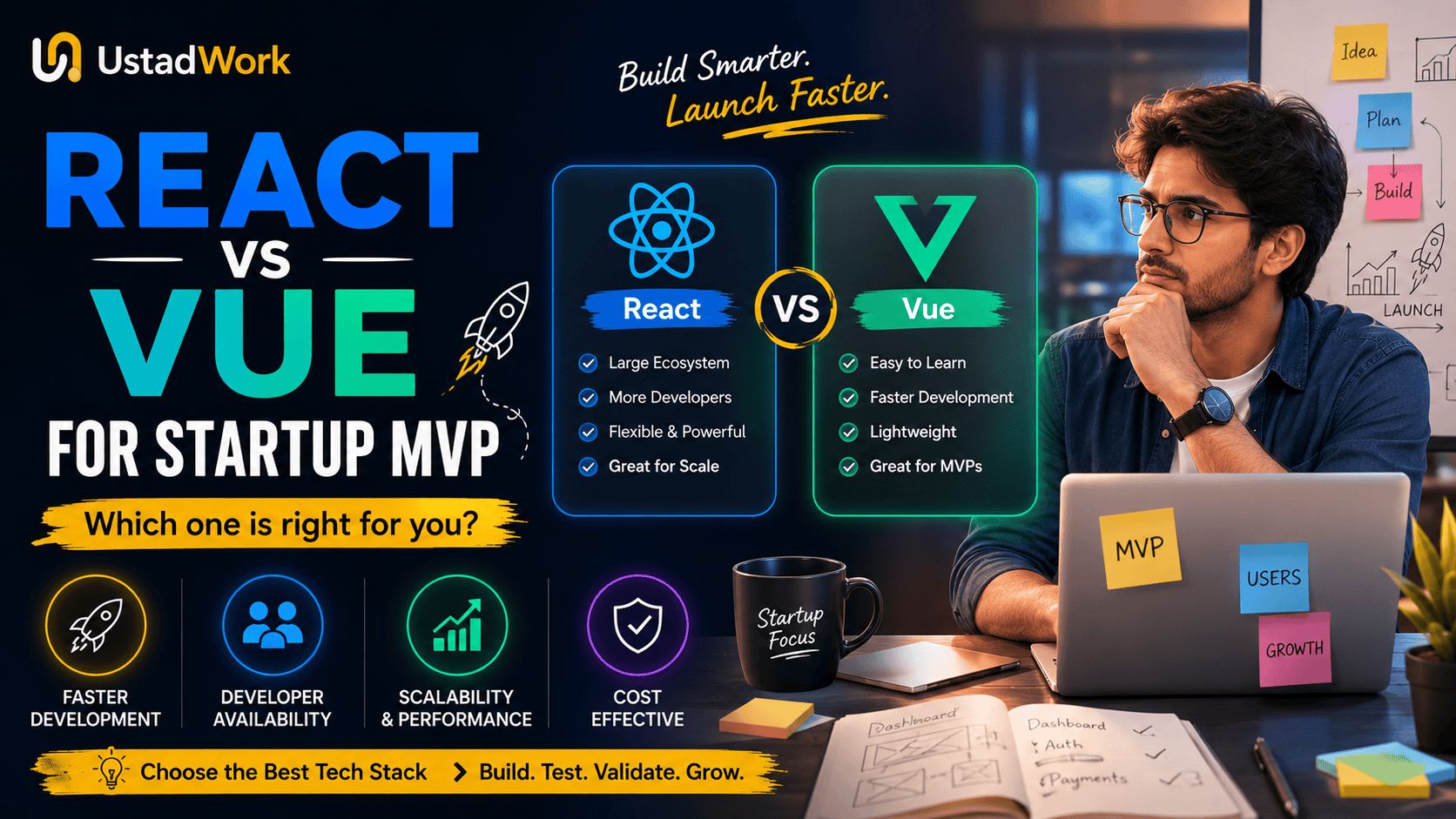
React vs Vue for a Startup MVP in 2026
Choosing a frontend framework for a startup MVP is not about finding a universal winner. The goal is to choose the option that helps your team validate the product with the least unnecessary risk.
React and Vue can both build dashboards, SaaS products, marketplaces, booking platforms, ecommerce experiences, customer portals, and internal tools. The difference usually appears in hiring availability, team experience, ecosystem choices, architecture, development workflow, and how the product may grow after validation.
A useful React vs Vue for startup MVP decision begins with the product outcome, not framework popularity. When your requirements are ready, you can post an MVP development job on UstadWork or browse Web Development services.
React and Vue can both build dashboards, SaaS products, marketplaces, booking platforms, ecommerce experiences, customer portals, and internal tools. The difference usually appears in hiring availability, team experience, ecosystem choices, architecture, development workflow, and how the product may grow after validation.
A useful React vs Vue for startup MVP decision begins with the product outcome, not framework popularity. When your requirements are ready, you can post an MVP development job on UstadWork or browse Web Development services.
Quick Answer: Should a Startup Choose React or Vue?
Choose React when your startup needs access to a larger developer market, expects to use the broader React ecosystem, may build web and native products, or already has React experience inside the team.
Choose Vue when your team values a more guided, approachable development experience, wants to move quickly with a smaller frontend team, already uses Vue or Laravel, or prefers Vue's template and reactivity model.
For a public-facing product, the practical comparison may actually become Next.js versus Nuxt rather than React versus Vue alone. These frameworks add routing, server rendering, data fetching, deployment structure, SEO controls, and full-stack capabilities.
The safest choice is normally the framework your available team can build, test, deploy, and maintain well.
Choose Vue when your team values a more guided, approachable development experience, wants to move quickly with a smaller frontend team, already uses Vue or Laravel, or prefers Vue's template and reactivity model.
For a public-facing product, the practical comparison may actually become Next.js versus Nuxt rather than React versus Vue alone. These frameworks add routing, server rendering, data fetching, deployment structure, SEO controls, and full-stack capabilities.
The safest choice is normally the framework your available team can build, test, deploy, and maintain well.
Define What the MVP Must Prove
Before discussing frontend technology, define what your MVP is meant to validate. An MVP should test a core user problem or business assumption—not include every feature imagined for the final product.
Write one outcome statement:
We need users to complete [core action] so that we can test [business assumption].
Examples:
A marketplace needs providers to create listings and customers to submit requests.
A SaaS product needs users to upload data and receive a useful result.
A booking platform needs customers to find availability and make a request.
A dashboard needs team members to review information and take action.
The framework matters less than whether the team can deliver this core flow reliably. Authentication, forms, permissions, data handling, integrations, testing, and deployment often create more risk than the UI library itself.
Write one outcome statement:
We need users to complete [core action] so that we can test [business assumption].
Examples:
A marketplace needs providers to create listings and customers to submit requests.
A SaaS product needs users to upload data and receive a useful result.
A booking platform needs customers to find availability and make a request.
A dashboard needs team members to review information and take action.
The framework matters less than whether the team can deliver this core flow reliably. Authentication, forms, permissions, data handling, integrations, testing, and deployment often create more risk than the UI library itself.
React for Startup MVP Development
React is a strong option when the startup wants broad ecosystem access and a large hiring pool. It is widely used across product teams, agencies, startups, and enterprise environments, which can make it easier to find developers with different experience levels.
React works well for:
Interactive SaaS products
Complex dashboards
Marketplaces and customer portals
Products that may later need React Native
Teams already using TypeScript and React
Products with specialised third-party component needs
The main challenge is that React itself does not make every architecture decision for you. Teams still need to choose a framework, routing approach, data-fetching pattern, form tools, state strategy, testing tools, and component system.
This flexibility is valuable with an experienced technical lead. Without clear decisions, it can also produce an inconsistent MVP with too many libraries.
React works well for:
Interactive SaaS products
Complex dashboards
Marketplaces and customer portals
Products that may later need React Native
Teams already using TypeScript and React
Products with specialised third-party component needs
The main challenge is that React itself does not make every architecture decision for you. Teams still need to choose a framework, routing approach, data-fetching pattern, form tools, state strategy, testing tools, and component system.
This flexibility is valuable with an experienced technical lead. Without clear decisions, it can also produce an inconsistent MVP with too many libraries.
Vue for Startup MVP Development
Vue is a strong option for startups that want a cohesive frontend experience and an approachable component model. Its template syntax can feel familiar to developers who already understand HTML, CSS, and JavaScript.
Vue works well for:
Small product teams
Admin dashboards and internal platforms
Customer portals
Fast product prototypes
Teams using Laravel or an existing Vue stack
Products that benefit from gradual frontend adoption
Vue provides an official ecosystem for routing, state management, tooling, testing guidance, server rendering, and TypeScript. This can reduce decision fatigue for a smaller team.
The trade-off is that the available hiring market is smaller than React's in many locations. This does not make Vue risky by itself, but the startup should confirm that it can hire, replace, or support Vue developers where it plans to operate.
Vue works well for:
Small product teams
Admin dashboards and internal platforms
Customer portals
Fast product prototypes
Teams using Laravel or an existing Vue stack
Products that benefit from gradual frontend adoption
Vue provides an official ecosystem for routing, state management, tooling, testing guidance, server rendering, and TypeScript. This can reduce decision fatigue for a smaller team.
The trade-off is that the available hiring market is smaller than React's in many locations. This does not make Vue risky by itself, but the startup should confirm that it can hire, replace, or support Vue developers where it plans to operate.
Development Speed and Time to Market
Framework choice can influence development speed, but the experience of the developer usually has a larger impact. A skilled Vue team will often deliver faster in Vue than in React, while an experienced React team will usually move faster in React.
Time to market depends on:
The team's existing knowledge.
The clarity of the product brief.
The number of integrations.
The availability of a reusable component system.
Authentication and permission requirements.
Backend and database readiness.
Testing expectations.
Deployment and monitoring setup.
Vue can reduce early setup decisions for teams that prefer its official conventions. React can move very quickly when the team uses an established framework and starter architecture.
Do not change frameworks only because another option looks easier in a tutorial. Rebuilding familiar infrastructure can remove any theoretical speed advantage.
Time to market depends on:
The team's existing knowledge.
The clarity of the product brief.
The number of integrations.
The availability of a reusable component system.
Authentication and permission requirements.
Backend and database readiness.
Testing expectations.
Deployment and monitoring setup.
Vue can reduce early setup decisions for teams that prefer its official conventions. React can move very quickly when the team uses an established framework and starter architecture.
Do not change frameworks only because another option looks easier in a tutorial. Rebuilding familiar infrastructure can remove any theoretical speed advantage.
Developer Availability and Hiring Risk
A startup should consider who will maintain the product six or twelve months after launch. A framework is not only a technical choice; it also affects recruitment, onboarding, replacement risk, and contractor availability.
React generally gives startups access to a larger pool of developers, agencies, learning material, components, and specialised product experience. This can help when the startup needs to hire quickly or expects the engineering team to expand.
Vue still has an active and mature developer community, but the hiring pool may be smaller depending on the country, budget, and required seniority. A startup choosing Vue should confirm local or remote talent availability before committing.
When evaluating candidates, do not ask only whether they know React or Vue. Ask whether they have built the type of product you need, handled authentication, data flows, testing, deployment, performance, and long-term maintenance.
For a structured hiring process, read how to hire a web developer for a startup MVP.
React generally gives startups access to a larger pool of developers, agencies, learning material, components, and specialised product experience. This can help when the startup needs to hire quickly or expects the engineering team to expand.
Vue still has an active and mature developer community, but the hiring pool may be smaller depending on the country, budget, and required seniority. A startup choosing Vue should confirm local or remote talent availability before committing.
When evaluating candidates, do not ask only whether they know React or Vue. Ask whether they have built the type of product you need, handled authentication, data flows, testing, deployment, performance, and long-term maintenance.
For a structured hiring process, read how to hire a web developer for a startup MVP.
React Frameworks vs Vue Frameworks
A production MVP often needs more than client-side components. It may need routing, metadata, server rendering, API routes, authentication, caching, image handling, error pages, analytics, and deployment configuration.
For React products, a common full-stack choice is Next.js. For Vue products, a common choice is Nuxt.
Next.js can be a good fit when:
Your team already knows React.
You need server and client components.
You want a large ecosystem and broad deployment support.
You need public pages alongside an authenticated product.
Nuxt can be a good fit when:
Your team prefers Vue.
You want file-based routing and server rendering by default.
You value Vue-focused conventions and integrated full-stack tooling.
You need public content and an interactive application together.
The correct comparison is not which framework has more features. It is which framework your team can use without creating unnecessary architectural complexity.
For React products, a common full-stack choice is Next.js. For Vue products, a common choice is Nuxt.
Next.js can be a good fit when:
Your team already knows React.
You need server and client components.
You want a large ecosystem and broad deployment support.
You need public pages alongside an authenticated product.
Nuxt can be a good fit when:
Your team prefers Vue.
You want file-based routing and server rendering by default.
You value Vue-focused conventions and integrated full-stack tooling.
You need public content and an interactive application together.
The correct comparison is not which framework has more features. It is which framework your team can use without creating unnecessary architectural complexity.
SEO and Rendering for Public MVPs
SEO matters when the MVP includes landing pages, public profiles, marketplace listings, product pages, articles, service pages, directories, or content intended to appear in search results.
A private dashboard does not normally need the same rendering strategy as a public marketplace. For public pages, consider server-side rendering, static generation, or hybrid rendering so important content is available quickly.
Both the React and Vue ecosystems support these rendering approaches through frameworks such as Next.js and Nuxt. The important decision is which routes need public HTML, which routes require live user data, and which pages can be generated ahead of time.
SSR can improve initial content delivery and search visibility, but it also adds server, caching, deployment, and debugging responsibilities. Do not add server rendering to every screen without understanding why it is needed.
A private dashboard does not normally need the same rendering strategy as a public marketplace. For public pages, consider server-side rendering, static generation, or hybrid rendering so important content is available quickly.
Both the React and Vue ecosystems support these rendering approaches through frameworks such as Next.js and Nuxt. The important decision is which routes need public HTML, which routes require live user data, and which pages can be generated ahead of time.
SSR can improve initial content delivery and search visibility, but it also adds server, caching, deployment, and debugging responsibilities. Do not add server rendering to every screen without understanding why it is needed.
Performance: React vs Vue
Both React and Vue can deliver a fast MVP. Poor performance normally comes from architecture and implementation choices rather than the framework name.
Common performance problems include:
Large JavaScript bundles.
Heavy third-party scripts.
Unoptimised images and media.
Too many API requests.
Poor caching.
Rendering large lists inefficiently.
Loading unnecessary components on the first screen.
Using client-side rendering for content that could be pre-rendered.
Ask the development team how it will measure real performance, reduce initial JavaScript, handle images, split code, cache data, and monitor errors after launch.
A simple, focused Vue MVP can outperform an overloaded React product. A carefully designed React architecture can outperform a poorly structured Vue build. The implementation remains the deciding factor.
Common performance problems include:
Large JavaScript bundles.
Heavy third-party scripts.
Unoptimised images and media.
Too many API requests.
Poor caching.
Rendering large lists inefficiently.
Loading unnecessary components on the first screen.
Using client-side rendering for content that could be pre-rendered.
Ask the development team how it will measure real performance, reduce initial JavaScript, handle images, split code, cache data, and monitor errors after launch.
A simple, focused Vue MVP can outperform an overloaded React product. A carefully designed React architecture can outperform a poorly structured Vue build. The implementation remains the deciding factor.
State Management and Product Complexity
State management becomes important when the product includes user sessions, permissions, filters, dashboards, forms, live data, shopping carts, collaborative workflows, or multi-step processes.
Vue provides a reactive model and an official state-management direction through Pinia. React offers built-in state tools and a large selection of external libraries for local, server, and global state.
React's variety can be useful for complex products, but teams should avoid adding a global state library before it is actually needed. Vue's official direction can make the choice simpler, but architecture still requires planning.
For an MVP, keep state as close to the component or feature as possible. Separate server data from temporary interface state. Document which information is stored in the browser, which comes from the API, and which must remain secure on the server.
Vue provides a reactive model and an official state-management direction through Pinia. React offers built-in state tools and a large selection of external libraries for local, server, and global state.
React's variety can be useful for complex products, but teams should avoid adding a global state library before it is actually needed. Vue's official direction can make the choice simpler, but architecture still requires planning.
For an MVP, keep state as close to the component or feature as possible. Separate server data from temporary interface state. Document which information is stored in the browser, which comes from the API, and which must remain secure on the server.
Ecosystem and Third-Party Integrations
React has a very large ecosystem of component libraries, authentication tools, charts, editors, payments, analytics integrations, testing tools, and developer services. This can help a startup find solutions quickly.
The risk is choosing a library only because it is popular. Some packages become inactive, conflict with framework updates, increase bundle size, or introduce security and maintenance responsibilities.
Vue also has mature options for routing, state, UI components, forms, charts, and product development. Its ecosystem is smaller, but many common startup requirements are well supported.
Before choosing either framework, list the integrations your MVP actually needs:
Authentication provider.
Payment gateway.
Email or notification service.
Analytics and event tracking.
File storage.
Search.
Maps or location data.
CRM or marketing tools.
Confirm that the required integrations have stable documentation and active support.
The risk is choosing a library only because it is popular. Some packages become inactive, conflict with framework updates, increase bundle size, or introduce security and maintenance responsibilities.
Vue also has mature options for routing, state, UI components, forms, charts, and product development. Its ecosystem is smaller, but many common startup requirements are well supported.
Before choosing either framework, list the integrations your MVP actually needs:
Authentication provider.
Payment gateway.
Email or notification service.
Analytics and event tracking.
File storage.
Search.
Maps or location data.
CRM or marketing tools.
Confirm that the required integrations have stable documentation and active support.
MVP Cost: Does React or Vue Cost More?
There is no fixed rule that React is more expensive or Vue is cheaper. Development cost depends on scope, developer location, seniority, framework experience, backend requirements, design readiness, integrations, testing, and deployment.
React may give you more proposals because the hiring pool is larger. However, high demand for experienced React and Next.js developers can still result in higher rates.
Vue may allow a focused team to move quickly, but a smaller local talent market can make specialised hiring more difficult in some regions.
The cheapest proposal is not always the lowest-cost product. A weak architecture may create expensive rewrites, bugs, slow delivery, and difficult handoff.
For budget planning, review the cost to hire a web developer and ask candidates to separate discovery, development, testing, deployment, and post-launch support.
React may give you more proposals because the hiring pool is larger. However, high demand for experienced React and Next.js developers can still result in higher rates.
Vue may allow a focused team to move quickly, but a smaller local talent market can make specialised hiring more difficult in some regions.
The cheapest proposal is not always the lowest-cost product. A weak architecture may create expensive rewrites, bugs, slow delivery, and difficult handoff.
For budget planning, review the cost to hire a web developer and ask candidates to separate discovery, development, testing, deployment, and post-launch support.
Choose React When
React may be the stronger MVP choice when:
Your team already has React or Next.js experience.
You need access to a larger developer market.
The product may share skills with a React Native mobile application.
You need specialised UI libraries or integrations.
The startup expects the frontend team to grow quickly.
You want broad agency and contractor availability.
You have a technical lead who can control architecture decisions.
React is especially useful when hiring flexibility and ecosystem depth are major business requirements.
Your team already has React or Next.js experience.
You need access to a larger developer market.
The product may share skills with a React Native mobile application.
You need specialised UI libraries or integrations.
The startup expects the frontend team to grow quickly.
You want broad agency and contractor availability.
You have a technical lead who can control architecture decisions.
React is especially useful when hiring flexibility and ecosystem depth are major business requirements.
Choose Vue When
Vue may be the stronger MVP choice when:
Your team already knows Vue or Nuxt.
You have a small frontend team that values clear conventions.
The product is a dashboard, portal, internal tool, or focused web platform.
Your existing backend or organisation already uses Vue.
You want gradual frontend adoption inside an existing application.
You have reliable access to Vue developers.
You prefer Vue's template and reactivity model.
Vue is especially useful when team productivity and architectural simplicity matter more than having the largest possible hiring pool.
Your team already knows Vue or Nuxt.
You have a small frontend team that values clear conventions.
The product is a dashboard, portal, internal tool, or focused web platform.
Your existing backend or organisation already uses Vue.
You want gradual frontend adoption inside an existing application.
You have reliable access to Vue developers.
You prefer Vue's template and reactivity model.
Vue is especially useful when team productivity and architectural simplicity matter more than having the largest possible hiring pool.
Common Framework-Selection Mistakes
Avoid these common startup mistakes:
Choosing by popularity alone: A larger community does not solve unclear product requirements.
Choosing by benchmark alone: Small performance differences rarely matter more than implementation quality.
Ignoring team experience: A familiar framework often delivers faster and with fewer mistakes.
Building for imaginary scale: Do not create enterprise complexity before validating the product.
Using too many libraries: Every dependency adds maintenance and upgrade risk.
Ignoring handoff: Source code, documentation, environments, accounts, and deployment access must remain under startup control.
Skipping tests: Core signup, payment, booking, messaging, and permission flows should be tested before launch.
The framework should reduce product risk, not become the product.
Choosing by popularity alone: A larger community does not solve unclear product requirements.
Choosing by benchmark alone: Small performance differences rarely matter more than implementation quality.
Ignoring team experience: A familiar framework often delivers faster and with fewer mistakes.
Building for imaginary scale: Do not create enterprise complexity before validating the product.
Using too many libraries: Every dependency adds maintenance and upgrade risk.
Ignoring handoff: Source code, documentation, environments, accounts, and deployment access must remain under startup control.
Skipping tests: Core signup, payment, booking, messaging, and permission flows should be tested before launch.
The framework should reduce product risk, not become the product.
React vs Vue MVP Decision Scorecard
Score both options from 1 to 5 for your startup:
Current team experience
Available developer market
Required integrations
Time-to-market confidence
Public-page SEO needs
Mobile product roadmap
Component-library requirements
Maintenance and upgrade capability
Agency or freelancer availability
Long-term hiring plan
Do not choose only by the total score. Use the scorecard to identify the highest business risks and discuss them with shortlisted developers.
Current team experience
Available developer market
Required integrations
Time-to-market confidence
Public-page SEO needs
Mobile product roadmap
Component-library requirements
Maintenance and upgrade capability
Agency or freelancer availability
Long-term hiring plan
Do not choose only by the total score. Use the scorecard to identify the highest business risks and discuss them with shortlisted developers.
Startup MVP Technology Checklist
Before choosing the framework:
Define the core user flow.
Separate must-have features from future ideas.
List public pages that require SEO.
Identify authentication and permission needs.
List required integrations.
Confirm the team's existing frontend experience.
Research React and Vue developer availability.
Choose the rendering approach for public and private routes.
Define the testing and deployment plan.
Confirm source-code ownership and account access.
Use milestones for discovery, build, testing, and handoff.
When ready, post your MVP project on UstadWork, browse web-development services, or review the UstadWork FAQ before hiring.
Define the core user flow.
Separate must-have features from future ideas.
List public pages that require SEO.
Identify authentication and permission needs.
List required integrations.
Confirm the team's existing frontend experience.
Research React and Vue developer availability.
Choose the rendering approach for public and private routes.
Define the testing and deployment plan.
Confirm source-code ownership and account access.
Use milestones for discovery, build, testing, and handoff.
When ready, post your MVP project on UstadWork, browse web-development services, or review the UstadWork FAQ before hiring.
Choose the Team Before the Trend
React and Vue can both support a successful startup MVP. React offers a broader hiring market and ecosystem, while Vue can provide a cohesive and approachable workflow for focused teams.
The stronger choice is the framework your team can use to deliver the core product, test it with real users, fix problems quickly, and maintain it after launch.
Do not choose technology only because it is trending. Choose based on product risk, team experience, hiring access, public-page requirements, integrations, and the next twelve months of your roadmap.
Ready to build? post a startup MVP job, explore the Web Development category, or use our freelancer hiring guide before selecting a developer.
The stronger choice is the framework your team can use to deliver the core product, test it with real users, fix problems quickly, and maintain it after launch.
Do not choose technology only because it is trending. Choose based on product risk, team experience, hiring access, public-page requirements, integrations, and the next twelve months of your roadmap.
Ready to build? post a startup MVP job, explore the Web Development category, or use our freelancer hiring guide before selecting a developer.
Frequently asked questions
Is React or Vue better for a startup MVP?
Both can work. React may be better when hiring availability, ecosystem size, or React Native plans matter. Vue may be better when a smaller team values clear conventions, fast onboarding, or already has Vue experience.
Is React faster than Vue?
Both can deliver strong performance. Real speed depends on bundle size, rendering strategy, images, scripts, API requests, caching, and implementation quality.
Should an MVP use React with Next.js?
Next.js can be useful when the product needs public SEO pages, server rendering, static generation, full-stack routes, or structured production deployment. A private dashboard may not need every feature.
Should a Vue MVP use Nuxt?
Nuxt can be useful when a Vue product needs routing, server rendering, SEO support, data fetching, and full-stack conventions. A simple internal interface may also work with a smaller Vue setup.
Is it easier to hire React or Vue developers?
React generally has a larger reported developer market, but availability and rates vary by country, seniority, and project type. Relevant product experience matters more than framework knowledge alone.
Can a startup switch from Vue to React later?
Yes, but a rewrite can be expensive and risky. Startups should switch only when there is a clear business or technical reason, not because another framework becomes fashionable.