Best Freelancing Platform for Beginners: What Actually Helps
Learn what makes a freelance platform easier for beginners, from profile setup to category fit and early trust signals.
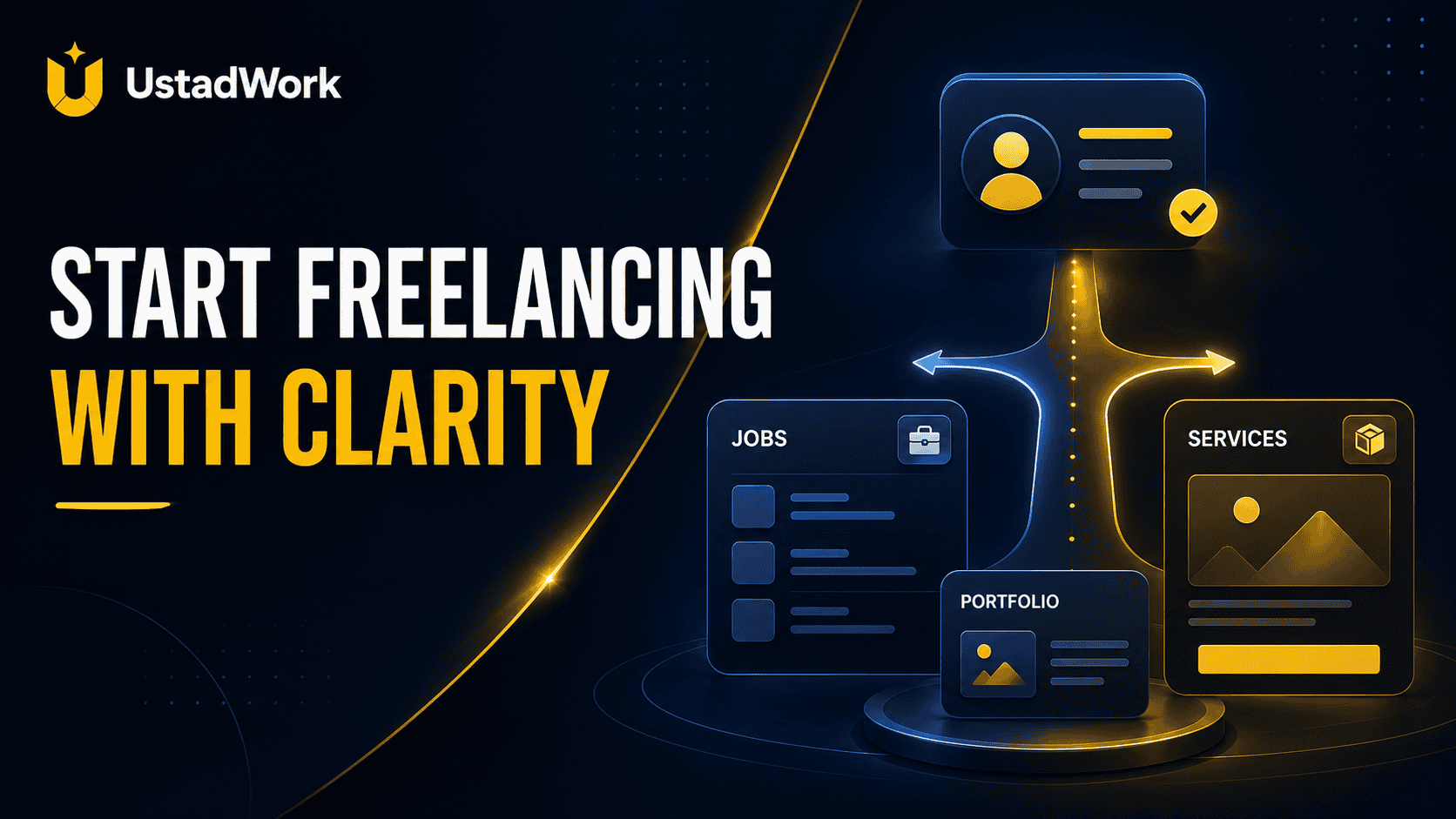
Quick Answer: What Is the Best Freelancing Platform for Beginners?
There is no single best freelancing platform for beginners. The right choice depends on the skill you want to sell, the type of work you want to find, the portfolio proof you already have, and whether you prefer applying for jobs or publishing a ready-made service.
A beginner-friendly platform should help you do three things clearly: build a profile, show a focused service, and find relevant work without making clients guess what you offer.
The best freelancing platform for beginners is usually the one where your skill fits the available categories, your first service is easy to explain, and you can build trust through a clear profile, relevant samples, and professional communication.
On UstadWork, you can publish a service, explore freelance jobs, and use the FAQ section to understand the marketplace before getting started.
A beginner-friendly platform should help you do three things clearly: build a profile, show a focused service, and find relevant work without making clients guess what you offer.
The best freelancing platform for beginners is usually the one where your skill fits the available categories, your first service is easy to explain, and you can build trust through a clear profile, relevant samples, and professional communication.
On UstadWork, you can publish a service, explore freelance jobs, and use the FAQ section to understand the marketplace before getting started.
What Actually Makes a Freelance Platform Beginner-Friendly?
A platform is not beginner-friendly only because it lets you create an account. It should make it easier for a new freelancer to understand what clients need and how to present their work clearly.
Look for these practical signs:
Clear service categories: You should be able to place your skill in a relevant category such as web development, graphic design, video editing, SEO, content writing, Shopify, WordPress, or virtual assistance.
Simple profile setup: Your profile should let you explain what you do, show skills, add portfolio samples, and share your service focus.
Jobs and service opportunities: Beginners benefit from being able to apply for relevant work and also create a service listing that clients can discover.
Visible trust signals: Clear portfolio samples, professional communication, verified information where available, and service details help clients feel more confident.
Easy-to-understand process: You should know how to create a service, apply for jobs, communicate with clients, and manage project expectations.
Look for these practical signs:
Clear service categories: You should be able to place your skill in a relevant category such as web development, graphic design, video editing, SEO, content writing, Shopify, WordPress, or virtual assistance.
Simple profile setup: Your profile should let you explain what you do, show skills, add portfolio samples, and share your service focus.
Jobs and service opportunities: Beginners benefit from being able to apply for relevant work and also create a service listing that clients can discover.
Visible trust signals: Clear portfolio samples, professional communication, verified information where available, and service details help clients feel more confident.
Easy-to-understand process: You should know how to create a service, apply for jobs, communicate with clients, and manage project expectations.
Key Difference: Jobs vs Service Listings
Most freelance marketplaces use one or both of these approaches: job-based work and service-based listings. Understanding the difference will help you choose how to start.
Job-based freelance work:
Clients post a project, freelancers review the requirements, and interested people send proposals. This works well when a client needs custom work, a larger project, or a specific combination of skills.
Service listings:
Freelancers create a focused offer with clear deliverables, scope, and expected outcome. This works well for repeatable services such as logo design, WordPress fixes, landing pages, short video edits, SEO audits, content writing, or product uploads.
As a beginner, you can use both. Apply for jobs that match your skill and create one clear service listing so clients can understand what you offer without waiting for you to send a proposal.
Job-based freelance work:
Clients post a project, freelancers review the requirements, and interested people send proposals. This works well when a client needs custom work, a larger project, or a specific combination of skills.
Service listings:
Freelancers create a focused offer with clear deliverables, scope, and expected outcome. This works well for repeatable services such as logo design, WordPress fixes, landing pages, short video edits, SEO audits, content writing, or product uploads.
As a beginner, you can use both. Apply for jobs that match your skill and create one clear service listing so clients can understand what you offer without waiting for you to send a proposal.
Cost, Fees, and Timeline: What Beginners Should Consider
Do not choose a platform only because you expect fast results or low fees. The real cost of freelancing includes the time you spend building your profile, preparing portfolio samples, writing proposals, improving your service offer, and learning how to communicate with clients.
Before committing to any platform, check how it handles service listings, job applications, payment flow, client communication, support, and any marketplace charges that apply to your work. Read the platform policies yourself before accepting a project or publishing a service.
Also set realistic expectations. Your first project may take time because clients need proof that you can deliver. Use that time to improve your profile, create stronger samples, understand common client requests, and make your offer more specific.
Before committing to any platform, check how it handles service listings, job applications, payment flow, client communication, support, and any marketplace charges that apply to your work. Read the platform policies yourself before accepting a project or publishing a service.
Also set realistic expectations. Your first project may take time because clients need proof that you can deliver. Use that time to improve your profile, create stronger samples, understand common client requests, and make your offer more specific.
Best Use Cases for Different Platform Types
Choose a job marketplace when:
You want to apply for custom projects, respond to client requirements, and build experience through proposals. This can suit website work, ecommerce projects, SEO campaigns, design work, video editing, writing, automation, or virtual assistance.
Choose a service marketplace when:
You have a clear, repeatable offer. For example, I will design five social-media posts, build a WordPress landing page, edit three product videos, create a logo kit, or complete an SEO audit.
Choose a niche-focused marketplace when:
Your work needs specialist proof or a particular audience. This can apply to technical development, creative design, ecommerce work, writing, consulting, or industry-specific services.
Choose a local or regional marketplace when:
You understand the audience, language, payment preferences, business needs, or working style of that market. A local fit can make communication and service positioning easier for some beginners.
You want to apply for custom projects, respond to client requirements, and build experience through proposals. This can suit website work, ecommerce projects, SEO campaigns, design work, video editing, writing, automation, or virtual assistance.
Choose a service marketplace when:
You have a clear, repeatable offer. For example, I will design five social-media posts, build a WordPress landing page, edit three product videos, create a logo kit, or complete an SEO audit.
Choose a niche-focused marketplace when:
Your work needs specialist proof or a particular audience. This can apply to technical development, creative design, ecommerce work, writing, consulting, or industry-specific services.
Choose a local or regional marketplace when:
You understand the audience, language, payment preferences, business needs, or working style of that market. A local fit can make communication and service positioning easier for some beginners.
Pick a Platform That Matches Your First Service
Your first platform choice should match the service you can explain most clearly. Do not start with a broad statement such as I can do anything online. Start with one offer that solves a real client problem.
Examples:
WordPress: I build mobile-friendly WordPress landing pages for service businesses.
Shopify: I help ecommerce brands improve Shopify product pages and store sections.
Graphic Design: I create branded social-media design kits for small businesses.
Video Editing: I edit short-form product videos for Reels and social ads.
SEO: I create keyword research and on-page SEO action plans.
Content Writing: I write service pages and blog content for growing businesses.
A clear offer makes it easier to decide whether a platform has the right categories, job types, and client needs for your work.
Examples:
WordPress: I build mobile-friendly WordPress landing pages for service businesses.
Shopify: I help ecommerce brands improve Shopify product pages and store sections.
Graphic Design: I create branded social-media design kits for small businesses.
Video Editing: I edit short-form product videos for Reels and social ads.
SEO: I create keyword research and on-page SEO action plans.
Content Writing: I write service pages and blog content for growing businesses.
A clear offer makes it easier to decide whether a platform has the right categories, job types, and client needs for your work.
Build Your Profile Before Expecting Results
A platform cannot do all the work for you. Clients still need to understand why they should choose you. Your profile should clearly explain your main service, target client, relevant skills, proof, and next step.
Use this simple profile structure:
Headline: State what you do and who you help.
Overview: Explain your main service, approach, and relevant skills.
Portfolio: Add three to six relevant samples or clearly labelled demo projects.
Skills: List tools and abilities that support the service you want to sell.
Service offer: Make your deliverables, scope, and call to action easy to understand.
Before you publish your first offer, read how to turn one service into a repeatable freelance offer.
Use this simple profile structure:
Headline: State what you do and who you help.
Overview: Explain your main service, approach, and relevant skills.
Portfolio: Add three to six relevant samples or clearly labelled demo projects.
Skills: List tools and abilities that support the service you want to sell.
Service offer: Make your deliverables, scope, and call to action easy to understand.
Before you publish your first offer, read how to turn one service into a repeatable freelance offer.
Use Early Trust Signals Carefully
Beginners often feel they need big client logos, huge project counts, or dramatic success claims before they can start. That is not necessary. You need honest and relevant proof.
Useful beginner trust signals include:
Clear profile photo and professional overview
Relevant demo projects clearly labelled as sample work
Portfolio examples that match your service
Clear deliverables and scope boundaries
Fast but professional responses
Reliable communication and realistic timelines
Genuine reviews after real projects
Do not use fake testimonials, copied portfolio work, invented client logos, or guarantees about sales, rankings, or viral results. Honest proof is more useful for long-term trust.
Useful beginner trust signals include:
Clear profile photo and professional overview
Relevant demo projects clearly labelled as sample work
Portfolio examples that match your service
Clear deliverables and scope boundaries
Fast but professional responses
Reliable communication and realistic timelines
Genuine reviews after real projects
Do not use fake testimonials, copied portfolio work, invented client logos, or guarantees about sales, rankings, or viral results. Honest proof is more useful for long-term trust.
A Simple Decision Framework for Beginners
Use this checklist before choosing where to focus your effort. Score each platform from 1 to 5:
Category fit: Does it clearly support your service type?
Client fit: Are the jobs or services relevant to the clients you want?
Profile clarity: Can you explain your skill, show samples, and create a focused offer?
Work style: Does it support job proposals, service listings, or both?
Portfolio fit: Can you show relevant work or demo examples?
Process clarity: Do you understand how to apply, communicate, and manage work?
Support and policies: Can you find the information you need before accepting work?
Do not spend months creating profiles everywhere. Choose one main platform, create one strong service, apply for relevant jobs, and improve your work based on the questions clients ask.
Category fit: Does it clearly support your service type?
Client fit: Are the jobs or services relevant to the clients you want?
Profile clarity: Can you explain your skill, show samples, and create a focused offer?
Work style: Does it support job proposals, service listings, or both?
Portfolio fit: Can you show relevant work or demo examples?
Process clarity: Do you understand how to apply, communicate, and manage work?
Support and policies: Can you find the information you need before accepting work?
Do not spend months creating profiles everywhere. Choose one main platform, create one strong service, apply for relevant jobs, and improve your work based on the questions clients ask.
A 7-Day Beginner Freelancing Plan
Day 1: Choose one service you can explain clearly.
Day 2: Research the types of clients who need that service.
Day 3: Create or improve three portfolio samples.
Day 4: Write a focused profile headline and overview.
Day 5: Publish one service listing with clear deliverables and boundaries.
Day 6: Review relevant jobs and write personalised proposals.
Day 7: Improve your profile based on what feels unclear or incomplete.
The goal is not to become perfect in one week. The goal is to create a practical starting point and begin learning from real client requirements.
Day 2: Research the types of clients who need that service.
Day 3: Create or improve three portfolio samples.
Day 4: Write a focused profile headline and overview.
Day 5: Publish one service listing with clear deliverables and boundaries.
Day 6: Review relevant jobs and write personalised proposals.
Day 7: Improve your profile based on what feels unclear or incomplete.
The goal is not to become perfect in one week. The goal is to create a practical starting point and begin learning from real client requirements.
Common Mistakes Beginners Make When Choosing a Platform
Avoid these common mistakes:
Creating profiles everywhere: This can spread your effort too thin before you have one strong offer.
Offering too many unrelated services: Clients may not understand what you are best at.
Copying other freelancers: Learn from good profiles, but write your own honest offer and use your own proof.
Expecting instant clients: Early freelancing requires profile building, portfolio work, proposals, and improvement.
Using vague service titles: A focused service is easier to understand and buy.
Ignoring project requirements: Personalise proposals and show that you understand the client goal.
Making promises you cannot support: Avoid guarantees about results, revenue, rankings, or deadlines you cannot control.
Creating profiles everywhere: This can spread your effort too thin before you have one strong offer.
Offering too many unrelated services: Clients may not understand what you are best at.
Copying other freelancers: Learn from good profiles, but write your own honest offer and use your own proof.
Expecting instant clients: Early freelancing requires profile building, portfolio work, proposals, and improvement.
Using vague service titles: A focused service is easier to understand and buy.
Ignoring project requirements: Personalise proposals and show that you understand the client goal.
Making promises you cannot support: Avoid guarantees about results, revenue, rankings, or deadlines you cannot control.
Start Where You Can Build Real Proof
The best platform for you is the one where you can build a clear profile, show relevant proof, create a focused service, and connect with work that matches your skill. It is not only about platform size or popularity. It is about whether the platform helps you present your work in a way clients can understand.
Start with one service, one platform, and one clear improvement plan. As you complete work, replace weaker portfolio samples, refine your offer, and build trust through real communication and delivery.
Ready to begin? publish your service on UstadWork, explore beginner-friendly freelance jobs, or read the UstadWork FAQ before getting started.
Start with one service, one platform, and one clear improvement plan. As you complete work, replace weaker portfolio samples, refine your offer, and build trust through real communication and delivery.
Ready to begin? publish your service on UstadWork, explore beginner-friendly freelance jobs, or read the UstadWork FAQ before getting started.
Frequently asked questions
What is the best freelancing platform for beginners?
The best option depends on your skill, the service you want to sell, the type of client you want, and whether you prefer applying for jobs or publishing a service listing. Choose a platform where you can clearly show your work and find relevant opportunities.
Can I start freelancing without experience?
Yes. Create honest demo projects, practice samples, portfolio examples, or mock client work that matches the service you want to sell. Clearly label demo work instead of presenting it as paid client work.
Should beginners apply for jobs or create service listings?
Both can work. Apply for jobs when a client needs custom work. Create service listings when you have a clear, repeatable offer with defined deliverables.
How many services should a beginner freelancer offer?
Start with one main service and one or two related supporting services. A focused offer is easier for clients to understand than a long list of unrelated skills.
How long does it take to get the first freelance client?
There is no guaranteed timeline. It depends on the quality of your profile, portfolio proof, service clarity, proposal effort, category fit, communication, and client demand.
What should I include in a beginner freelancer profile?
Include a clear headline, focused overview, relevant skills, portfolio samples, honest proof, one service offer, and a simple call to action for clients.