How to Build a Remote Freelance Team in 2026
Build a remote freelance team with clear roles, onboarding, workflows, milestones, and secure access.
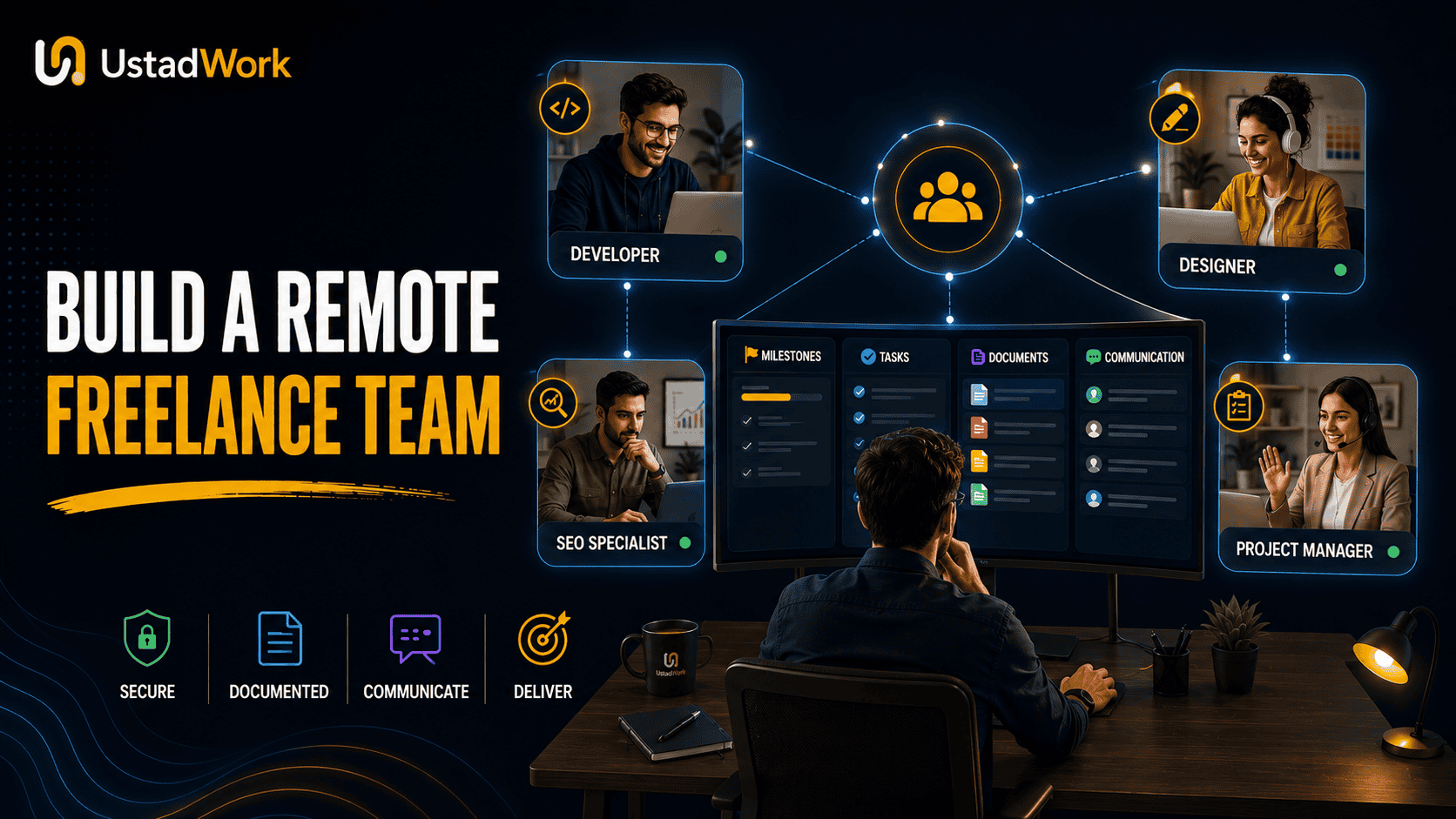
How to Build a Remote Freelance Team in 2026
Building a remote freelance team can give a business access to specialised talent without hiring every skill as a permanent full-time role. A startup may need a developer, designer, copywriter, SEO specialist, video editor, automation expert, and project coordinator—but not all of them for the same number of hours every month.
The challenge is not simply finding talented freelancers. The challenge is creating a system where responsibilities are clear, information is easy to find, decisions are documented, access is controlled, and every person understands what successful delivery means.
This guide explains how to build a remote freelance team using clear roles, structured hiring, organised onboarding, milestones, asynchronous communication, quality checks, and secure handoff. When your requirements are ready, you can post a remote freelance project on UstadWork or browse specialised freelancer services.
The challenge is not simply finding talented freelancers. The challenge is creating a system where responsibilities are clear, information is easy to find, decisions are documented, access is controlled, and every person understands what successful delivery means.
This guide explains how to build a remote freelance team using clear roles, structured hiring, organised onboarding, milestones, asynchronous communication, quality checks, and secure handoff. When your requirements are ready, you can post a remote freelance project on UstadWork or browse specialised freelancer services.
Quick Answer: What Does a Strong Remote Freelance Team Need?
A reliable remote freelance team usually needs seven things:
A defined outcome: Everyone understands what the business or project must achieve.
Clear roles: Every major responsibility has one primary owner.
Relevant specialists: People are selected for the actual work rather than impressive but unrelated profiles.
A shared workspace: Files, decisions, tasks, deadlines, and feedback are stored in predictable places.
Milestones: Larger work is divided into reviewable stages.
Communication rules: The team knows when to write, meet, escalate, and expect a response.
Secure access: Freelancers receive only the accounts and permissions required for their responsibilities.
Remote teamwork becomes difficult when these decisions remain informal or exist only inside private messages.
A defined outcome: Everyone understands what the business or project must achieve.
Clear roles: Every major responsibility has one primary owner.
Relevant specialists: People are selected for the actual work rather than impressive but unrelated profiles.
A shared workspace: Files, decisions, tasks, deadlines, and feedback are stored in predictable places.
Milestones: Larger work is divided into reviewable stages.
Communication rules: The team knows when to write, meet, escalate, and expect a response.
Secure access: Freelancers receive only the accounts and permissions required for their responsibilities.
Remote teamwork becomes difficult when these decisions remain informal or exist only inside private messages.
Define the Business Outcome Before Hiring Roles
Do not begin by creating a list of job titles. Start with the result the team must deliver.
Use this outcome statement:
We need [deliverable or system] so that [business result] can happen by [target date].
Examples:
We need a conversion-focused service website so qualified visitors can request quotes before our campaign launch.
We need a Shopify store redesign so customers can find products and complete purchases more easily.
We need a three-month SEO content system so the business can improve visibility for priority services.
We need an automated lead-follow-up workflow so enquiries do not remain unanswered.
A clear outcome prevents the business from hiring too many people before understanding the work.
Use this outcome statement:
We need [deliverable or system] so that [business result] can happen by [target date].
Examples:
We need a conversion-focused service website so qualified visitors can request quotes before our campaign launch.
We need a Shopify store redesign so customers can find products and complete purchases more easily.
We need a three-month SEO content system so the business can improve visibility for priority services.
We need an automated lead-follow-up workflow so enquiries do not remain unanswered.
A clear outcome prevents the business from hiring too many people before understanding the work.
Decide Whether You Need a Project Team or an Ongoing Team
Not every freelance team needs to operate permanently. Choose the structure based on the work.
Project-based team:
Suitable for a website build, campaign, product launch, brand redesign, video series, migration, or defined automation project. Roles may end after the final handoff.
Ongoing support team:
Suitable for recurring SEO, content, design, ecommerce management, video editing, development support, customer service, or administration.
Hybrid team:
A small core group handles ongoing work while specialists join for defined projects. For example, a project manager and content specialist may remain active while a developer or video editor joins only when needed.
The hybrid model can help businesses maintain continuity without paying every specialist for unused capacity.
Project-based team:
Suitable for a website build, campaign, product launch, brand redesign, video series, migration, or defined automation project. Roles may end after the final handoff.
Ongoing support team:
Suitable for recurring SEO, content, design, ecommerce management, video editing, development support, customer service, or administration.
Hybrid team:
A small core group handles ongoing work while specialists join for defined projects. For example, a project manager and content specialist may remain active while a developer or video editor joins only when needed.
The hybrid model can help businesses maintain continuity without paying every specialist for unused capacity.
Map the Roles and Responsibilities
Every important responsibility should have one clear owner. Several people may contribute, but accountability becomes weak when everyone assumes someone else is responsible.
Create a simple responsibility map containing:
Role: Developer, designer, project manager, writer, SEO specialist, editor, or another position.
Primary responsibilities: The work this person owns.
Inputs required: Information, files, access, or approvals needed to start.
Deliverables: What this role must produce.
Approval owner: Who reviews and approves the work.
Dependencies: Which roles must complete work first.
Backup owner: Who handles urgent issues when the primary person is unavailable.
Review the map for unassigned responsibilities such as testing, uploading, proofreading, final approval, documentation, or account handoff.
Create a simple responsibility map containing:
Role: Developer, designer, project manager, writer, SEO specialist, editor, or another position.
Primary responsibilities: The work this person owns.
Inputs required: Information, files, access, or approvals needed to start.
Deliverables: What this role must produce.
Approval owner: Who reviews and approves the work.
Dependencies: Which roles must complete work first.
Backup owner: Who handles urgent issues when the primary person is unavailable.
Review the map for unassigned responsibilities such as testing, uploading, proofreading, final approval, documentation, or account handoff.
Example Remote Freelance Team Structure
A business website project may use this structure:
Business owner: Defines goals, provides business information, and gives final approval.
Project manager: Organises tasks, dependencies, deadlines, communication, and approvals.
UX or web designer: Creates page structure, visual direction, and responsive layouts.
Copywriter: Writes headlines, page copy, calls to action, and supporting content.
Developer: Builds the website, forms, integrations, and responsive functionality.
SEO specialist: Reviews keyword intent, metadata, headings, internal links, and technical basics.
QA specialist: Tests pages, links, forms, layouts, content, and launch readiness.
A smaller project may combine several responsibilities under one experienced freelancer. The combined scope should still be written clearly.
Business owner: Defines goals, provides business information, and gives final approval.
Project manager: Organises tasks, dependencies, deadlines, communication, and approvals.
UX or web designer: Creates page structure, visual direction, and responsive layouts.
Copywriter: Writes headlines, page copy, calls to action, and supporting content.
Developer: Builds the website, forms, integrations, and responsive functionality.
SEO specialist: Reviews keyword intent, metadata, headings, internal links, and technical basics.
QA specialist: Tests pages, links, forms, layouts, content, and launch readiness.
A smaller project may combine several responsibilities under one experienced freelancer. The combined scope should still be written clearly.
Hire a Team Lead or Project Coordinator
When several freelancers depend on one another, someone must coordinate the work. Without a clear lead, the business owner may become the person manually connecting every task and conversation.
A team lead or coordinator may handle:
Breaking the project into tasks.
Assigning owners and deadlines.
Tracking dependencies.
Collecting updates.
Organising review rounds.
Escalating blockers.
Keeping documentation current.
Preparing weekly summaries.
Confirming that final files and access are organised.
The coordinator does not need to control every technical decision. Their role is to keep information, ownership, timing, and approvals clear.
A team lead or coordinator may handle:
Breaking the project into tasks.
Assigning owners and deadlines.
Tracking dependencies.
Collecting updates.
Organising review rounds.
Escalating blockers.
Keeping documentation current.
Preparing weekly summaries.
Confirming that final files and access are organised.
The coordinator does not need to control every technical decision. Their role is to keep information, ownership, timing, and approvals clear.
Source Specialists Based on the Work
Search for freelancers whose proof matches the actual project. A general portfolio may look impressive but still provide little evidence for your specific requirements.
Use service listings when the work is focused and repeatable. Use a custom job post when the project includes several deliverables, dependencies, or specialist roles.
For each role, define:
Required skills.
Preferred tools or platforms.
Relevant industry or project experience.
Expected availability.
Time-zone overlap if genuinely needed.
Communication expectations.
Required portfolio proof.
Budget model.
Start date and duration.
Do not combine every specialist role into one unrealistic job post unless one person is genuinely expected to manage the entire outcome.
Use service listings when the work is focused and repeatable. Use a custom job post when the project includes several deliverables, dependencies, or specialist roles.
For each role, define:
Required skills.
Preferred tools or platforms.
Relevant industry or project experience.
Expected availability.
Time-zone overlap if genuinely needed.
Communication expectations.
Required portfolio proof.
Budget model.
Start date and duration.
Do not combine every specialist role into one unrealistic job post unless one person is genuinely expected to manage the entire outcome.
Review Relevant Portfolio Proof
Evaluate whether the freelancer has solved a similar problem—not simply whether the work looks attractive.
Ask:
What part of this project did you personally complete?
What was the original client problem?
Which tools and process did you use?
What information did the client provide?
What challenges or limitations existed?
How did you test the final work?
What did you deliver at handoff?
For writers and strategists, request briefs, outlines, audits, or anonymised planning examples. For developers, review functionality, responsiveness, integrations, and documentation. For project managers, ask how they handled dependencies, scope changes, and delayed approvals.
Ask:
What part of this project did you personally complete?
What was the original client problem?
Which tools and process did you use?
What information did the client provide?
What challenges or limitations existed?
How did you test the final work?
What did you deliver at handoff?
For writers and strategists, request briefs, outlines, audits, or anonymised planning examples. For developers, review functionality, responsiveness, integrations, and documentation. For project managers, ask how they handled dependencies, scope changes, and delayed approvals.
Use Role-Specific Interview Questions
General questions such as tell me about yourself do not reveal how the freelancer will work inside your team.
Ask every candidate:
How do you understand this project's main outcome?
What information would you need before starting?
Which parts of the scope are unclear?
How would your work depend on other team members?
How do you communicate a blocker?
What should be reviewed at each milestone?
How do you handle scope changes?
What files, documentation, or access will you provide at handoff?
A strong candidate should ask useful questions back. This usually shows that they are evaluating the work rather than sending a generic response.
Ask every candidate:
How do you understand this project's main outcome?
What information would you need before starting?
Which parts of the scope are unclear?
How would your work depend on other team members?
How do you communicate a blocker?
What should be reviewed at each milestone?
How do you handle scope changes?
What files, documentation, or access will you provide at handoff?
A strong candidate should ask useful questions back. This usually shows that they are evaluating the work rather than sending a generic response.
Use a Small Paid Test When Necessary
A paid test can be useful when the role is ongoing, high-risk, or difficult to evaluate from a portfolio alone. The test should be a real, limited piece of work—not unpaid speculative work.
Examples include:
One landing-page section for a designer.
One short article brief for an SEO strategist.
One edited video for a video editor.
One small component for a developer.
One weekly project plan for a coordinator.
Define the test deliverable, payment, deadline, review criteria, and ownership before it starts. Do not use several candidates to complete free parts of a commercial project.
Examples include:
One landing-page section for a designer.
One short article brief for an SEO strategist.
One edited video for a video editor.
One small component for a developer.
One weekly project plan for a coordinator.
Define the test deliverable, payment, deadline, review criteria, and ownership before it starts. Do not use several candidates to complete free parts of a commercial project.
Compare Candidates With a Scorecard
Use the same criteria for every shortlisted freelancer. Score each area from 1 to 5:
Relevant proof
Understanding of the outcome
Role-specific skill
Communication clarity
Availability and reliability
Process and documentation
Collaboration experience
Budget fit
Handoff approach
Security awareness
Do not choose solely by the lowest quote. A freelancer who documents decisions, identifies risks, and works well with other specialists may reduce the total cost of coordination and rework.
Relevant proof
Understanding of the outcome
Role-specific skill
Communication clarity
Availability and reliability
Process and documentation
Collaboration experience
Budget fit
Handoff approach
Security awareness
Do not choose solely by the lowest quote. A freelancer who documents decisions, identifies risks, and works well with other specialists may reduce the total cost of coordination and rework.
Create a Realistic Team Budget
A remote team budget should include more than individual freelancer rates.
Plan for:
Specialist work.
Project coordination.
Meetings and communication.
Revision rounds.
Testing and quality assurance.
Software subscriptions.
Paid assets or licences.
Urgent changes.
Documentation and training.
Post-launch support.
For larger projects, assign budgets to milestones or workstreams. Keep must-have deliverables separate from future ideas.
Use our freelance project pricing guide to plan scope, complexity, risk, revisions, and handoff before hiring.
Plan for:
Specialist work.
Project coordination.
Meetings and communication.
Revision rounds.
Testing and quality assurance.
Software subscriptions.
Paid assets or licences.
Urgent changes.
Documentation and training.
Post-launch support.
For larger projects, assign budgets to milestones or workstreams. Keep must-have deliverables separate from future ideas.
Use our freelance project pricing guide to plan scope, complexity, risk, revisions, and handoff before hiring.
Use Milestones and Approval Criteria
Milestones make distributed work easier to review because the team does not wait until the end to discover misunderstandings.
A milestone should include:
Deliverable: What must be submitted.
Owner: Who is responsible.
Dependencies: What must be completed first.
Deadline: When the work is due.
Review period: How long the approver has to respond.
Approval criteria: What must be true for the work to pass.
Revision allowance: Which changes are included.
Example website milestones:
Planning and sitemap.
Design direction.
Priority page designs.
Development build.
Content and integrations.
Testing and revisions.
Launch and handoff.
A milestone should include:
Deliverable: What must be submitted.
Owner: Who is responsible.
Dependencies: What must be completed first.
Deadline: When the work is due.
Review period: How long the approver has to respond.
Approval criteria: What must be true for the work to pass.
Revision allowance: Which changes are included.
Example website milestones:
Planning and sitemap.
Design direction.
Priority page designs.
Development build.
Content and integrations.
Testing and revisions.
Launch and handoff.
Build a Remote Onboarding System
Do not assume experienced freelancers automatically understand your business, tools, audience, or internal preferences.
A remote onboarding pack can include:
Business overview.
Customer or audience information.
Project brief.
Role and responsibilities.
Team directory.
Communication rules.
Tool access instructions.
Brand guidelines.
File structure.
Approval process.
Meeting schedule.
Security expectations.
First-week tasks.
Schedule one kick-off meeting for important context, then document the agreed decisions so team members can refer back to them.
A remote onboarding pack can include:
Business overview.
Customer or audience information.
Project brief.
Role and responsibilities.
Team directory.
Communication rules.
Tool access instructions.
Brand guidelines.
File structure.
Approval process.
Meeting schedule.
Security expectations.
First-week tasks.
Schedule one kick-off meeting for important context, then document the agreed decisions so team members can refer back to them.
Use Asynchronous Communication by Default
A remote freelance team should not require everyone to be online at the same time for every decision. Written updates and documented tasks allow specialists in different time zones to continue work without waiting for meetings.
An effective asynchronous update should include:
Current status.
Work completed.
Decision required.
Relevant link or file.
Blocker or risk.
Owner of the next step.
Required response date.
Use meetings for complex decisions, sensitive feedback, urgent blockers, brainstorming, or issues that are taking too long through written discussion. After the meeting, document the decision and next steps.
An effective asynchronous update should include:
Current status.
Work completed.
Decision required.
Relevant link or file.
Blocker or risk.
Owner of the next step.
Required response date.
Use meetings for complex decisions, sensitive feedback, urgent blockers, brainstorming, or issues that are taking too long through written discussion. After the meeting, document the decision and next steps.
Create One Source of Truth
Important information becomes unreliable when it is spread across private chats, personal documents, email threads, and meeting recordings.
Choose one primary location for each type of information:
Project brief: Approved requirements and outcome.
Task board: Owners, deadlines, status, and dependencies.
File storage: Approved assets, drafts, and final files.
Decision log: Important choices and reasons.
Meeting notes: Decisions, owners, and deadlines.
Access register: Accounts, permission owners, and removal status.
Handoff folder: Final files, documentation, credentials, and training resources.
Team members should know where to find information without asking the same question repeatedly.
Choose one primary location for each type of information:
Project brief: Approved requirements and outcome.
Task board: Owners, deadlines, status, and dependencies.
File storage: Approved assets, drafts, and final files.
Decision log: Important choices and reasons.
Meeting notes: Decisions, owners, and deadlines.
Access register: Accounts, permission owners, and removal status.
Handoff folder: Final files, documentation, credentials, and training resources.
Team members should know where to find information without asking the same question repeatedly.
Set Communication and Response Rules
Remote teams need explicit working agreements because every person may have different assumptions about availability and urgency.
Define:
Primary communication channel.
Expected response window.
Working days and time zones.
Required overlap hours, if any.
Urgent issue procedure.
Meeting frequency.
Update format.
Feedback process.
Vacation or unavailability notice.
A message sent outside someone's working hours should not automatically require an immediate response. Use an agreed urgent channel only for issues that genuinely block delivery or create risk.
Define:
Primary communication channel.
Expected response window.
Working days and time zones.
Required overlap hours, if any.
Urgent issue procedure.
Meeting frequency.
Update format.
Feedback process.
Vacation or unavailability notice.
A message sent outside someone's working hours should not automatically require an immediate response. Use an agreed urgent channel only for issues that genuinely block delivery or create risk.
Keep the Tool Stack Simple
A remote team does not need a different tool for every task. Too many platforms can create duplicate information and missed updates.
A basic stack may include:
Communication: One team chat or platform conversation.
Project management: Tasks, owners, status, and deadlines.
Documentation: Briefs, processes, decisions, and meeting notes.
File storage: Assets, drafts, and approved final files.
Meetings: Video calls for selected discussions.
Passwords and access: Secure business-controlled credential management.
Choose tools the team can actually maintain. A simple documented workflow is stronger than an advanced system nobody updates.
A basic stack may include:
Communication: One team chat or platform conversation.
Project management: Tasks, owners, status, and deadlines.
Documentation: Briefs, processes, decisions, and meeting notes.
File storage: Assets, drafts, and approved final files.
Meetings: Video calls for selected discussions.
Passwords and access: Secure business-controlled credential management.
Choose tools the team can actually maintain. A simple documented workflow is stronger than an advanced system nobody updates.
Manage Accounts and Access Securely
Freelancers should receive the minimum access needed to complete their role. Do not share one master password with the entire team.
Use these practices:
Create individual user accounts where possible.
Enable multifactor authentication.
Use role-based permissions.
Keep billing, ownership, and admin control under the business account.
Use temporary or collaborator access where available.
Record which person has access to each system.
Remove access when a role or project ends.
Do not send passwords through ordinary chat messages.
Back up important files and configurations.
For sensitive customer, financial, medical, legal, or confidential data, get appropriate security and legal guidance before granting external access.
Use these practices:
Create individual user accounts where possible.
Enable multifactor authentication.
Use role-based permissions.
Keep billing, ownership, and admin control under the business account.
Use temporary or collaborator access where available.
Record which person has access to each system.
Remove access when a role or project ends.
Do not send passwords through ordinary chat messages.
Back up important files and configurations.
For sensitive customer, financial, medical, legal, or confidential data, get appropriate security and legal guidance before granting external access.
Create a Quality Review Process
Every deliverable should have a named reviewer and clear criteria. Without this, freelancers may receive conflicting feedback from several stakeholders.
A quality review may check:
Scope completion.
Accuracy.
Brand consistency.
Technical functionality.
Mobile usability.
Grammar and content quality.
Links and forms.
Required file formats.
Security or privacy requirements.
Documentation and source files.
Collect feedback in one organised place. When possible, one approval owner should combine stakeholder comments before sending them to the freelancer.
A quality review may check:
Scope completion.
Accuracy.
Brand consistency.
Technical functionality.
Mobile usability.
Grammar and content quality.
Links and forms.
Required file formats.
Security or privacy requirements.
Documentation and source files.
Collect feedback in one organised place. When possible, one approval owner should combine stakeholder comments before sending them to the freelancer.
Measure Outcomes, Not Online Activity
Do not judge remote freelancers by whether they appear online all day. Evaluate work through agreed deliverables, deadlines, quality, communication, and business outcomes.
Possible measures include:
Milestones completed.
Delivery accuracy.
Revision frequency.
Response to blockers.
Documentation quality.
Testing results.
Client or user feedback.
Lead, sales, engagement, or operational outcomes where relevant.
Not every role controls the final business result. For example, a developer can improve functionality but cannot independently guarantee sales. Measure each person based on responsibilities they can realistically influence.
Possible measures include:
Milestones completed.
Delivery accuracy.
Revision frequency.
Response to blockers.
Documentation quality.
Testing results.
Client or user feedback.
Lead, sales, engagement, or operational outcomes where relevant.
Not every role controls the final business result. For example, a developer can improve functionality but cannot independently guarantee sales. Measure each person based on responsibilities they can realistically influence.
Run Short Retrospectives
At the end of a milestone or project, ask the team:
What worked well?
What caused delays?
Which requirements were unclear?
Which dependencies created problems?
Where was information difficult to find?
Which meeting was unnecessary?
What should be documented for the next project?
Which role or responsibility was missing?
Turn useful answers into updated templates, checklists, onboarding documents, and working agreements. The next project should benefit from what the team learned.
What worked well?
What caused delays?
Which requirements were unclear?
Which dependencies created problems?
Where was information difficult to find?
Which meeting was unnecessary?
What should be documented for the next project?
Which role or responsibility was missing?
Turn useful answers into updated templates, checklists, onboarding documents, and working agreements. The next project should benefit from what the team learned.
Scale the Team Gradually
Do not add several freelancers before the existing workflow is stable. More people can increase communication and dependency problems if roles and processes are still unclear.
Hire the next role when:
A required skill is genuinely missing.
A specialist is overloaded with unrelated work.
A repeated bottleneck has been identified.
The project has enough budget and management capacity.
The responsibilities and success criteria can be documented.
Before expanding, confirm that the brief, task system, access process, communication rules, and quality review are working for the current team.
Hire the next role when:
A required skill is genuinely missing.
A specialist is overloaded with unrelated work.
A repeated bottleneck has been identified.
The project has enough budget and management capacity.
The responsibilities and success criteria can be documented.
Before expanding, confirm that the brief, task system, access process, communication rules, and quality review are working for the current team.
Common Remote Freelance Team Mistakes
Avoid these problems:
Hiring before defining the outcome: The business pays for activity without a shared result.
Unclear ownership: Several people contribute but nobody owns completion.
Too many private messages: Decisions become difficult to find.
Meeting overload: Specialists lose working time without clearer decisions.
No project coordinator: The business owner manually connects every task.
Weak access control: Too many people receive unnecessary permissions.
Conflicting feedback: Freelancers receive different instructions from several stakeholders.
No handoff process: Files, source access, and documentation remain incomplete.
Choosing only by price: The cheapest individual quotes can create more coordination and rework.
Hiring before defining the outcome: The business pays for activity without a shared result.
Unclear ownership: Several people contribute but nobody owns completion.
Too many private messages: Decisions become difficult to find.
Meeting overload: Specialists lose working time without clearer decisions.
No project coordinator: The business owner manually connects every task.
Weak access control: Too many people receive unnecessary permissions.
Conflicting feedback: Freelancers receive different instructions from several stakeholders.
No handoff process: Files, source access, and documentation remain incomplete.
Choosing only by price: The cheapest individual quotes can create more coordination and rework.
A 30-Day Remote Team Setup Plan
Days 1–5: Define the system
Clarify the outcome, deliverables, roles, budget, milestones, and approval process.
Days 6–10: Prepare hiring materials
Create role descriptions, portfolio criteria, interview questions, and candidate scorecards.
Days 11–15: Shortlist and evaluate
Review proof, interview candidates, and use paid tests where necessary.
Days 16–20: Onboard the team
Share the brief, role map, tools, access, communication rules, and first milestone.
Days 21–25: Run the first work cycle
Track tasks, identify blockers, collect updates, and review initial deliverables.
Days 26–30: Improve the workflow
Run a short retrospective, update documentation, remove unnecessary access, and confirm the next milestone.
Clarify the outcome, deliverables, roles, budget, milestones, and approval process.
Days 6–10: Prepare hiring materials
Create role descriptions, portfolio criteria, interview questions, and candidate scorecards.
Days 11–15: Shortlist and evaluate
Review proof, interview candidates, and use paid tests where necessary.
Days 16–20: Onboard the team
Share the brief, role map, tools, access, communication rules, and first milestone.
Days 21–25: Run the first work cycle
Track tasks, identify blockers, collect updates, and review initial deliverables.
Days 26–30: Improve the workflow
Run a short retrospective, update documentation, remove unnecessary access, and confirm the next milestone.
Remote Freelance Team Checklist
Before starting, confirm that:
The business outcome is clear.
Must-have deliverables are documented.
Every responsibility has an owner.
A coordinator or decision owner is assigned.
Relevant specialists have been selected.
Budget and milestones are approved.
The project brief is accessible.
Communication and response rules are documented.
Files and decisions have clear storage locations.
Individual accounts and permissions are used.
Quality reviewers are assigned.
Scope-change rules are defined.
Handoff requirements are documented.
When ready, post your remote team requirements on UstadWork, browse specialist services, or review the UstadWork FAQ before hiring.
The business outcome is clear.
Must-have deliverables are documented.
Every responsibility has an owner.
A coordinator or decision owner is assigned.
Relevant specialists have been selected.
Budget and milestones are approved.
The project brief is accessible.
Communication and response rules are documented.
Files and decisions have clear storage locations.
Individual accounts and permissions are used.
Quality reviewers are assigned.
Scope-change rules are defined.
Handoff requirements are documented.
When ready, post your remote team requirements on UstadWork, browse specialist services, or review the UstadWork FAQ before hiring.
Build the Operating System Before Expanding the Team
A remote freelance team succeeds when talented specialists can work inside a clear operating system. The business should define the outcome, assign responsibilities, document decisions, control access, review milestones, and make the next step visible.
Do not try to solve unclear project management by adding more freelancers. Start with the smallest team that can deliver the required outcome, learn from the first work cycle, and expand only when a genuine skill or capacity gap exists.
A structured approach to building a remote freelance team protects the budget while giving specialists the context and ownership they need to produce stronger work.
Ready to begin? Use our freelancer hiring guide, post your project, or explore remote freelancer services.
Do not try to solve unclear project management by adding more freelancers. Start with the smallest team that can deliver the required outcome, learn from the first work cycle, and expand only when a genuine skill or capacity gap exists.
A structured approach to building a remote freelance team protects the budget while giving specialists the context and ownership they need to produce stronger work.
Ready to begin? Use our freelancer hiring guide, post your project, or explore remote freelancer services.
Frequently asked questions
How do I build a remote freelance team?
Define the business outcome, map the required roles, write a shared brief, hire specialists with relevant proof, assign ownership, use milestones, document communication rules, and control access securely.
What roles should a remote freelance team include?
Roles depend on the project. A typical digital project may include a project manager, designer, developer, writer, SEO specialist, video editor, automation expert, or quality reviewer.
Does a freelance team need a project manager?
A coordinator becomes valuable when several freelancers depend on one another. The role can manage tasks, dependencies, updates, approvals, blockers, and documentation.
How should a remote freelance team communicate?
Use asynchronous written updates for normal work, a shared task system for ownership and deadlines, and meetings for complex decisions, sensitive discussions, or blockers that cannot be resolved efficiently in writing.
How do I manage freelancers in different time zones?
Set response windows, document decisions, minimise unnecessary real-time meetings, define required overlap only where necessary, and make tasks clear enough that work can continue asynchronously.
How can I protect business accounts when hiring remote freelancers?
Use individual accounts, minimum required permissions, multifactor authentication, business-controlled ownership, secure password tools, an access register, and prompt access removal after the project.