Remote Web Development Jobs and Skills That Get Noticed
Discover remote web development roles, valuable skills, portfolio strategies, rate factors, and practical ways to stand out to clients.
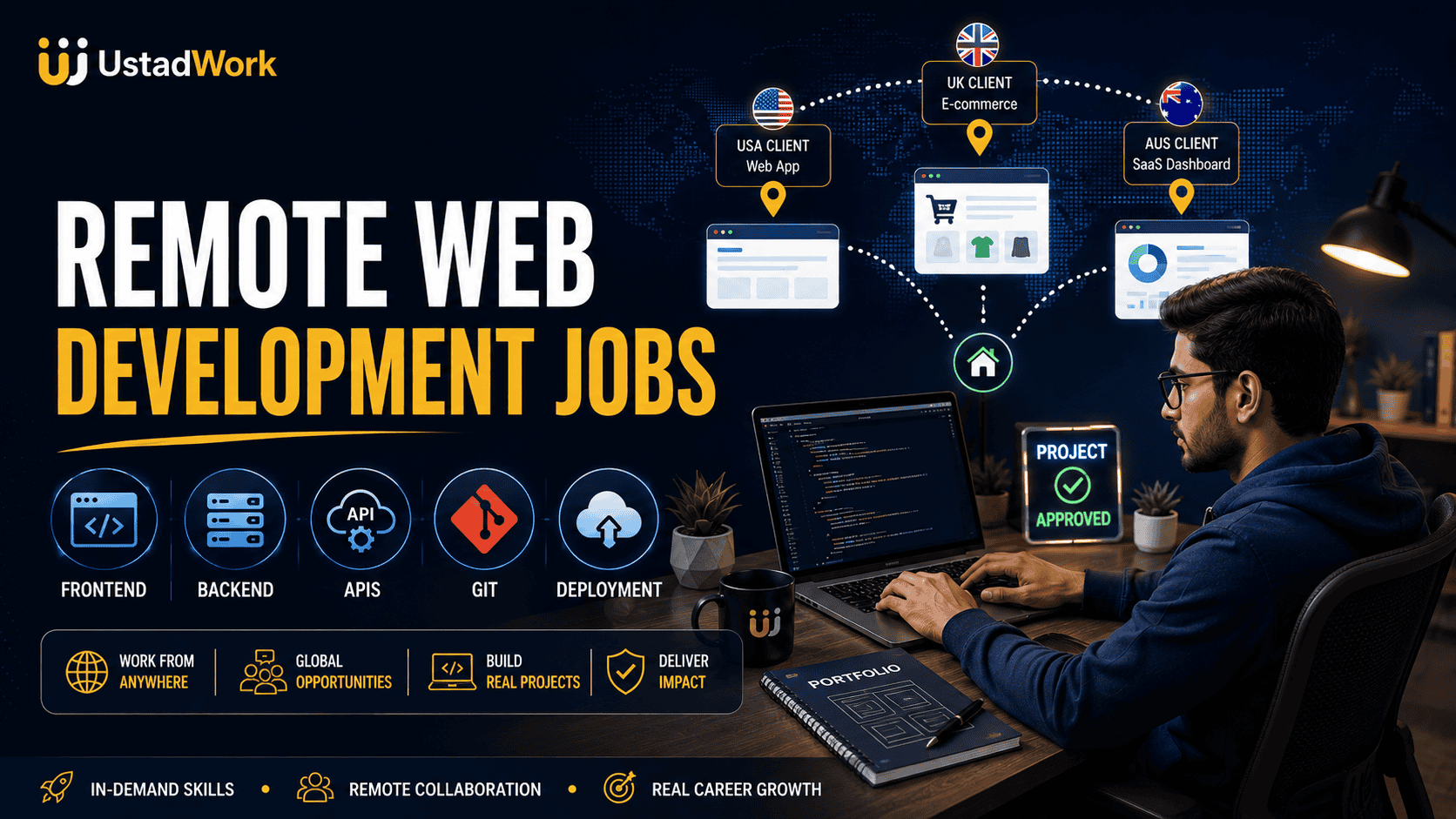
Remote Web Development Jobs and Skills That Get Noticed
Remote web development allows developers to build, improve, test, maintain, and support websites or web applications for clients and teams in different locations.
Opportunities can include short freelance fixes, complete business websites, ecommerce stores, software products, recurring maintenance, agency subcontracting, or longer remote contracts.
However, knowing how to write code is only one part of becoming competitive. Buyers also evaluate whether you understand business requirements, can work inside an existing codebase, communicate clearly, use version control, test your work, meet deadlines, and provide a dependable handoff.
This guide explains how to find and prepare for remote web development jobs, which skills receive attention, how to build convincing portfolio proof, and how to position yourself without exaggerating your experience.
You can also browse current jobs on UstadWork, explore development services, or visit the Web Development category.
Opportunities can include short freelance fixes, complete business websites, ecommerce stores, software products, recurring maintenance, agency subcontracting, or longer remote contracts.
However, knowing how to write code is only one part of becoming competitive. Buyers also evaluate whether you understand business requirements, can work inside an existing codebase, communicate clearly, use version control, test your work, meet deadlines, and provide a dependable handoff.
This guide explains how to find and prepare for remote web development jobs, which skills receive attention, how to build convincing portfolio proof, and how to position yourself without exaggerating your experience.
You can also browse current jobs on UstadWork, explore development services, or visit the Web Development category.
Quick Answer: What Helps a Remote Web Developer Stand Out?
Remote web developers stand out when they combine technical ability with visible proof and reliable working habits.
Clients commonly look for:
A clear development specialisation.
Relevant projects rather than random tutorial exercises.
Readable and maintainable code.
Responsive and accessible interfaces.
API and database understanding where relevant.
Git and collaborative-development experience.
Testing and debugging ability.
Website performance awareness.
Deployment and environment knowledge.
Clear written communication.
Realistic estimates and scope boundaries.
A professional portfolio and profile.
You do not need to claim expertise in every technology. A focused developer with three strong, relevant examples can be easier to hire than someone listing twenty tools without showing how they were used.
Clients commonly look for:
A clear development specialisation.
Relevant projects rather than random tutorial exercises.
Readable and maintainable code.
Responsive and accessible interfaces.
API and database understanding where relevant.
Git and collaborative-development experience.
Testing and debugging ability.
Website performance awareness.
Deployment and environment knowledge.
Clear written communication.
Realistic estimates and scope boundaries.
A professional portfolio and profile.
You do not need to claim expertise in every technology. A focused developer with three strong, relevant examples can be easier to hire than someone listing twenty tools without showing how they were used.
Who This Guide Is For
This guide is useful for:
Students learning web development.
Junior developers seeking their first remote project.
Frontend, backend, or full-stack developers moving into freelancing.
WordPress and Shopify specialists.
Developers returning to work after a career break.
Agency developers seeking independent clients.
Freelancers trying to improve weak profiles and proposals.
Developers adding AI, API, ecommerce, or automation services.
The guide does not promise immediate employment or income. Remote development remains competitive, and results depend on technical ability, proof, communication, market fit, availability, and consistent applications.
Students learning web development.
Junior developers seeking their first remote project.
Frontend, backend, or full-stack developers moving into freelancing.
WordPress and Shopify specialists.
Developers returning to work after a career break.
Agency developers seeking independent clients.
Freelancers trying to improve weak profiles and proposals.
Developers adding AI, API, ecommerce, or automation services.
The guide does not promise immediate employment or income. Remote development remains competitive, and results depend on technical ability, proof, communication, market fit, availability, and consistent applications.
Current Web Development Opportunity
Web development remains relevant because organisations continue to need business websites, ecommerce experiences, customer portals, internal dashboards, integrations, mobile-friendly interfaces, and ongoing maintenance.
The U.S. Bureau of Labor Statistics projects employment of web developers and digital interface designers to grow faster than the average for all occupations between 2024 and 2034. It connects continued demand partly to ecommerce growth and the need for experiences that work across different mobile screen sizes.
Remote and freelance opportunities are not identical to salaried employment figures, but the broader demand supports continued investment in practical web skills.
Official source: U.S. Bureau of Labor Statistics.
The U.S. Bureau of Labor Statistics projects employment of web developers and digital interface designers to grow faster than the average for all occupations between 2024 and 2034. It connects continued demand partly to ecommerce growth and the need for experiences that work across different mobile screen sizes.
Remote and freelance opportunities are not identical to salaried employment figures, but the broader demand supports continued investment in practical web skills.
Official source: U.S. Bureau of Labor Statistics.
Types of Remote Web Development Jobs
Remote web development includes several different roles.
Frontend developer:
Builds interfaces using HTML, CSS, JavaScript, TypeScript, and frontend frameworks.
Backend developer:
Builds APIs, authentication, databases, integrations, and server-side business logic.
Full-stack developer:
Works across both interface and server-side layers.
CMS developer:
Builds or maintains WordPress, Shopify, Webflow, or another content and commerce platform.
Ecommerce developer:
Works on product pages, checkout-related integrations, themes, collections, speed, and store operations.
Maintenance developer:
Handles bugs, updates, backups, monitoring, compatibility, and recurring improvements.
Web performance specialist:
Improves loading, responsiveness, rendering, assets, caching, and user experience.
Integration developer:
Connects websites with CRMs, payment systems, email platforms, analytics, AI services, and business APIs.
Frontend developer:
Builds interfaces using HTML, CSS, JavaScript, TypeScript, and frontend frameworks.
Backend developer:
Builds APIs, authentication, databases, integrations, and server-side business logic.
Full-stack developer:
Works across both interface and server-side layers.
CMS developer:
Builds or maintains WordPress, Shopify, Webflow, or another content and commerce platform.
Ecommerce developer:
Works on product pages, checkout-related integrations, themes, collections, speed, and store operations.
Maintenance developer:
Handles bugs, updates, backups, monitoring, compatibility, and recurring improvements.
Web performance specialist:
Improves loading, responsiveness, rendering, assets, caching, and user experience.
Integration developer:
Connects websites with CRMs, payment systems, email platforms, analytics, AI services, and business APIs.
1. HTML, CSS, and JavaScript Fundamentals
Frameworks change, but core browser technologies remain foundational.
A remote developer should understand:
Semantic HTML.
Responsive layouts.
CSS positioning and modern layout systems.
Forms and validation.
DOM events.
Asynchronous requests.
Browser debugging.
Cross-browser behaviour.
Basic accessibility.
Performance implications.
Do not hide weak fundamentals behind a long list of frameworks. A developer who can diagnose layout, browser, form, accessibility, and JavaScript problems independently is useful across many projects.
A remote developer should understand:
Semantic HTML.
Responsive layouts.
CSS positioning and modern layout systems.
Forms and validation.
DOM events.
Asynchronous requests.
Browser debugging.
Cross-browser behaviour.
Basic accessibility.
Performance implications.
Do not hide weak fundamentals behind a long list of frameworks. A developer who can diagnose layout, browser, form, accessibility, and JavaScript problems independently is useful across many projects.
2. TypeScript and Modern Frontend Development
TypeScript has become increasingly important across modern frontend and full-stack projects. GitHub’s 2025 Octoverse placed TypeScript first by contributor activity on its platform, while JavaScript continued to support a very large web ecosystem.
Useful frontend skills may include:
React.
Next.js.
Vue.
Nuxt.
Angular.
Svelte or SvelteKit.
Component architecture.
State management.
API integration.
Form handling.
Testing.
Build tools.
You do not need to learn every framework. Choose one primary framework, understand JavaScript and browser fundamentals, and create projects that demonstrate real user flows.
For framework selection, read React vs Vue for startup MVPs.
Useful frontend skills may include:
React.
Next.js.
Vue.
Nuxt.
Angular.
Svelte or SvelteKit.
Component architecture.
State management.
API integration.
Form handling.
Testing.
Build tools.
You do not need to learn every framework. Choose one primary framework, understand JavaScript and browser fundamentals, and create projects that demonstrate real user flows.
For framework selection, read React vs Vue for startup MVPs.
3. Backend and API Skills
Backend work becomes important when a project needs accounts, permissions, data storage, payments, integrations, dashboards, or custom business rules.
Possible backend stacks include:
Node.js with Express, NestJS, or another framework.
Python with Django, Flask, or FastAPI.
PHP with Laravel or WordPress.
Ruby on Rails.
Java with Spring.
C# with .NET.
Useful capabilities include:
REST or GraphQL APIs.
Authentication and authorisation.
Database queries.
Input validation.
Error handling.
Logging.
Background jobs.
Third-party integrations.
Security basics.
Automated tests.
A client is usually more interested in whether you can build a reliable workflow than in how many programming languages you list.
Possible backend stacks include:
Node.js with Express, NestJS, or another framework.
Python with Django, Flask, or FastAPI.
PHP with Laravel or WordPress.
Ruby on Rails.
Java with Spring.
C# with .NET.
Useful capabilities include:
REST or GraphQL APIs.
Authentication and authorisation.
Database queries.
Input validation.
Error handling.
Logging.
Background jobs.
Third-party integrations.
Security basics.
Automated tests.
A client is usually more interested in whether you can build a reliable workflow than in how many programming languages you list.
4. Database Knowledge
Web applications commonly depend on structured and reliable data.
Developers should understand concepts such as:
Tables and relationships.
Primary and foreign keys.
Queries and filtering.
Indexes.
Migrations.
Transactions.
Validation.
Backups.
Access permissions.
Data privacy.
Possible technologies include PostgreSQL, MySQL, SQLite, MongoDB, Firebase, and platform-specific databases.
Your portfolio should explain why a particular data structure was chosen and how you protected consistency—not only show the final interface.
Developers should understand concepts such as:
Tables and relationships.
Primary and foreign keys.
Queries and filtering.
Indexes.
Migrations.
Transactions.
Validation.
Backups.
Access permissions.
Data privacy.
Possible technologies include PostgreSQL, MySQL, SQLite, MongoDB, Firebase, and platform-specific databases.
Your portfolio should explain why a particular data structure was chosen and how you protected consistency—not only show the final interface.
5. Git and Collaborative Development
Remote teams need a reliable way to manage changes across developers.
Important Git skills include:
Creating branches.
Writing meaningful commits.
Reviewing differences.
Opening pull requests.
Resolving merge conflicts.
Using ignore files correctly.
Reverting unwanted changes.
Reading project history.
Following repository conventions.
A public GitHub profile can support your credibility, but activity alone is not proof of production experience. Pin your strongest projects, write useful README files, and keep demonstration repositories understandable.
Important Git skills include:
Creating branches.
Writing meaningful commits.
Reviewing differences.
Opening pull requests.
Resolving merge conflicts.
Using ignore files correctly.
Reverting unwanted changes.
Reading project history.
Following repository conventions.
A public GitHub profile can support your credibility, but activity alone is not proof of production experience. Pin your strongest projects, write useful README files, and keep demonstration repositories understandable.
6. Testing and Debugging
Clients value developers who can investigate problems instead of creating another patch without understanding the cause.
Useful testing experience includes:
Unit testing.
Integration testing.
End-to-end testing.
API testing.
Manual browser testing.
Mobile and responsive testing.
Regression checks.
Error reproduction.
Logging and monitoring.
When presenting a project, explain one difficult bug, how you reproduced it, what caused it, how you fixed it, and which test prevents the same problem from returning.
Useful testing experience includes:
Unit testing.
Integration testing.
End-to-end testing.
API testing.
Manual browser testing.
Mobile and responsive testing.
Regression checks.
Error reproduction.
Logging and monitoring.
When presenting a project, explain one difficult bug, how you reproduced it, what caused it, how you fixed it, and which test prevents the same problem from returning.
7. Performance and Accessibility
A website should not only look attractive. It should load efficiently, respond to interaction, and remain usable for different users and devices.
Performance skills may include:
Image optimisation.
Code splitting.
Caching.
Font loading.
Reducing unnecessary JavaScript.
Database-query improvements.
Content-delivery networks.
Core Web Vitals analysis.
Accessibility skills may include:
Semantic HTML.
Keyboard navigation.
Form labels.
Alternative text.
Colour contrast.
Focus states.
Screen-reader awareness.
MDN treats performance and accessibility as important parts of modern web-development practice.
Official references: web performance and web accessibility.
Performance skills may include:
Image optimisation.
Code splitting.
Caching.
Font loading.
Reducing unnecessary JavaScript.
Database-query improvements.
Content-delivery networks.
Core Web Vitals analysis.
Accessibility skills may include:
Semantic HTML.
Keyboard navigation.
Form labels.
Alternative text.
Colour contrast.
Focus states.
Screen-reader awareness.
MDN treats performance and accessibility as important parts of modern web-development practice.
Official references: web performance and web accessibility.
8. Deployment and Production Basics
Developers become more useful when they understand what happens after the code works locally.
Relevant skills include:
Environment variables.
Domains and DNS.
SSL certificates.
Build and deployment pipelines.
Cloud platforms.
Containers.
Application logs.
Database migrations.
Backups and rollback.
Error monitoring.
Staging and production environments.
You do not need to become a full DevOps engineer, but you should understand how your work reaches users and how to respond when a deployment fails.
Relevant skills include:
Environment variables.
Domains and DNS.
SSL certificates.
Build and deployment pipelines.
Cloud platforms.
Containers.
Application logs.
Database migrations.
Backups and rollback.
Error monitoring.
Staging and production environments.
You do not need to become a full DevOps engineer, but you should understand how your work reaches users and how to respond when a deployment fails.
9. AI and Automation Integration
Some clients now need websites that connect with AI assistants, document systems, workflow tools, chat interfaces, or automated business processes.
Useful supporting skills may include:
API integration.
Structured outputs.
Webhook handling.
Authentication.
Background processing.
Human approval steps.
Usage and cost limits.
Data protection.
Evaluation and error handling.
Do not describe yourself as an AI developer merely because you connected one chatbot. Show the business workflow, data path, safety limits, testing, and the exact part you implemented.
Developers exploring terminal-based AI workflows can read the Claude Code tutorial for beginners.
Useful supporting skills may include:
API integration.
Structured outputs.
Webhook handling.
Authentication.
Background processing.
Human approval steps.
Usage and cost limits.
Data protection.
Evaluation and error handling.
Do not describe yourself as an AI developer merely because you connected one chatbot. Show the business workflow, data path, safety limits, testing, and the exact part you implemented.
Developers exploring terminal-based AI workflows can read the Claude Code tutorial for beginners.
Choose a Focused Remote Development Niche
A broad profile such as full-stack developer available for anything can be difficult for buyers to understand.
Focused positioning examples include:
WordPress developer for local service businesses.
Shopify developer for product-page and theme improvements.
React developer for SaaS dashboards.
Python developer for APIs and internal tools.
Frontend developer for responsive landing pages.
Web performance specialist for ecommerce stores.
Maintenance developer for agency websites.
API integration developer for CRM and automation workflows.
Your niche does not permanently limit your career. It gives clients a clear reason to contact you.
Focused positioning examples include:
WordPress developer for local service businesses.
Shopify developer for product-page and theme improvements.
React developer for SaaS dashboards.
Python developer for APIs and internal tools.
Frontend developer for responsive landing pages.
Web performance specialist for ecommerce stores.
Maintenance developer for agency websites.
API integration developer for CRM and automation workflows.
Your niche does not permanently limit your career. It gives clients a clear reason to contact you.
Build Portfolio Projects That Resemble Paid Work
Tutorial projects can help you learn, but a portfolio should demonstrate independent decisions.
Create examples such as:
A service-business website with enquiry handling.
An ecommerce product and collection flow.
A role-based dashboard.
A booking system.
A small API with authentication.
A content-management interface.
A performance-improvement case study.
A third-party integration.
Include realistic states such as loading, empty results, validation errors, mobile layouts, and failed requests.
Use our freelance portfolio guide to organise your strongest work.
Create examples such as:
A service-business website with enquiry handling.
An ecommerce product and collection flow.
A role-based dashboard.
A booking system.
A small API with authentication.
A content-management interface.
A performance-improvement case study.
A third-party integration.
Include realistic states such as loading, empty results, validation errors, mobile layouts, and failed requests.
Use our freelance portfolio guide to organise your strongest work.
Turn Every Portfolio Sample Into a Case Study
A screenshot does not explain how you work.
For each important sample, include:
Problem: What user or business issue existed?
Audience: Who needed the solution?
Your role: What did you personally handle?
Stack: Which technologies were used and why?
Process: How did you plan and build the work?
Challenge: What required the most problem-solving?
Testing: How was the result checked?
Outcome: What was delivered or improved?
Limitations: What remains outside the demonstration?
Do not invent client results, traffic improvements, sales, testimonials, or business relationships.
For each important sample, include:
Problem: What user or business issue existed?
Audience: Who needed the solution?
Your role: What did you personally handle?
Stack: Which technologies were used and why?
Process: How did you plan and build the work?
Challenge: What required the most problem-solving?
Testing: How was the result checked?
Outcome: What was delivered or improved?
Limitations: What remains outside the demonstration?
Do not invent client results, traffic improvements, sales, testimonials, or business relationships.
Make Your GitHub Repositories Easier to Review
A useful project repository should help another developer understand and run the work.
Add:
A clear project description.
Feature summary.
Technology stack.
Setup instructions.
Environment-variable example.
Database and migration instructions.
Test commands.
Screenshots or a demonstration link.
Known limitations.
Licence information where appropriate.
Remove secrets, temporary files, broken links, generated clutter, and confusing commit messages before sharing the repository.
Add:
A clear project description.
Feature summary.
Technology stack.
Setup instructions.
Environment-variable example.
Database and migration instructions.
Test commands.
Screenshots or a demonstration link.
Known limitations.
Licence information where appropriate.
Remove secrets, temporary files, broken links, generated clutter, and confusing commit messages before sharing the repository.
Build a Focused Freelancer Profile
Your profile should explain the service before presenting your life story.
Recommended structure:
Headline: Main skill, target client, and useful outcome.
Opening: The problem you help solve.
Services: Specific deliverables you can complete.
Proof: Relevant projects and responsibilities.
Process: How requirements, development, testing, and handoff work.
Tools: Only the technologies supporting your offer.
CTA: What information the client should send next.
Read how to build a freelancer profile that gets hired faster.
Recommended structure:
Headline: Main skill, target client, and useful outcome.
Opening: The problem you help solve.
Services: Specific deliverables you can complete.
Proof: Relevant projects and responsibilities.
Process: How requirements, development, testing, and handoff work.
Tools: Only the technologies supporting your offer.
CTA: What information the client should send next.
Read how to build a freelancer profile that gets hired faster.
Write Proposals Around the Client's Project
Avoid proposals that begin with a long generic introduction.
A practical proposal can include:
Understanding: Restate the required result briefly.
Relevant proof: Share one comparable project.
Approach: Explain the first technical steps.
Risk: Identify an important unknown or dependency.
Question: Ask for missing information needed to scope the work.
Next step: Suggest a short discussion or first milestone.
Do not claim that you have fully understood a complex project when the brief lacks essential details.
A practical proposal can include:
Understanding: Restate the required result briefly.
Relevant proof: Share one comparable project.
Approach: Explain the first technical steps.
Risk: Identify an important unknown or dependency.
Question: Ask for missing information needed to scope the work.
Next step: Suggest a short discussion or first milestone.
Do not claim that you have fully understood a complex project when the brief lacks essential details.
Prepare for Technical Screening
A client or development team may ask you to explain existing work, review code, solve a small problem, or discuss architecture.
Prepare to explain:
Why you selected the stack.
How data moves through the application.
How authentication works.
How errors are handled.
How the project is tested.
How it is deployed.
What you would improve next.
Which part you personally completed.
A clear explanation of a modest project is more convincing than vague claims about a large system you cannot describe.
Prepare to explain:
Why you selected the stack.
How data moves through the application.
How authentication works.
How errors are handled.
How the project is tested.
How it is deployed.
What you would improve next.
Which part you personally completed.
A clear explanation of a modest project is more convincing than vague claims about a large system you cannot describe.
Use Paid Tests Carefully
A small paid test can help both sides confirm technical fit.
A good test should be:
Relevant to the real project.
Limited in time and scope.
Paid fairly.
Completed without unrestricted production access.
Reviewed using written criteria.
Separate from the complete deliverable.
Possible tests include fixing one isolated bug, implementing a small component, integrating a test API, or reviewing a limited code sample.
Avoid large unpaid tests that resemble production work.
A good test should be:
Relevant to the real project.
Limited in time and scope.
Paid fairly.
Completed without unrestricted production access.
Reviewed using written criteria.
Separate from the complete deliverable.
Possible tests include fixing one isolated bug, implementing a small component, integrating a test API, or reviewing a limited code sample.
Avoid large unpaid tests that resemble production work.
Remote Communication Skills Matter
Remote developers often work asynchronously, which makes written communication especially important.
Useful habits include:
Confirming requirements in writing.
Posting concise progress updates.
Explaining blockers early.
Separating confirmed work from assumptions.
Documenting decisions.
Using clear issue and pull-request descriptions.
Sharing demonstrations before major milestones.
Recording handoff notes.
Respecting agreed response windows and time zones.
Clients do not need constant messages. They need enough visibility to understand progress, risk, and the next decision.
Useful habits include:
Confirming requirements in writing.
Posting concise progress updates.
Explaining blockers early.
Separating confirmed work from assumptions.
Documenting decisions.
Using clear issue and pull-request descriptions.
Sharing demonstrations before major milestones.
Recording handoff notes.
Respecting agreed response windows and time zones.
Clients do not need constant messages. They need enough visibility to understand progress, risk, and the next decision.
How Much Can Remote Web Developers Charge?
Rates vary by region, platform, experience, specialisation, project complexity, urgency, communication, and the level of responsibility.
Upwork currently presents historical platform examples such as:
Entry-level work around $15–$25 per hour.
Intermediate work around $30–$50 per hour.
Specialist or experienced work potentially ranging from $50 to $200 per hour.
These are directional platform ranges, not guaranteed rates. Many projects use fixed pricing instead of hourly billing.
A higher rate normally requires stronger proof, deeper specialisation, reliable delivery, and the ability to reduce project risk.
Official reference: Upwork web-developer cost guide.
Upwork currently presents historical platform examples such as:
Entry-level work around $15–$25 per hour.
Intermediate work around $30–$50 per hour.
Specialist or experienced work potentially ranging from $50 to $200 per hour.
These are directional platform ranges, not guaranteed rates. Many projects use fixed pricing instead of hourly billing.
A higher rate normally requires stronger proof, deeper specialisation, reliable delivery, and the ability to reduce project risk.
Official reference: Upwork web-developer cost guide.
Calculate a Sustainable Freelance Rate
Your rate should cover more than coding time.
Consider:
Research and requirements.
Development.
Meetings and communication.
Testing.
Revisions.
Project management.
Software and tools.
Platform fees.
Payment costs.
Taxes and records.
Unpaid business development.
Support and maintenance.
Do not price a custom application using only the number of visible pages. Data, integrations, permissions, testing, and deployment may create more work than the interface itself.
Consider:
Research and requirements.
Development.
Meetings and communication.
Testing.
Revisions.
Project management.
Software and tools.
Platform fees.
Payment costs.
Taxes and records.
Unpaid business development.
Support and maintenance.
Do not price a custom application using only the number of visible pages. Data, integrations, permissions, testing, and deployment may create more work than the interface itself.
Where to Find Remote Web Development Work
Use several client-acquisition channels instead of relying on one website.
Possible channels include:
Freelance marketplaces.
Remote job boards.
LinkedIn.
Professional communities.
Open-source participation.
Agency subcontracting.
Referrals.
Local businesses needing remote support.
Direct outreach based on a visible problem.
Your own portfolio website.
Start by exploring jobs on UstadWork and publishing a focused web-development service.
Possible channels include:
Freelance marketplaces.
Remote job boards.
LinkedIn.
Professional communities.
Open-source participation.
Agency subcontracting.
Referrals.
Local businesses needing remote support.
Direct outreach based on a visible problem.
Your own portfolio website.
Start by exploring jobs on UstadWork and publishing a focused web-development service.
Remote Web Development Scams and Risks
Be cautious when a supposed client:
Asks you to pay before receiving work.
Requests cryptocurrency or money transfers.
Sends unknown executable files.
Requests account passwords or verification codes.
Offers unusually high payment for a simple task.
Refuses to define the project.
Asks for a large unpaid test.
Requests production credentials before an agreement exists.
Wants you to receive or forward money.
Uses another company’s identity without verification.
Use controlled access, written scope, protected payments, backups, and staged permissions.
Asks you to pay before receiving work.
Requests cryptocurrency or money transfers.
Sends unknown executable files.
Requests account passwords or verification codes.
Offers unusually high payment for a simple task.
Refuses to define the project.
Asks for a large unpaid test.
Requests production credentials before an agreement exists.
Wants you to receive or forward money.
Uses another company’s identity without verification.
Use controlled access, written scope, protected payments, backups, and staged permissions.
Common Remote Developer Mistakes
Avoid these common problems:
Learning many frameworks without completing projects.
Copying tutorials without understanding the code.
Using a generic profile for every type of job.
Sharing projects with broken demonstrations.
Ignoring mobile, accessibility, and error states.
Applying without reading the project brief.
Giving an estimate before understanding the scope.
Accepting production access without backups or controls.
Using AI-generated code without review or testing.
Disappearing when a blocker appears.
Presenting team work as entirely your own.
Learning many frameworks without completing projects.
Copying tutorials without understanding the code.
Using a generic profile for every type of job.
Sharing projects with broken demonstrations.
Ignoring mobile, accessibility, and error states.
Applying without reading the project brief.
Giving an estimate before understanding the scope.
Accepting production access without backups or controls.
Using AI-generated code without review or testing.
Disappearing when a blocker appears.
Presenting team work as entirely your own.
A 30-Day Remote Web Development Plan
Days 1–5:
Choose one development focus and review current job requirements.
Days 6–10:
Complete or improve one strong portfolio project.
Days 11–15:
Add testing, mobile behaviour, documentation, and a professional README.
Days 16–20:
Create a focused profile, case study, and service listing.
Days 21–25:
Apply selectively to relevant jobs and begin professional outreach.
Days 26–30:
Review responses, proposal performance, common client questions, and missing portfolio proof.
This plan does not guarantee employment in thirty days. It creates a stronger foundation for consistent applications.
Choose one development focus and review current job requirements.
Days 6–10:
Complete or improve one strong portfolio project.
Days 11–15:
Add testing, mobile behaviour, documentation, and a professional README.
Days 16–20:
Create a focused profile, case study, and service listing.
Days 21–25:
Apply selectively to relevant jobs and begin professional outreach.
Days 26–30:
Review responses, proposal performance, common client questions, and missing portfolio proof.
This plan does not guarantee employment in thirty days. It creates a stronger foundation for consistent applications.
Remote Web Developer Checklist
Before applying, confirm that:
Your development focus is clear.
Your core web fundamentals are reliable.
You have relevant portfolio proof.
Your projects work on mobile devices.
Your repositories are documented.
You can explain your architecture and decisions.
You understand Git collaboration.
You can test and debug your work.
You know the basic deployment process.
Your profile explains a useful service.
Your proposal addresses the actual project.
Your estimate includes testing and communication.
You can protect credentials and client information.
You have a clear remote-update process.
For further help, read how to get your first freelance client and how to create a gig that converts.
Your development focus is clear.
Your core web fundamentals are reliable.
You have relevant portfolio proof.
Your projects work on mobile devices.
Your repositories are documented.
You can explain your architecture and decisions.
You understand Git collaboration.
You can test and debug your work.
You know the basic deployment process.
Your profile explains a useful service.
Your proposal addresses the actual project.
Your estimate includes testing and communication.
You can protect credentials and client information.
You have a clear remote-update process.
For further help, read how to get your first freelance client and how to create a gig that converts.
Build Proof That Makes Remote Hiring Easier
Remote web development remains a practical career and freelance path, but clients need evidence that you can complete work without constant supervision.
Focus on one useful service, strengthen your technical fundamentals, create realistic projects, explain your decisions, test your work, and communicate progress clearly.
The strongest candidate for remote web development jobs is not always the developer listing the greatest number of technologies. It is often the person who presents relevant proof, asks useful questions, understands project risk, and delivers work that another person can review and maintain.
Explore Web Development services, browse available jobs, or publish your own development service on UstadWork.
Focus on one useful service, strengthen your technical fundamentals, create realistic projects, explain your decisions, test your work, and communicate progress clearly.
The strongest candidate for remote web development jobs is not always the developer listing the greatest number of technologies. It is often the person who presents relevant proof, asks useful questions, understands project risk, and delivers work that another person can review and maintain.
Explore Web Development services, browse available jobs, or publish your own development service on UstadWork.
Frequently asked questions
What skills are required for remote web development jobs?
Common skills include HTML, CSS, JavaScript or TypeScript, a frontend or backend framework, APIs, databases, Git, debugging, testing, responsive design, performance, accessibility, and basic deployment knowledge.
Can a beginner get a remote web development job?
A beginner can compete for suitable junior or small freelance projects by developing strong fundamentals, completing realistic portfolio projects, documenting their work, and applying selectively.
Which web development skill is most valuable?
The most valuable skill depends on the target work. Strong fundamentals combined with a focused specialisation such as React, WordPress, Shopify, Python APIs, ecommerce, or performance can create clearer positioning.
Do remote web developers need a degree?
Requirements differ by client and employer. Some roles require formal education, while others evaluate practical skills, portfolio evidence, experience, testing ability, and communication.
How much do freelance web developers charge?
Rates vary by location, experience, specialisation, platform, project complexity, and responsibility. Marketplace examples may range from entry-level rates around $15–$25 per hour to much higher specialist rates.
How can I get my first remote web development client?
Choose one focused service, create two or three relevant projects, improve your profile, write personalised proposals, use professional outreach, and ask existing contacts for referrals.