How to Hire a Legal Freelancer in 2026
Hire a legal freelancer with verified licensing, relevant experience, clear scope, confidentiality, and written fees.
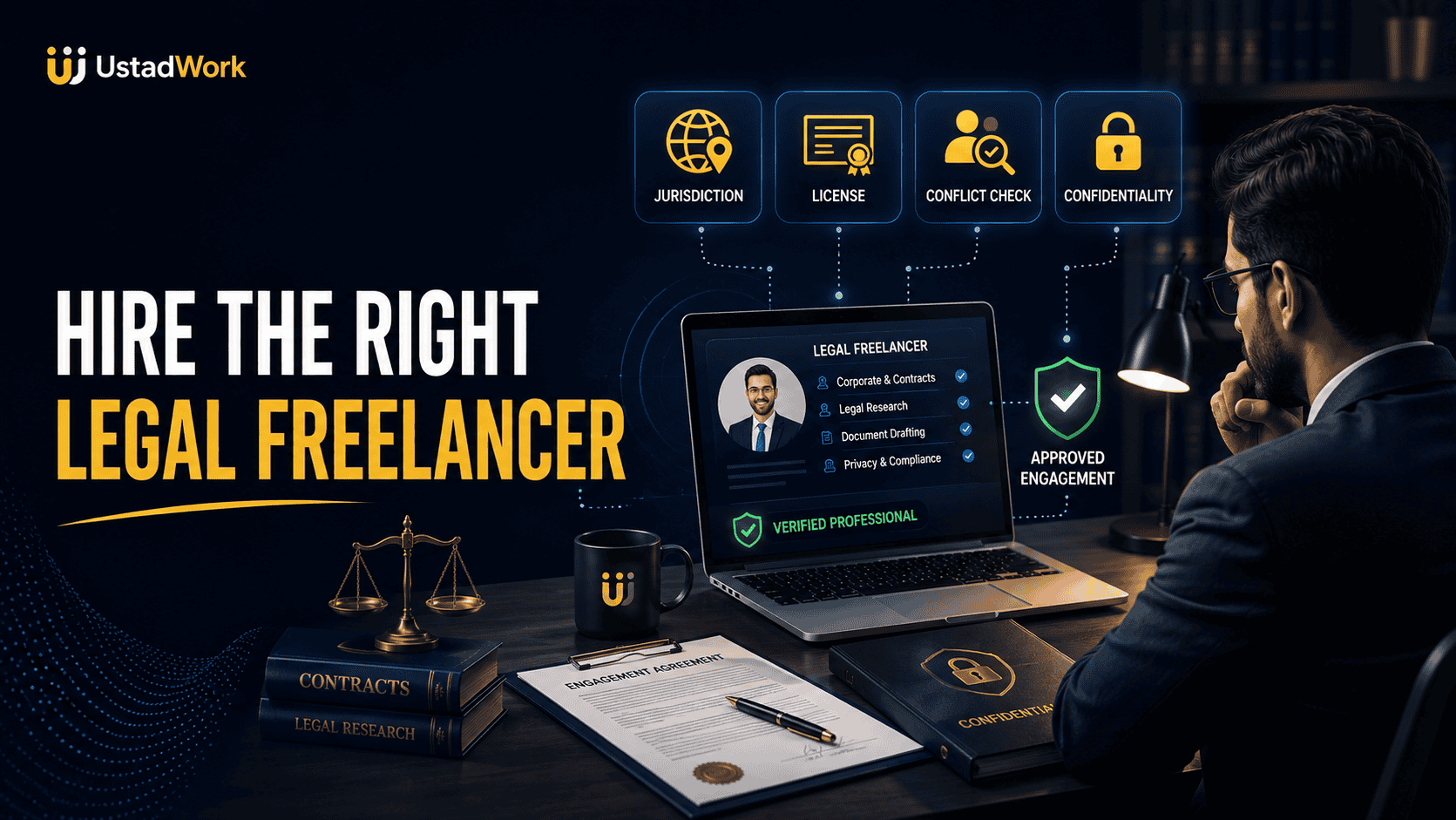
How to Hire a Legal Freelancer in 2026
A legal freelancer may help with contract drafting, legal research, document review, compliance projects, policy writing, due diligence, intellectual-property support, litigation assistance, or ongoing legal operations.
However, legal work is regulated and jurisdiction-specific. A professional who can research or format a document may not be authorized to independently advise you about your rights, represent you, or apply the law of a particular state or country.
This guide explains how to hire a legal freelancer by identifying the correct professional, verifying credentials, defining jurisdiction, protecting confidential information, checking conflicts, comparing fees, and documenting the engagement. When your brief is ready, you can post a legal-services project on UstadWork or browse available professional services.
However, legal work is regulated and jurisdiction-specific. A professional who can research or format a document may not be authorized to independently advise you about your rights, represent you, or apply the law of a particular state or country.
This guide explains how to hire a legal freelancer by identifying the correct professional, verifying credentials, defining jurisdiction, protecting confidential information, checking conflicts, comparing fees, and documenting the engagement. When your brief is ready, you can post a legal-services project on UstadWork or browse available professional services.
Important Legal Disclaimer
This guide provides general hiring and project-management information. It is not legal advice and does not create a lawyer-client relationship.
Licensing, privilege, confidentiality, fee rules, advertising rules, supervision requirements, and permitted services vary by jurisdiction. Consult an appropriately licensed lawyer or relevant professional regulator when your matter involves legal rights, court proceedings, regulatory deadlines, disputes, confidential client information, or significant financial consequences.
Licensing, privilege, confidentiality, fee rules, advertising rules, supervision requirements, and permitted services vary by jurisdiction. Consult an appropriately licensed lawyer or relevant professional regulator when your matter involves legal rights, court proceedings, regulatory deadlines, disputes, confidential client information, or significant financial consequences.
Quick Answer: What Should You Verify Before Hiring?
Before engaging a legal freelancer, confirm:
The exact service: Legal advice, drafting, research, review, filing support, writing, or administration.
The jurisdiction: Which country, state, province, court, agency, or regulatory system applies.
Professional authorization: Whether the person must be a licensed lawyer for the work requested.
Relevant experience: Similar practice area, document, industry, and matter type.
Conflict status: Whether the freelancer has worked for an adverse or related party.
Confidentiality: How information, files, communications, and credentials will be protected.
Scope and fees: Deliverables, exclusions, timing, revisions, expenses, and billing method.
Review responsibility: Who provides final legal approval and remains accountable for the work.
The exact service: Legal advice, drafting, research, review, filing support, writing, or administration.
The jurisdiction: Which country, state, province, court, agency, or regulatory system applies.
Professional authorization: Whether the person must be a licensed lawyer for the work requested.
Relevant experience: Similar practice area, document, industry, and matter type.
Conflict status: Whether the freelancer has worked for an adverse or related party.
Confidentiality: How information, files, communications, and credentials will be protected.
Scope and fees: Deliverables, exclusions, timing, revisions, expenses, and billing method.
Review responsibility: Who provides final legal approval and remains accountable for the work.
Understand the Different Types of Legal Freelancers
The term legal freelancer can describe several different professionals. They should not be treated as interchangeable.
Freelance lawyer or contract attorney:
A licensed lawyer providing project-based legal services. Their authority depends on licensing, jurisdiction, matter type, and applicable professional rules.
Paralegal or legal assistant:
A nonlawyer who may support research, document organisation, discovery, filings, case management, and drafting under appropriate lawyer supervision. They generally cannot independently provide legal advice or represent themselves as lawyers.
Legal researcher:
A professional who researches statutes, cases, regulations, or legal questions. Confirm whether lawyer supervision and specific database access are required.
Legal writer:
A writer producing legal articles, summaries, educational content, case descriptions, or marketing material. Legal-content experience does not automatically authorize the writer to advise a client.
Compliance specialist:
A professional supporting policies, controls, records, audits, or implementation. Their work may still require licensed counsel review depending on the subject and jurisdiction.
Freelance lawyer or contract attorney:
A licensed lawyer providing project-based legal services. Their authority depends on licensing, jurisdiction, matter type, and applicable professional rules.
Paralegal or legal assistant:
A nonlawyer who may support research, document organisation, discovery, filings, case management, and drafting under appropriate lawyer supervision. They generally cannot independently provide legal advice or represent themselves as lawyers.
Legal researcher:
A professional who researches statutes, cases, regulations, or legal questions. Confirm whether lawyer supervision and specific database access are required.
Legal writer:
A writer producing legal articles, summaries, educational content, case descriptions, or marketing material. Legal-content experience does not automatically authorize the writer to advise a client.
Compliance specialist:
A professional supporting policies, controls, records, audits, or implementation. Their work may still require licensed counsel review depending on the subject and jurisdiction.
Step 1: Define the Exact Legal Outcome
Do not post a vague requirement such as need a legal expert. Explain what must be delivered and what decision or process it supports.
Examples include:
A lawyer-reviewed independent-contractor agreement governed by California law.
A research memorandum covering a defined federal regulatory question.
A redline and risk summary for a SaaS vendor contract.
A trademark search and filing strategy for a U.S. brand.
A document-review project following instructions from supervising counsel.
A privacy-policy content draft for later review by licensed counsel.
A focused outcome helps candidates determine whether they are authorized, qualified, available, and able to quote accurately.
Examples include:
A lawyer-reviewed independent-contractor agreement governed by California law.
A research memorandum covering a defined federal regulatory question.
A redline and risk summary for a SaaS vendor contract.
A trademark search and filing strategy for a U.S. brand.
A document-review project following instructions from supervising counsel.
A privacy-policy content draft for later review by licensed counsel.
A focused outcome helps candidates determine whether they are authorized, qualified, available, and able to quote accurately.
Step 2: Identify the Jurisdiction
Legal work often depends on the law governing the transaction, dispute, business, property, employment relationship, or regulated activity.
Your brief should identify where relevant:
Country.
State or province.
Applicable federal law.
Court or tribunal.
Regulatory authority.
Location of the parties.
Governing-law clause.
Location where representation or filing is required.
A lawyer licensed in one jurisdiction may not automatically be authorized to advise on another jurisdiction's law. Confirm this before sharing the substantive matter or paying for legal advice.
Your brief should identify where relevant:
Country.
State or province.
Applicable federal law.
Court or tribunal.
Regulatory authority.
Location of the parties.
Governing-law clause.
Location where representation or filing is required.
A lawyer licensed in one jurisdiction may not automatically be authorized to advise on another jurisdiction's law. Confirm this before sharing the substantive matter or paying for legal advice.
Step 3: Decide Whether the Work Requires a Licensed Lawyer
Use a properly licensed lawyer when the project requires legal advice, professional judgment about rights or obligations, representation, negotiation on your behalf, court or agency work, or jurisdiction-specific interpretation.
Some research, administration, document formatting, case summarisation, filing preparation, or legal marketing work may be delegated to nonlawyers under appropriate conditions. However, the permitted boundary depends on the jurisdiction and whether a supervising attorney is involved.
Do not ask a paralegal, writer, consultant, or general freelancer to act as your attorney when they are not authorized to do so.
Some research, administration, document formatting, case summarisation, filing preparation, or legal marketing work may be delegated to nonlawyers under appropriate conditions. However, the permitted boundary depends on the jurisdiction and whether a supervising attorney is involved.
Do not ask a paralegal, writer, consultant, or general freelancer to act as your attorney when they are not authorized to do so.
Step 4: Verify Licensing and Professional Standing
Do not rely only on a marketplace profile, title, uploaded certificate, or statement that the person has a law degree.
For a lawyer, verify:
Full professional name.
Licensing jurisdiction.
Bar or registration number.
Current authorization or active status.
Public disciplinary history where available.
Practice-area experience.
Any limitations on the work they can perform.
Use the relevant official state bar, court, law society, professional body, or government directory. Confirm that the identity and contact details match the person you are hiring.
For a lawyer, verify:
Full professional name.
Licensing jurisdiction.
Bar or registration number.
Current authorization or active status.
Public disciplinary history where available.
Practice-area experience.
Any limitations on the work they can perform.
Use the relevant official state bar, court, law society, professional body, or government directory. Confirm that the identity and contact details match the person you are hiring.
Step 5: Review Relevant Practice-Area Experience
A lawyer who handles family matters may not be the right person for securities compliance, software licensing, immigration, employment agreements, trademarks, or complex commercial litigation.
Ask candidates about:
Matters similar to yours.
The jurisdiction involved.
The type and complexity of documents.
The industries they understand.
Their role in previous projects.
Issues they commonly identify.
The review or approval process they use.
Whether another specialist may be required.
Relevant, recent work normally provides stronger evidence than broad claims such as experienced in all areas of law.
Ask candidates about:
Matters similar to yours.
The jurisdiction involved.
The type and complexity of documents.
The industries they understand.
Their role in previous projects.
Issues they commonly identify.
The review or approval process they use.
Whether another specialist may be required.
Relevant, recent work normally provides stronger evidence than broad claims such as experienced in all areas of law.
Step 6: Request Appropriate Work Samples
Request redacted or anonymized examples when professional and confidentiality rules permit them.
Useful samples may include:
A redacted contract or clause set.
A legal-research memorandum.
A due-diligence checklist.
A policy or compliance framework.
A legal article with accurate citations.
A document-review protocol.
A risk-summary format.
Ask what the candidate personally completed. A sample produced by a team does not prove that the individual handled the analysis, drafting, negotiation, or final review.
Useful samples may include:
A redacted contract or clause set.
A legal-research memorandum.
A due-diligence checklist.
A policy or compliance framework.
A legal article with accurate citations.
A document-review protocol.
A risk-summary format.
Ask what the candidate personally completed. A sample produced by a team does not prove that the individual handled the analysis, drafting, negotiation, or final review.
Step 7: Complete a Conflict Check
Before sharing detailed confidential information, provide enough party names and matter information for an appropriate conflict review.
The check may need to cover:
Clients and former clients.
Opposing parties.
Affiliated businesses.
Key executives or witnesses.
Law firms and insurers.
Related transactions or disputes.
Ask the freelancer to confirm the result in writing. If a law firm is outsourcing work, its internal conflict and supervision procedures should apply to the external professional as well.
The check may need to cover:
Clients and former clients.
Opposing parties.
Affiliated businesses.
Key executives or witnesses.
Law firms and insurers.
Related transactions or disputes.
Ask the freelancer to confirm the result in writing. If a law firm is outsourcing work, its internal conflict and supervision procedures should apply to the external professional as well.
Step 8: Protect Confidential and Privileged Information
Legal projects may involve commercially sensitive information, customer records, employee data, contracts, negotiations, litigation strategy, trade secrets, financial records, or personal information.
Before providing access, confirm:
Confidentiality obligations.
Approved communication channels.
Secure file storage and transfer.
Device and account security.
Multifactor authentication.
Who else can access the files.
Whether subcontractors are permitted.
Data location and retention.
Deletion and return requirements.
Incident-reporting procedures.
Share only the information necessary for the assigned task, and obtain qualified advice on preserving privilege where that protection matters.
Before providing access, confirm:
Confidentiality obligations.
Approved communication channels.
Secure file storage and transfer.
Device and account security.
Multifactor authentication.
Who else can access the files.
Whether subcontractors are permitted.
Data location and retention.
Deletion and return requirements.
Incident-reporting procedures.
Share only the information necessary for the assigned task, and obtain qualified advice on preserving privilege where that protection matters.
Step 9: Ask About AI and External Tools
Legal professionals increasingly use research platforms, contract-review systems, transcription tools, generative AI, cloud storage, and other external services.
Ask candidates:
Will any client information be entered into an AI system?
Which legal-research or document-review tools will be used?
Can the provider retain or train on submitted information?
Will subcontractors or external vendors access the matter?
How will AI-generated research or drafting be verified?
Can the project be completed without specific external tools if required?
Do not assume that automated legal text is correct, current, confidential, or suitable for your jurisdiction. Important work requires professional verification.
Ask candidates:
Will any client information be entered into an AI system?
Which legal-research or document-review tools will be used?
Can the provider retain or train on submitted information?
Will subcontractors or external vendors access the matter?
How will AI-generated research or drafting be verified?
Can the project be completed without specific external tools if required?
Do not assume that automated legal text is correct, current, confidential, or suitable for your jurisdiction. Important work requires professional verification.
Step 10: Write a Clear Legal Project Brief
A strong brief should include:
Background: Explain the business, transaction, dispute, or legal question without sharing unnecessary sensitive details publicly.
Jurisdiction: Identify the applicable country, state, court, agency, or governing law.
Deliverable: Contract, memorandum, review, filing support, policy, checklist, research, or another defined output.
Scope: State what is included and excluded.
Source materials: Identify documents and information available after conflict clearance.
Deadline: Include any court, filing, closing, response, or business date.
Review process: Explain who will approve the work.
Fee structure: Fixed fee, hourly billing, capped hours, or milestone-based arrangement.
Confidentiality: State security and access expectations.
Use our freelance project brief guide to organise the initial scope.
Background: Explain the business, transaction, dispute, or legal question without sharing unnecessary sensitive details publicly.
Jurisdiction: Identify the applicable country, state, court, agency, or governing law.
Deliverable: Contract, memorandum, review, filing support, policy, checklist, research, or another defined output.
Scope: State what is included and excluded.
Source materials: Identify documents and information available after conflict clearance.
Deadline: Include any court, filing, closing, response, or business date.
Review process: Explain who will approve the work.
Fee structure: Fixed fee, hourly billing, capped hours, or milestone-based arrangement.
Confidentiality: State security and access expectations.
Use our freelance project brief guide to organise the initial scope.
Questions to Ask During the Interview
Ask shortlisted candidates:
Where are you licensed, and is your status currently active?
Are you authorized to handle this jurisdiction and matter type?
What similar work have you completed recently?
What information do you need for a conflict check?
Which legal issues do you expect this project may involve?
What is included and excluded from your proposed scope?
Will another lawyer, paralegal, vendor, or AI tool assist with the work?
How will confidential information be protected?
What requires client or supervising-lawyer approval?
How are revisions and scope changes billed?
What final files, notes, citations, or documentation will be delivered?
A strong candidate should ask detailed questions rather than immediately promising a standard solution.
Where are you licensed, and is your status currently active?
Are you authorized to handle this jurisdiction and matter type?
What similar work have you completed recently?
What information do you need for a conflict check?
Which legal issues do you expect this project may involve?
What is included and excluded from your proposed scope?
Will another lawyer, paralegal, vendor, or AI tool assist with the work?
How will confidential information be protected?
What requires client or supervising-lawyer approval?
How are revisions and scope changes billed?
What final files, notes, citations, or documentation will be delivered?
A strong candidate should ask detailed questions rather than immediately promising a standard solution.
Compare Candidates With a Scorecard
Score candidates from 1 to 5 across consistent criteria:
Correct licensing and jurisdiction.
Relevant practice-area experience.
Quality of similar work.
Understanding of the matter.
Conflict-check process.
Confidentiality and security controls.
Communication clarity.
Scope and fee transparency.
Use of technology and AI.
Availability and deadline fit.
Supervision and review process.
Handoff quality.
Jurisdiction, authorization, conflicts, and confidentiality should normally be treated as mandatory requirements rather than optional scoring advantages.
Correct licensing and jurisdiction.
Relevant practice-area experience.
Quality of similar work.
Understanding of the matter.
Conflict-check process.
Confidentiality and security controls.
Communication clarity.
Scope and fee transparency.
Use of technology and AI.
Availability and deadline fit.
Supervision and review process.
Handoff quality.
Jurisdiction, authorization, conflicts, and confidentiality should normally be treated as mandatory requirements rather than optional scoring advantages.
Understand Legal Pricing Models
Legal freelancers may use several billing structures.
Hourly billing:
Useful when the amount of research, negotiation, correspondence, or revision cannot be predicted accurately. Request an estimated range and maximum authorization level.
Fixed fee:
Useful for a clearly defined contract, memorandum, filing, review, or consultation. Confirm exactly what the amount covers.
Milestone pricing:
Useful for larger projects such as research, first draft, revision, negotiation support, and final handoff.
Retainer:
Useful for recurring legal support. Clarify whether it is an advance against hourly work, a recurring availability arrangement, or another structure.
Contingency fee:
Available only for certain matters and subject to jurisdiction-specific restrictions and written-agreement requirements.
Ask separately about filing fees, database charges, expert costs, travel, taxes, third-party vendors, and other expenses.
Hourly billing:
Useful when the amount of research, negotiation, correspondence, or revision cannot be predicted accurately. Request an estimated range and maximum authorization level.
Fixed fee:
Useful for a clearly defined contract, memorandum, filing, review, or consultation. Confirm exactly what the amount covers.
Milestone pricing:
Useful for larger projects such as research, first draft, revision, negotiation support, and final handoff.
Retainer:
Useful for recurring legal support. Clarify whether it is an advance against hourly work, a recurring availability arrangement, or another structure.
Contingency fee:
Available only for certain matters and subject to jurisdiction-specific restrictions and written-agreement requirements.
Ask separately about filing fees, database charges, expert costs, travel, taxes, third-party vendors, and other expenses.
Use a Written Engagement Agreement
The engagement should clearly document:
Client and professional identities.
Jurisdiction and matter description.
Exact scope of services.
Excluded services.
Fee basis and payment timing.
Expenses and approval limits.
Deadlines and client responsibilities.
Communication and response expectations.
Confidentiality and data security.
Conflict disclosures.
Use of subcontractors and technology.
Ownership and permitted use of deliverables.
Termination rights.
File return, retention, and deletion.
Dispute and governing-law provisions where appropriate.
Do not begin significant legal work based only on informal chat messages.
Client and professional identities.
Jurisdiction and matter description.
Exact scope of services.
Excluded services.
Fee basis and payment timing.
Expenses and approval limits.
Deadlines and client responsibilities.
Communication and response expectations.
Confidentiality and data security.
Conflict disclosures.
Use of subcontractors and technology.
Ownership and permitted use of deliverables.
Termination rights.
File return, retention, and deletion.
Dispute and governing-law provisions where appropriate.
Do not begin significant legal work based only on informal chat messages.
Supervision When Law Firms Outsource Legal Work
A law firm outsourcing work should assign a supervising lawyer who remains responsible for the client matter and reviews the external professional's work.
The supervising lawyer may need to address:
Competence and instructions.
Conflict screening.
Client communication or consent.
Confidentiality safeguards.
Unauthorized-practice boundaries.
Reasonableness and disclosure of fees.
Quality review.
Final legal judgment.
The external freelancer should understand that approval authority remains with the responsible lawyer unless the engagement lawfully provides otherwise.
The supervising lawyer may need to address:
Competence and instructions.
Conflict screening.
Client communication or consent.
Confidentiality safeguards.
Unauthorized-practice boundaries.
Reasonableness and disclosure of fees.
Quality review.
Final legal judgment.
The external freelancer should understand that approval authority remains with the responsible lawyer unless the engagement lawfully provides otherwise.
Use Milestones and Review Checkpoints
Divide larger legal projects into reviewable stages.
Example milestones:
1. Conflict and scope confirmation
2. Document collection and issue list
3. Research or initial review
4. First draft or redline
5. Client or supervising-lawyer feedback
6. Final document and supporting notes
7. Secure file return and project closure
Each milestone should state the deliverable, reviewer, deadline, included revisions, and criteria for approval.
Example milestones:
1. Conflict and scope confirmation
2. Document collection and issue list
3. Research or initial review
4. First draft or redline
5. Client or supervising-lawyer feedback
6. Final document and supporting notes
7. Secure file return and project closure
Each milestone should state the deliverable, reviewer, deadline, included revisions, and criteria for approval.
Legal Freelancer Red Flags
Be cautious when a candidate:
Refuses to identify their licensing jurisdiction.
Claims they can practise law everywhere.
Uses lawyer or attorney titles without verifiable authorization.
Provides advice before understanding the jurisdiction and facts.
Promises guaranteed legal outcomes.
Will not perform a conflict check.
Requests sensitive documents through unsecured channels.
Cannot explain how client information is protected.
Uses another professional's samples or credentials.
Offers copied contracts as universally valid.
Refuses to document scope and fees.
Cannot explain whether AI or subcontractors will be used.
Stop the engagement when authorization, identity, conflicts, or confidentiality cannot be verified.
Refuses to identify their licensing jurisdiction.
Claims they can practise law everywhere.
Uses lawyer or attorney titles without verifiable authorization.
Provides advice before understanding the jurisdiction and facts.
Promises guaranteed legal outcomes.
Will not perform a conflict check.
Requests sensitive documents through unsecured channels.
Cannot explain how client information is protected.
Uses another professional's samples or credentials.
Offers copied contracts as universally valid.
Refuses to document scope and fees.
Cannot explain whether AI or subcontractors will be used.
Stop the engagement when authorization, identity, conflicts, or confidentiality cannot be verified.
Copy-and-Paste Legal Freelancer Job Template
Project Title:
Licensed [practice area] lawyer needed for [specific deliverable].
Background:
Briefly explain the business or matter without publishing confidential details.
Jurisdiction:
State the country, state, court, agency, or governing law.
Required Professional:
Licensed attorney, supervised paralegal, legal researcher, legal writer, or compliance specialist.
Deliverables:
List the exact document, review, memorandum, filing support, research, or consultation required.
Experience:
State the practice area, industry, and comparable work expected.
Deadline:
Include any fixed legal or business date.
Security:
State confidentiality, file-transfer, subcontractor, and AI-tool requirements.
Proposal Requirements:
Ask for licensing information, relevant experience, proposed approach, scope, timeline, fee structure, and conflict-check process.
Important:
Do not include confidential facts or privileged documents in the public job post.
Licensed [practice area] lawyer needed for [specific deliverable].
Background:
Briefly explain the business or matter without publishing confidential details.
Jurisdiction:
State the country, state, court, agency, or governing law.
Required Professional:
Licensed attorney, supervised paralegal, legal researcher, legal writer, or compliance specialist.
Deliverables:
List the exact document, review, memorandum, filing support, research, or consultation required.
Experience:
State the practice area, industry, and comparable work expected.
Deadline:
Include any fixed legal or business date.
Security:
State confidentiality, file-transfer, subcontractor, and AI-tool requirements.
Proposal Requirements:
Ask for licensing information, relevant experience, proposed approach, scope, timeline, fee structure, and conflict-check process.
Important:
Do not include confidential facts or privileged documents in the public job post.
Legal Freelancer Hiring Checklist
Before hiring, confirm that:
The service and deliverable are clearly defined.
The jurisdiction is identified.
You know whether a licensed lawyer is required.
Professional identity and current status are verified.
Practice-area experience matches the matter.
A conflict check has been completed.
Confidentiality and security requirements are documented.
Use of AI, vendors, and subcontractors is disclosed.
Fees, expenses, revisions, and limits are written.
A responsible legal reviewer is assigned where required.
Milestones and approval criteria are clear.
Files and access can be securely returned or deleted.
When ready, post your legal project on UstadWork, browse professional services, or review the UstadWork FAQ.
The service and deliverable are clearly defined.
The jurisdiction is identified.
You know whether a licensed lawyer is required.
Professional identity and current status are verified.
Practice-area experience matches the matter.
A conflict check has been completed.
Confidentiality and security requirements are documented.
Use of AI, vendors, and subcontractors is disclosed.
Fees, expenses, revisions, and limits are written.
A responsible legal reviewer is assigned where required.
Milestones and approval criteria are clear.
Files and access can be securely returned or deleted.
When ready, post your legal project on UstadWork, browse professional services, or review the UstadWork FAQ.
Hire for the Right Jurisdiction, Experience, and Responsibility
The best legal freelancer is not simply the lowest-priced candidate or the person with the most polished profile. They must be properly authorized for the work, experienced in the relevant subject, free from disqualifying conflicts, and able to protect sensitive information.
Define the outcome before hiring, verify credentials independently, document fees and scope, and use professional review for every important legal conclusion or deliverable.
For additional help, read our general freelancer hiring guide, learn how to write a stronger job post, or review the marketplace payment process.
Define the outcome before hiring, verify credentials independently, document fees and scope, and use professional review for every important legal conclusion or deliverable.
For additional help, read our general freelancer hiring guide, learn how to write a stronger job post, or review the marketplace payment process.
Frequently asked questions
What is a legal freelancer?
A legal freelancer may be a project-based lawyer, contract attorney, supervised paralegal, legal researcher, legal writer, document reviewer, or compliance specialist. Their permitted services depend on licensing, supervision, jurisdiction, and the type of work.
Does a legal freelancer need to be a licensed lawyer?
A licensed lawyer is generally required when the work involves legal advice, representation, professional legal judgment, or jurisdiction-specific interpretation. Some support, research, administrative, or writing tasks may be completed by nonlawyers under applicable rules and supervision.
How do I verify a freelance lawyer?
Confirm their full name, jurisdiction, bar or registration number, current status, disciplinary record where available, and authority to handle the relevant matter through the official professional regulator.
What should a legal project brief include?
Include the matter type, jurisdiction, deliverables, exclusions, background, available documents, deadline, approval process, confidentiality requirements, and preferred billing structure.
How are legal freelancers paid?
Legal freelancers may charge hourly, fixed, by milestone, or through a recurring retainer. Some matters may allow contingency fees, subject to applicable legal and professional restrictions.
Can a legal freelancer use AI on my matter?
The engagement should state whether AI or external tools may be used, what information may be entered, how outputs will be verified, and how confidentiality, retention, and third-party access will be controlled.