Programmatic SEO With AI Freelancers: How to Scale Without Spam
Build programmatic SEO pages with AI, human QA, and safer scaling.
Programmatic SEO With AI Freelancers: How to Scale Without Spam
Programmatic SEO uses a repeatable page structure and reliable data to create useful pages for many related search intents. AI can help researchers, writers, developers, and quality-assurance freelancers complete parts of this process faster, but automation should not replace strategy or human judgement.
The goal is not to publish thousands of pages because a spreadsheet contains thousands of keyword combinations. The goal is to identify a genuinely useful page pattern, create a strong content model, add unique value to every page, and launch only the pages that deserve to exist.
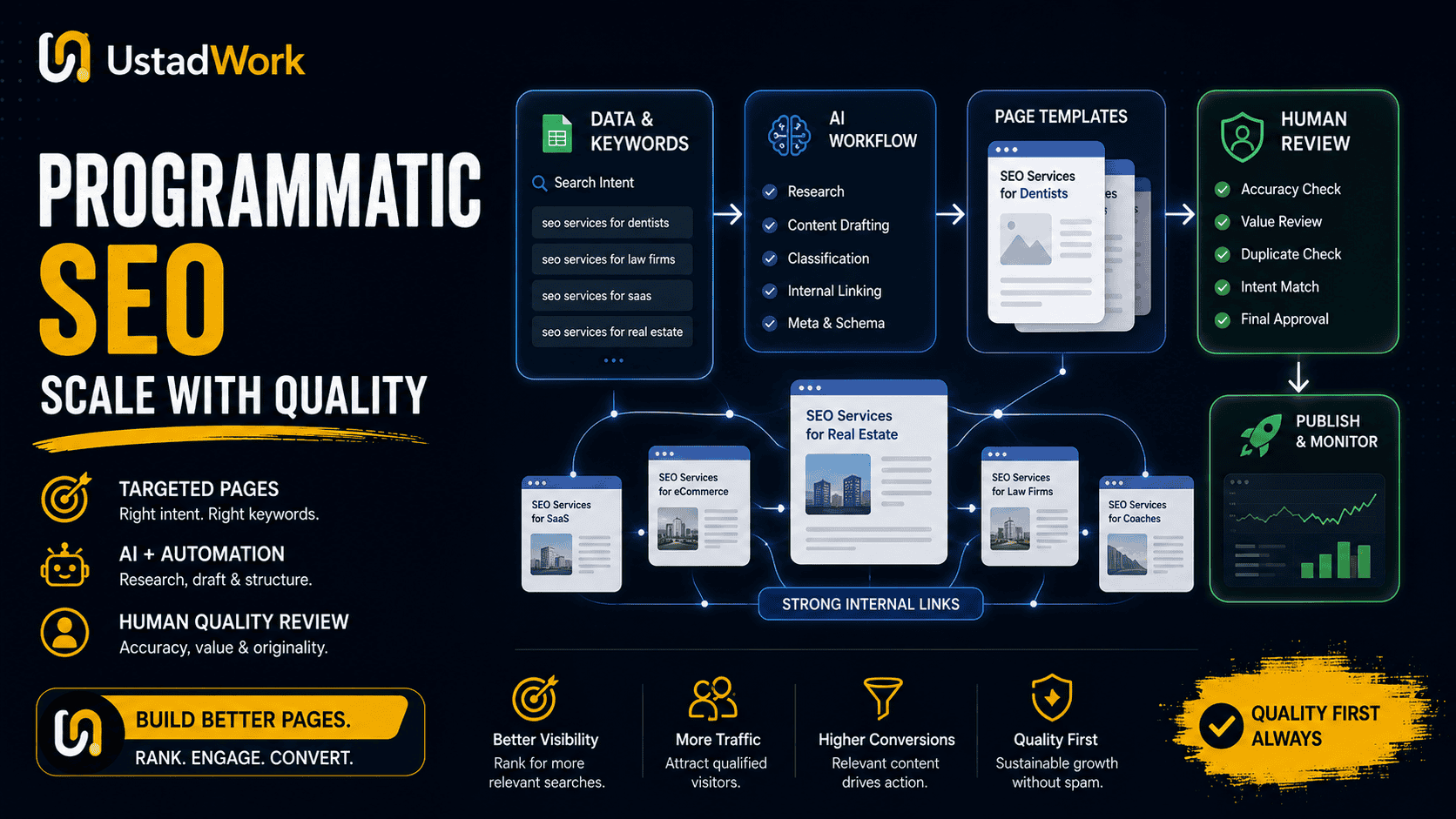
A safe programmatic SEO with AI workflow combines search-intent research, structured data, page templates, original information, editorial review, technical controls, internal linking, and performance monitoring. When your project scope is ready, you can post a programmatic SEO project on UstadWork or browse SEO and automation services.
The goal is not to publish thousands of pages because a spreadsheet contains thousands of keyword combinations. The goal is to identify a genuinely useful page pattern, create a strong content model, add unique value to every page, and launch only the pages that deserve to exist.
A safe programmatic SEO with AI workflow combines search-intent research, structured data, page templates, original information, editorial review, technical controls, internal linking, and performance monitoring. When your project scope is ready, you can post a programmatic SEO project on UstadWork or browse SEO and automation services.
Quick Answer: Can AI Be Used for Programmatic SEO?
Yes, AI can support programmatic SEO when it improves research, organisation, drafting, classification, quality checks, or content maintenance. It becomes risky when AI is used to produce large numbers of pages with little original value, weak fact checking, or only small keyword substitutions.
A safer model is:
Human strategy: Choose the market, page type, user intent, and quality standard.
Reliable data: Use approved internal, public, licensed, or researched data.
Structured template: Define required page sections and conditional content.
AI assistance: Summarise, classify, draft, compare, and identify missing information.
Human review: Check accuracy, usefulness, tone, duplication, and search intent.
Controlled launch: Publish small batches, measure performance, and improve the model before scaling.
AI should help the team create better pages. It should not be used only to make more pages.
A safer model is:
Human strategy: Choose the market, page type, user intent, and quality standard.
Reliable data: Use approved internal, public, licensed, or researched data.
Structured template: Define required page sections and conditional content.
AI assistance: Summarise, classify, draft, compare, and identify missing information.
Human review: Check accuracy, usefulness, tone, duplication, and search intent.
Controlled launch: Publish small batches, measure performance, and improve the model before scaling.
AI should help the team create better pages. It should not be used only to make more pages.
What Programmatic SEO Actually Means
Programmatic SEO is a method for creating pages from a repeatable content and data model. Each page targets a distinct user need while following a shared structure.
Common examples include:
Marketplace category pages: Services organised by skill, platform, industry, or use case.
Integration pages: How one software product connects with another.
Location and service pages: Useful local service information supported by genuine market details.
Comparison pages: Structured comparisons for different tools, plans, or solutions.
Template libraries: Templates created for distinct roles, industries, or workflows.
Directories: Useful listings supported by filters, data, reviews, or expert information.
The common structure makes production more efficient. The unique data, intent, examples, and usefulness make each page worth indexing.
Common examples include:
Marketplace category pages: Services organised by skill, platform, industry, or use case.
Integration pages: How one software product connects with another.
Location and service pages: Useful local service information supported by genuine market details.
Comparison pages: Structured comparisons for different tools, plans, or solutions.
Template libraries: Templates created for distinct roles, industries, or workflows.
Directories: Useful listings supported by filters, data, reviews, or expert information.
The common structure makes production more efficient. The unique data, intent, examples, and usefulness make each page worth indexing.
What Programmatic SEO Is Not
Programmatic SEO is not a licence to generate thousands of nearly identical pages. Replacing only a city, profession, product name, or keyword while keeping the rest of the page unchanged rarely creates enough value for users.
Weak examples include:
Creating hundreds of city pages that all lead visitors to the same generic service.
Publishing AI pages that repeat information already available on the main category page.
Generating comparison pages without real differences, research, or testing.
Creating empty directory pages before enough useful listings exist.
Using scraped data without permission, verification, or original analysis.
Publishing every possible keyword combination without reviewing search intent.
A page should exist because it gives a user a better answer, decision, tool, dataset, or path—not only because the keyword is available.
Weak examples include:
Creating hundreds of city pages that all lead visitors to the same generic service.
Publishing AI pages that repeat information already available on the main category page.
Generating comparison pages without real differences, research, or testing.
Creating empty directory pages before enough useful listings exist.
Using scraped data without permission, verification, or original analysis.
Publishing every possible keyword combination without reviewing search intent.
A page should exist because it gives a user a better answer, decision, tool, dataset, or path—not only because the keyword is available.
When Programmatic SEO Is a Good Fit
Programmatic SEO works best when the business has a repeatable search pattern and enough trustworthy information to make every page useful.
It may be a good fit when:
Users search for the same need with meaningful variations.
For example, a service by platform, industry, location, role, integration, or use case.
The business has structured data.
This may include service details, categories, pricing factors, integrations, templates, locations, verified providers, or product attributes.
Each variation needs a different answer.
A healthcare workflow page should not provide the same examples and risks as an ecommerce workflow page.
The site can support ongoing maintenance.
Pages may require data updates, broken-link checks, content improvement, and removal when they stop being useful.
The project supports the main business.
The pages should connect naturally to products, services, jobs, gigs, categories, or tools that users can actually access.
It may be a good fit when:
Users search for the same need with meaningful variations.
For example, a service by platform, industry, location, role, integration, or use case.
The business has structured data.
This may include service details, categories, pricing factors, integrations, templates, locations, verified providers, or product attributes.
Each variation needs a different answer.
A healthcare workflow page should not provide the same examples and risks as an ecommerce workflow page.
The site can support ongoing maintenance.
Pages may require data updates, broken-link checks, content improvement, and removal when they stop being useful.
The project supports the main business.
The pages should connect naturally to products, services, jobs, gigs, categories, or tools that users can actually access.
When You Should Not Build Programmatic Pages
Do not start a programmatic SEO project when the team cannot explain what unique value every page will provide.
Delay or reject the project when:
The only difference between pages is one keyword.
The data is incomplete, outdated, scraped, or legally uncertain.
The site has no editorial or technical review process.
The page does not support a real user action.
The project depends on invented reviews, prices, statistics, or locations.
The current website already has indexing or duplicate-content problems.
The business cannot maintain the pages after launch.
The strategy is based only on publishing more URLs than competitors.
A smaller library of strong pages can produce more useful traffic than a large index of weak pages.
Delay or reject the project when:
The only difference between pages is one keyword.
The data is incomplete, outdated, scraped, or legally uncertain.
The site has no editorial or technical review process.
The page does not support a real user action.
The project depends on invented reviews, prices, statistics, or locations.
The current website already has indexing or duplicate-content problems.
The business cannot maintain the pages after launch.
The strategy is based only on publishing more URLs than competitors.
A smaller library of strong pages can produce more useful traffic than a large index of weak pages.
Step 1: Choose One Repeatable Search Pattern
Start with one clear page pattern instead of combining several unrelated ideas.
Example patterns include:
Service by platform: Shopify speed optimisation, WordPress speed optimisation, Webflow speed optimisation.
Service by industry: SEO for dentists, SEO for law firms, SEO for SaaS companies.
Tool integrations: CRM and email platform combinations.
Role-based templates: Proposal templates for developers, designers, editors, or consultants.
Marketplace skills: Freelancer categories based on specialised client needs.
Write the pattern as a formula:
[Service or solution] for [specific audience, platform, use case, or location]
Then manually review at least 20 possible pages. If many pages would answer the same question, the pattern is probably too weak.
Example patterns include:
Service by platform: Shopify speed optimisation, WordPress speed optimisation, Webflow speed optimisation.
Service by industry: SEO for dentists, SEO for law firms, SEO for SaaS companies.
Tool integrations: CRM and email platform combinations.
Role-based templates: Proposal templates for developers, designers, editors, or consultants.
Marketplace skills: Freelancer categories based on specialised client needs.
Write the pattern as a formula:
[Service or solution] for [specific audience, platform, use case, or location]
Then manually review at least 20 possible pages. If many pages would answer the same question, the pattern is probably too weak.
Step 2: Validate Search Intent and Business Value
Keyword volume alone does not prove that a programmatic page should exist. Review what the searcher expects and whether your business can provide a useful next step.
For every page type, check:
User intent: Are people researching, comparing, looking for a provider, or trying to complete a task?
Page expectation: Do current useful results provide a guide, directory, tool, service page, comparison, or product?
Business relevance: Can your platform or service genuinely help this visitor?
Unique information: What can your page provide that a generic article cannot?
Conversion path: Can the visitor browse a category, publish a job, choose a service, download a template, or contact a specialist?
Remove patterns where the page would have no distinct answer or meaningful business action.
For every page type, check:
User intent: Are people researching, comparing, looking for a provider, or trying to complete a task?
Page expectation: Do current useful results provide a guide, directory, tool, service page, comparison, or product?
Business relevance: Can your platform or service genuinely help this visitor?
Unique information: What can your page provide that a generic article cannot?
Conversion path: Can the visitor browse a category, publish a job, choose a service, download a template, or contact a specialist?
Remove patterns where the page would have no distinct answer or meaningful business action.
Step 3: Build a Page Value Model
Before creating the template, define the unique value that every page must contain. This becomes the minimum publishing standard.
A useful page-value model may require:
A unique introduction based on the exact audience or use case.
Relevant problems and priorities.
Platform, industry, or location-specific examples.
Original data, calculations, filters, or comparisons where available.
Different required skills or deliverables.
Specific risks and limitations.
Frequently asked questions based on the page intent.
Useful internal links to related categories and guides.
A relevant next step for the visitor.
If a page cannot meet the minimum standard, keep it in draft, combine it with a broader page, or exclude it from publication.
A useful page-value model may require:
A unique introduction based on the exact audience or use case.
Relevant problems and priorities.
Platform, industry, or location-specific examples.
Original data, calculations, filters, or comparisons where available.
Different required skills or deliverables.
Specific risks and limitations.
Frequently asked questions based on the page intent.
Useful internal links to related categories and guides.
A relevant next step for the visitor.
If a page cannot meet the minimum standard, keep it in draft, combine it with a broader page, or exclude it from publication.
Step 4: Create a Flexible Content Template
A strong programmatic template provides consistency without forcing every page to say the same thing.
Your template may include:
Page title and H1
Intent-specific introduction
Who the page is for
Main problems or use cases
Recommended process
Required skills or features
Relevant examples
Comparison or decision criteria
Risk and limitation section
FAQs
Related pages
Primary CTA
Use conditional sections. A section should appear only when the required data exists. Do not publish empty cards, repeated filler, or invented information simply to keep every template the same length.
Your template may include:
Page title and H1
Intent-specific introduction
Who the page is for
Main problems or use cases
Recommended process
Required skills or features
Relevant examples
Comparison or decision criteria
Risk and limitation section
FAQs
Related pages
Primary CTA
Use conditional sections. A section should appear only when the required data exists. Do not publish empty cards, repeated filler, or invented information simply to keep every template the same length.
Step 5: Define the Data Source for Every Field
Every automated field should have a known and reviewable source. Create a data dictionary that explains what each value means, where it comes from, who owns it, and how often it is updated.
Possible sources include:
Approved internal service data.
Verified marketplace categories or provider profiles.
First-party customer questions.
Licensed product or integration information.
Original research completed by the team.
Public datasets that allow your intended use.
Human-created examples and expert notes.
Do not allow AI to invent missing prices, ratings, client results, certifications, locations, or technical capabilities. If the data is unavailable, remove the field or clearly mark the information as unavailable.
Possible sources include:
Approved internal service data.
Verified marketplace categories or provider profiles.
First-party customer questions.
Licensed product or integration information.
Original research completed by the team.
Public datasets that allow your intended use.
Human-created examples and expert notes.
Do not allow AI to invent missing prices, ratings, client results, certifications, locations, or technical capabilities. If the data is unavailable, remove the field or clearly mark the information as unavailable.
How AI Freelancers Can Support the Workflow
AI freelancers can help several parts of a programmatic SEO project, but the roles should be separated clearly.
SEO strategist: Defines page patterns, intent, page value, and launch priorities.
Data researcher: Collects, cleans, verifies, and documents structured information.
AI workflow specialist: Builds prompts, classification systems, quality checks, and automation logic.
Content editor: Reviews drafts for usefulness, accuracy, tone, and duplication.
Developer: Builds templates, CMS fields, URLs, internal links, sitemaps, and technical controls.
QA specialist: Tests content, links, page layouts, metadata, data accuracy, and mobile rendering.
Analyst: Monitors indexing, queries, conversions, duplication, and page performance.
One freelancer may handle several roles for a small pilot, but responsibilities should still be documented.
SEO strategist: Defines page patterns, intent, page value, and launch priorities.
Data researcher: Collects, cleans, verifies, and documents structured information.
AI workflow specialist: Builds prompts, classification systems, quality checks, and automation logic.
Content editor: Reviews drafts for usefulness, accuracy, tone, and duplication.
Developer: Builds templates, CMS fields, URLs, internal links, sitemaps, and technical controls.
QA specialist: Tests content, links, page layouts, metadata, data accuracy, and mobile rendering.
Analyst: Monitors indexing, queries, conversions, duplication, and page performance.
One freelancer may handle several roles for a small pilot, but responsibilities should still be documented.
Create a Human-in-the-Loop AI Workflow
The safest AI workflow includes mandatory human decisions before publication.
A practical sequence is:
1. Input validation: Confirm the keyword pattern, source data, and page eligibility.
2. Structured generation: AI creates a draft using only approved fields and sources.
3. Automated checks: Test for missing sections, repetition, unsupported claims, and formatting errors.
4. Editorial review: A human checks the page against the exact user intent.
5. Technical QA: Test URL, canonical, metadata, structured data, links, and rendering.
6. Approval: A responsible person signs off before publication.
7. Monitoring: Review indexing, engagement, conversions, and quality after launch.
The system should record which source data, template version, AI workflow, editor, and approval status were used for every page.
A practical sequence is:
1. Input validation: Confirm the keyword pattern, source data, and page eligibility.
2. Structured generation: AI creates a draft using only approved fields and sources.
3. Automated checks: Test for missing sections, repetition, unsupported claims, and formatting errors.
4. Editorial review: A human checks the page against the exact user intent.
5. Technical QA: Test URL, canonical, metadata, structured data, links, and rendering.
6. Approval: A responsible person signs off before publication.
7. Monitoring: Review indexing, engagement, conversions, and quality after launch.
The system should record which source data, template version, AI workflow, editor, and approval status were used for every page.
Quality Assurance Rules for AI-Generated Drafts
Create a written QA standard before generating the first batch. Reviewers should not decide quality only by whether the grammar looks correct.
Check every page for:
Intent match: Does it answer the exact search need?
Accuracy: Can every important factual claim be verified?
Original value: Does the page provide more than a keyword variation?
Duplication: Are paragraphs substantially different from related pages?
Usefulness: Does the visitor receive a clear answer or action?
Natural language: Does the page sound written for humans rather than prompts?
Brand fit: Is the tone consistent with the business?
Safety: Are legal, financial, health, or sensitive claims reviewed appropriately?
Conversion relevance: Does the CTA match the page intent?
Failing pages should return to editing instead of being published automatically.
Check every page for:
Intent match: Does it answer the exact search need?
Accuracy: Can every important factual claim be verified?
Original value: Does the page provide more than a keyword variation?
Duplication: Are paragraphs substantially different from related pages?
Usefulness: Does the visitor receive a clear answer or action?
Natural language: Does the page sound written for humans rather than prompts?
Brand fit: Is the tone consistent with the business?
Safety: Are legal, financial, health, or sensitive claims reviewed appropriately?
Conversion relevance: Does the CTA match the page intent?
Failing pages should return to editing instead of being published automatically.
Technical SEO for Programmatic Pages
Programmatic page templates must be technically reliable because one mistake can affect hundreds or thousands of URLs.
Check:
Every indexable page returns a successful response.
Titles, descriptions, H1s, and canonical URLs are generated correctly.
Pages are accessible without requiring login or blocked scripts.
Important content appears in the rendered HTML.
Links use standard anchor elements with href attributes.
The mobile layout works with long names and variable data.
Empty or invalid pages are not published.
Deleted or consolidated pages use the correct redirect or status.
Test and staging environments are blocked from indexing.
Test the template with short, long, missing, and unusual data before a large launch.
Check:
Every indexable page returns a successful response.
Titles, descriptions, H1s, and canonical URLs are generated correctly.
Pages are accessible without requiring login or blocked scripts.
Important content appears in the rendered HTML.
Links use standard anchor elements with href attributes.
The mobile layout works with long names and variable data.
Empty or invalid pages are not published.
Deleted or consolidated pages use the correct redirect or status.
Test and staging environments are blocked from indexing.
Test the template with short, long, missing, and unusual data before a large launch.
URL Structure, Canonicals, and Duplicate Control
Use one predictable and readable URL structure for the page type. Avoid creating several URL versions for the same page through filters, tracking parameters, mixed case, or duplicate routes.
Each indexable page should normally reference its preferred canonical URL. Internal links should point consistently to that same version.
Use canonicalisation when different URLs display substantially the same content, but do not use canonical tags as an excuse to publish thousands of unnecessary duplicates.
When two pages target the same intent and provide almost the same answer, combine them into the stronger page and redirect the weaker version where appropriate.
Each indexable page should normally reference its preferred canonical URL. Internal links should point consistently to that same version.
Use canonicalisation when different URLs display substantially the same content, but do not use canonical tags as an excuse to publish thousands of unnecessary duplicates.
When two pages target the same intent and provide almost the same answer, combine them into the stronger page and redirect the weaker version where appropriate.
Sitemaps and Controlled Indexation
A programmatic site should not automatically place every generated URL into the sitemap. Only include canonical pages that are published, useful, and intended for search discovery.
Use a sitemap or sitemap index organised by page type or launch batch. This makes monitoring and debugging easier.
A controlled launch can follow this process:
Publish a small batch.
Add approved pages to the sitemap.
Check crawling and indexing.
Review queries and page quality.
Fix template or data problems.
Publish the next batch only after the first group meets expectations.
Do not interpret sitemap submission as a guarantee that every page will be indexed.
Use a sitemap or sitemap index organised by page type or launch batch. This makes monitoring and debugging easier.
A controlled launch can follow this process:
Publish a small batch.
Add approved pages to the sitemap.
Check crawling and indexing.
Review queries and page quality.
Fix template or data problems.
Publish the next batch only after the first group meets expectations.
Do not interpret sitemap submission as a guarantee that every page will be indexed.
Build Internal Links Into the Page Model
Programmatic pages should be part of a clear browseable hierarchy rather than isolated URLs created only for search engines.
Useful internal links may connect:
Parent category to child pages.
Child pages back to the parent category.
Related use cases or platforms.
Relevant hiring and pricing guides.
Jobs and service listings matching the page topic.
Comparison pages and supporting educational content.
Use concise and descriptive anchor text. Avoid adding dozens of unrelated links simply to pass authority.
For UstadWork, a page about AI SEO services could link naturally to how to hire an SEO freelancer, SEO freelancer costs, relevant service listings, and open SEO projects.
Useful internal links may connect:
Parent category to child pages.
Child pages back to the parent category.
Related use cases or platforms.
Relevant hiring and pricing guides.
Jobs and service listings matching the page topic.
Comparison pages and supporting educational content.
Use concise and descriptive anchor text. Avoid adding dozens of unrelated links simply to pass authority.
For UstadWork, a page about AI SEO services could link naturally to how to hire an SEO freelancer, SEO freelancer costs, relevant service listings, and open SEO projects.
Structured Data and AI Search Visibility
Use structured data only when it accurately represents the visible page content and matches a supported page type. A blog guide may use Article or BlogPosting markup. A marketplace profile, product, or job page may require a different valid type.
Do not create fake ratings, unavailable products, invented prices, or markup that users cannot see on the page.
Programmatic pages do not need special GEO, AEO, or AI-search schema. The core priorities remain indexable pages, helpful content, accurate metadata, clear internal links, relevant images, and a technically sound site.
If AI was used significantly in page production, consider giving users useful context about the editorial and review process where appropriate.
Do not create fake ratings, unavailable products, invented prices, or markup that users cannot see on the page.
Programmatic pages do not need special GEO, AEO, or AI-search schema. The core priorities remain indexable pages, helpful content, accurate metadata, clear internal links, relevant images, and a technically sound site.
If AI was used significantly in page production, consider giving users useful context about the editorial and review process where appropriate.
Launch in Batches, Not All at Once
Start with a pilot batch large enough to test the system but small enough for complete manual review. This may be 20, 50, or 100 pages depending on page complexity and team capacity.
Use the first batch to evaluate:
Template quality.
Data accuracy.
Duplicate wording.
Indexing behaviour.
Search impressions.
Internal-link coverage.
User engagement.
Conversion relevance.
Editorial review time.
Maintenance requirements.
Do not move to the next batch only because the automation worked technically. Scale only after the pages prove useful to users and manageable for the team.
Use the first batch to evaluate:
Template quality.
Data accuracy.
Duplicate wording.
Indexing behaviour.
Search impressions.
Internal-link coverage.
User engagement.
Conversion relevance.
Editorial review time.
Maintenance requirements.
Do not move to the next batch only because the automation worked technically. Scale only after the pages prove useful to users and manageable for the team.
Metrics to Monitor After Publishing
Programmatic SEO performance should be reviewed at the page-pattern and batch level, not only through total traffic.
Track:
Valid indexed pages
Excluded and duplicate URLs
Impressions and clicks by page type
Queries matching the intended pattern
CTR by title and page group
Engagement and useful on-page actions
Internal clicks to categories, gigs, or jobs
Lead, signup, or order quality
Pages receiving no impressions over time
Pages requiring data updates
Improve, consolidate, redirect, or remove pages that repeatedly fail to provide value.
Track:
Valid indexed pages
Excluded and duplicate URLs
Impressions and clicks by page type
Queries matching the intended pattern
CTR by title and page group
Engagement and useful on-page actions
Internal clicks to categories, gigs, or jobs
Lead, signup, or order quality
Pages receiving no impressions over time
Pages requiring data updates
Improve, consolidate, redirect, or remove pages that repeatedly fail to provide value.
Scaled Content and Doorway Page Red Flags
Pause the project when you notice these warning signs:
The team measures success only by the number of published URLs.
AI writes pages from keywords without approved source data.
Pages differ only by city, profession, or product name.
Every page sends visitors to the same generic destination.
Reviewers approve pages without reading them.
Thousands of pages are launched before testing a pilot.
Content contains invented facts or unsupported comparisons.
Pages are not accessible through normal site navigation.
Multiple pages compete for the same intent.
The business has no plan to update or remove outdated pages.
These are not signs of scale. They are signs that the system is producing inventory instead of useful content.
The team measures success only by the number of published URLs.
AI writes pages from keywords without approved source data.
Pages differ only by city, profession, or product name.
Every page sends visitors to the same generic destination.
Reviewers approve pages without reading them.
Thousands of pages are launched before testing a pilot.
Content contains invented facts or unsupported comparisons.
Pages are not accessible through normal site navigation.
Multiple pages compete for the same intent.
The business has no plan to update or remove outdated pages.
These are not signs of scale. They are signs that the system is producing inventory instead of useful content.
Programmatic SEO Project Brief Template
Business Goal:
Explain what the page library should help the business achieve.
Target Audience:
Describe the users, industries, platforms, locations, or use cases.
Page Pattern:
Write the repeatable keyword and page formula.
Search Intent:
Explain what users expect from each page.
Unique Page Value:
List the information that must be different and useful on every page.
Data Sources:
Document where each field comes from and who verifies it.
Template Sections:
List required and optional content blocks.
AI Workflow:
Explain which tasks use AI and which require human approval.
Technical Requirements:
Include CMS, URL structure, canonicals, sitemaps, schema, redirects, and internal links.
QA Standard:
Define accuracy, duplication, usability, and approval checks.
Pilot Size:
State how many pages will launch first.
Success Metrics:
Define impressions, indexed pages, conversions, useful clicks, and quality targets.
For a broader project structure, use our freelance project brief guide.
Explain what the page library should help the business achieve.
Target Audience:
Describe the users, industries, platforms, locations, or use cases.
Page Pattern:
Write the repeatable keyword and page formula.
Search Intent:
Explain what users expect from each page.
Unique Page Value:
List the information that must be different and useful on every page.
Data Sources:
Document where each field comes from and who verifies it.
Template Sections:
List required and optional content blocks.
AI Workflow:
Explain which tasks use AI and which require human approval.
Technical Requirements:
Include CMS, URL structure, canonicals, sitemaps, schema, redirects, and internal links.
QA Standard:
Define accuracy, duplication, usability, and approval checks.
Pilot Size:
State how many pages will launch first.
Success Metrics:
Define impressions, indexed pages, conversions, useful clicks, and quality targets.
For a broader project structure, use our freelance project brief guide.
Questions to Ask an AI or Programmatic SEO Freelancer
Ask candidates:
How do you decide whether a page pattern deserves to scale?
What unique value will every page provide?
Which data sources will be used?
How will AI-generated claims be verified?
How will duplicate and near-duplicate pages be detected?
What is the human editorial workflow?
How will canonicals, sitemaps, and internal links be managed?
What batch size do you recommend first?
Which pages should not be indexed?
How will poor-performing pages be improved or removed?
What documentation and source access will I receive?
A strong freelancer should discuss quality limits and risks—not only how many pages they can generate.
How do you decide whether a page pattern deserves to scale?
What unique value will every page provide?
Which data sources will be used?
How will AI-generated claims be verified?
How will duplicate and near-duplicate pages be detected?
What is the human editorial workflow?
How will canonicals, sitemaps, and internal links be managed?
What batch size do you recommend first?
Which pages should not be indexed?
How will poor-performing pages be improved or removed?
What documentation and source access will I receive?
A strong freelancer should discuss quality limits and risks—not only how many pages they can generate.
Programmatic SEO Action Checklist
Before scaling, confirm that:
The page pattern represents distinct user needs.
The data is accurate, permitted, and maintainable.
Every page has defined unique value.
The content template supports conditional sections.
AI is restricted to approved data and tasks.
Human editorial review is mandatory.
URLs and canonical rules are documented.
Internal links connect pages into a clear hierarchy.
Only approved pages enter the sitemap.
A pilot batch is reviewed before scaling.
Search and conversion metrics are monitored.
Weak, duplicate, or outdated pages can be removed.
When ready, post a programmatic SEO project on UstadWork, browse SEO and AI freelancers, or review the UstadWork FAQ before hiring.
The page pattern represents distinct user needs.
The data is accurate, permitted, and maintainable.
Every page has defined unique value.
The content template supports conditional sections.
AI is restricted to approved data and tasks.
Human editorial review is mandatory.
URLs and canonical rules are documented.
Internal links connect pages into a clear hierarchy.
Only approved pages enter the sitemap.
A pilot batch is reviewed before scaling.
Search and conversion metrics are monitored.
Weak, duplicate, or outdated pages can be removed.
When ready, post a programmatic SEO project on UstadWork, browse SEO and AI freelancers, or review the UstadWork FAQ before hiring.
Scale Page Value, Not Just Page Count
Programmatic SEO can create useful search experiences when it combines structured data, a strong page model, technical discipline, editorial judgement, and a real reason for every page to exist.
AI freelancers can speed up research, data cleaning, drafting, classification, testing, and monitoring. Human experts must still decide what deserves publication, verify important claims, review quality, and protect the site from duplicate or low-value output.
The strongest programmatic SEO strategy is not the one that publishes the most URLs. It is the one that repeatedly creates useful pages, connects them to real business value, and maintains them over time.
Ready to build a controlled pilot? post your SEO automation project, explore specialist services, or use our freelancer hiring guide before selecting a team.
AI freelancers can speed up research, data cleaning, drafting, classification, testing, and monitoring. Human experts must still decide what deserves publication, verify important claims, review quality, and protect the site from duplicate or low-value output.
The strongest programmatic SEO strategy is not the one that publishes the most URLs. It is the one that repeatedly creates useful pages, connects them to real business value, and maintains them over time.
Ready to build a controlled pilot? post your SEO automation project, explore specialist services, or use our freelancer hiring guide before selecting a team.
Frequently asked questions
What is programmatic SEO?
Programmatic SEO uses a repeatable page structure and structured data to create useful pages for multiple related search intents, such as services by industry, integrations, locations, templates, or comparisons.
Can AI be used for programmatic SEO?
Yes. AI can support research, data classification, drafting, quality checks, and maintenance. Human experts should still approve strategy, sources, accuracy, usefulness, and publication.
Is programmatic SEO against Google guidelines?
Programmatic SEO itself is not automatically a violation. Risk increases when large numbers of unoriginal or near-identical pages are created mainly to manipulate rankings instead of helping users.
How many programmatic pages should I launch first?
Start with a fully reviewed pilot batch that your team can monitor closely. The right size depends on page complexity, data quality, editorial capacity, and technical risk.
What should make every programmatic page unique?
Each page should have a distinct intent, relevant data, useful examples, specific problems, suitable recommendations, meaningful internal links, and a next step that matches the visitor's need.
Should programmatic pages use canonical tags?
Each preferred indexable page should normally have a clear canonical URL. Substantially duplicate URL versions should point to the preferred page or be consolidated appropriately.