How to Scale Organic Traffic With Freelance SEO in 2026
Build a freelance SEO strategy for sustainable organic traffic growth.
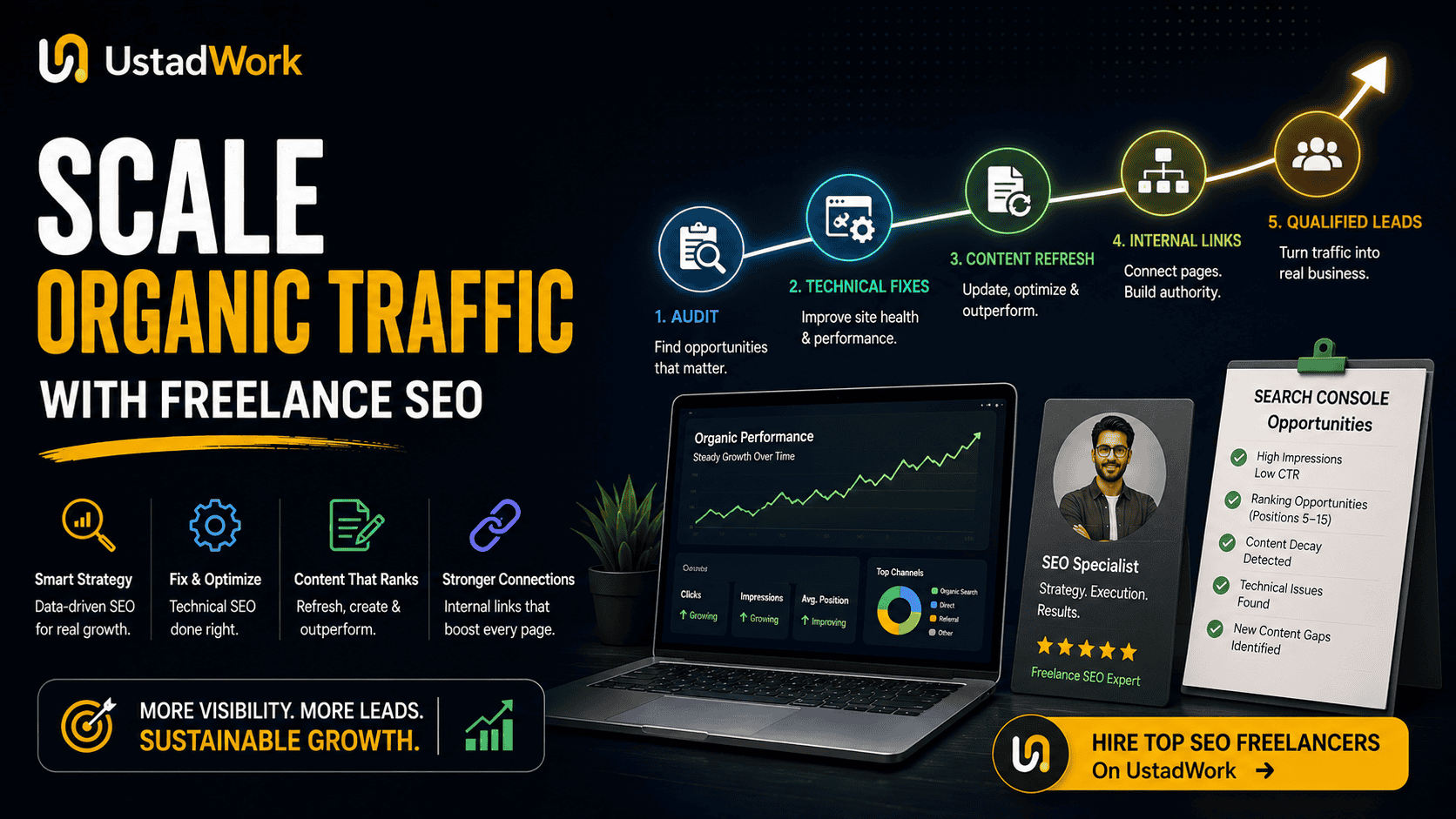
How to Scale Organic Traffic With Freelance SEO in 2026
Scaling organic traffic is not the same as publishing more articles. Sustainable growth comes from understanding what your audience searches for, fixing technical barriers, improving pages that already have potential, creating genuinely useful new content, and connecting every page to a relevant business action.
A business may already have dozens of articles but still struggle because its strongest pages are outdated, important service pages are poorly connected, several articles compete for the same intent, or visitors cannot find a useful next step.
A strong freelance SEO strategy combines technical review, Search Console analysis, content refreshes, search-intent planning, internal linking, conversion improvements, and measured publishing. When your goals are ready, you can post an SEO project on UstadWork or browse SEO freelancer services.
A business may already have dozens of articles but still struggle because its strongest pages are outdated, important service pages are poorly connected, several articles compete for the same intent, or visitors cannot find a useful next step.
A strong freelance SEO strategy combines technical review, Search Console analysis, content refreshes, search-intent planning, internal linking, conversion improvements, and measured publishing. When your goals are ready, you can post an SEO project on UstadWork or browse SEO freelancer services.
Quick Answer: What Actually Scales Organic Traffic?
Organic growth usually comes from improving the entire search journey rather than relying on one tactic.
A practical system includes:
Technical accessibility: Important pages must be crawlable, indexable, mobile-friendly, and easy to navigate.
Search-intent alignment: Each page should answer one clear user need.
Content improvement: Existing pages should be updated when their information, structure, proof, or search intent becomes weak.
Topic coverage: Related pages should work together as a useful content cluster.
Internal links: Visitors and search engines should be able to move between related guides, services, categories, and conversion pages.
Original value: Content should include practical examples, first-hand knowledge, templates, checklists, data, or expert analysis.
Conversion path: Organic visitors should have a relevant next step, such as requesting a quote, browsing a service, posting a project, or downloading a resource.
Traffic becomes valuable when the right visitors reach the right page and can take a useful action.
A practical system includes:
Technical accessibility: Important pages must be crawlable, indexable, mobile-friendly, and easy to navigate.
Search-intent alignment: Each page should answer one clear user need.
Content improvement: Existing pages should be updated when their information, structure, proof, or search intent becomes weak.
Topic coverage: Related pages should work together as a useful content cluster.
Internal links: Visitors and search engines should be able to move between related guides, services, categories, and conversion pages.
Original value: Content should include practical examples, first-hand knowledge, templates, checklists, data, or expert analysis.
Conversion path: Organic visitors should have a relevant next step, such as requesting a quote, browsing a service, posting a project, or downloading a resource.
Traffic becomes valuable when the right visitors reach the right page and can take a useful action.
Define the Business Outcome Before Starting SEO
Do not begin an SEO project with the goal of simply increasing traffic. Define what organic visibility should help the business achieve.
Possible outcomes include:
More qualified service enquiries.
More project posts or marketplace signups.
More product or category discovery.
More consultation bookings.
More newsletter or resource downloads.
Lower dependence on paid advertising.
Better visibility for high-value services.
Connect every target topic to a business stage. Informational articles can build awareness, comparison pages can support evaluation, and service or hiring guides can help users take action.
A freelancer should understand the commercial goal before recommending keywords, content volume, or technical work.
Possible outcomes include:
More qualified service enquiries.
More project posts or marketplace signups.
More product or category discovery.
More consultation bookings.
More newsletter or resource downloads.
Lower dependence on paid advertising.
Better visibility for high-value services.
Connect every target topic to a business stage. Informational articles can build awareness, comparison pages can support evaluation, and service or hiring guides can help users take action.
A freelancer should understand the commercial goal before recommending keywords, content volume, or technical work.
Establish an Organic Traffic Baseline
Before changing the site, document its current performance. Without a baseline, it becomes difficult to know whether the SEO work created improvement or whether traffic changed for another reason.
Record:
Organic clicks and impressions
Queries and landing pages
Average position and click-through rate
Indexed and excluded pages
Conversions from organic visitors
Internal clicks to services or jobs
Pages losing traffic
Pages receiving impressions but few clicks
Important pages with no visibility
Separate branded searches from non-branded searches where possible. A rise in brand searches may reflect another campaign, while non-branded growth can show stronger topic discovery.
Create a simple dashboard that the business and freelancer can review together each month.
Record:
Organic clicks and impressions
Queries and landing pages
Average position and click-through rate
Indexed and excluded pages
Conversions from organic visitors
Internal clicks to services or jobs
Pages losing traffic
Pages receiving impressions but few clicks
Important pages with no visibility
Separate branded searches from non-branded searches where possible. A rise in brand searches may reflect another campaign, while non-branded growth can show stronger topic discovery.
Create a simple dashboard that the business and freelancer can review together each month.
Start With an SEO Audit, Not a Content Calendar
Publishing more content before understanding the site can waste budget. A technical or content problem may prevent new pages from performing properly.
The first audit should review:
Indexation: Are important pages appearing in search?
Duplicate intent: Are several pages competing for the same query?
Site structure: Can users reach important pages through normal navigation?
Page quality: Do key pages answer the intended question completely?
Internal links: Are valuable pages isolated?
Metadata: Do titles and descriptions communicate the page value clearly?
Page experience: Does the site work well across devices?
Conversion path: Can visitors understand what to do next?
The audit should finish with a prioritised action list. Avoid reports containing hundreds of issues without explaining which items matter first.
The first audit should review:
Indexation: Are important pages appearing in search?
Duplicate intent: Are several pages competing for the same query?
Site structure: Can users reach important pages through normal navigation?
Page quality: Do key pages answer the intended question completely?
Internal links: Are valuable pages isolated?
Metadata: Do titles and descriptions communicate the page value clearly?
Page experience: Does the site work well across devices?
Conversion path: Can visitors understand what to do next?
The audit should finish with a prioritised action list. Avoid reports containing hundreds of issues without explaining which items matter first.
Use Search Console to Find Existing Opportunities
Search Console data can reveal pages that already have enough relevance to improve without starting from zero.
Look for:
High impressions with low CTR: The title, description, or search-intent match may need improvement.
Queries ranking below the strongest positions: The page may need clearer coverage, proof, internal links, or a stronger answer.
Pages losing clicks over time: Information may be outdated, competitors may provide better answers, or several pages may be competing.
Unexpected queries: Visitors may be finding a useful angle that the page does not fully address.
Important pages with low impressions: The page may need technical review, stronger internal links, or better intent alignment.
Group opportunities by likely impact and effort. A page already receiving impressions may produce results faster than a completely new topic.
Look for:
High impressions with low CTR: The title, description, or search-intent match may need improvement.
Queries ranking below the strongest positions: The page may need clearer coverage, proof, internal links, or a stronger answer.
Pages losing clicks over time: Information may be outdated, competitors may provide better answers, or several pages may be competing.
Unexpected queries: Visitors may be finding a useful angle that the page does not fully address.
Important pages with low impressions: The page may need technical review, stronger internal links, or better intent alignment.
Group opportunities by likely impact and effort. A page already receiving impressions may produce results faster than a completely new topic.
Fix Technical Barriers Before Scaling Content
Technical SEO should support discovery and usability. It should not become an endless checklist disconnected from business impact.
Prioritise problems that affect important pages:
Blocked or accidentally noindexed URLs.
Broken internal links.
Incorrect canonical URLs.
Important pages missing from navigation.
Duplicate URL versions.
Slow or unstable key templates.
Mobile layout problems.
JavaScript-dependent content that is difficult to access.
Broken redirects after migrations.
Thin tag, archive, filter, or search pages being indexed unnecessarily.
For larger websites, ask the SEO freelancer and developer to work together. The freelancer should explain the search impact, while the developer should determine the safest implementation.
Prioritise problems that affect important pages:
Blocked or accidentally noindexed URLs.
Broken internal links.
Incorrect canonical URLs.
Important pages missing from navigation.
Duplicate URL versions.
Slow or unstable key templates.
Mobile layout problems.
JavaScript-dependent content that is difficult to access.
Broken redirects after migrations.
Thin tag, archive, filter, or search pages being indexed unnecessarily.
For larger websites, ask the SEO freelancer and developer to work together. The freelancer should explain the search impact, while the developer should determine the safest implementation.
Refresh Existing Content Before Publishing More
Many websites have pages that once performed well but now contain outdated information, weak examples, broken links, poor formatting, or an incomplete answer. Updating these pages may be more valuable than creating another article on the same subject.
A content refresh can include:
Updating facts, screenshots, tools, and processes.
Rewriting the introduction to answer the query faster.
Removing filler and repeated advice.
Adding original examples, templates, or decision frameworks.
Improving headings and page structure.
Combining overlapping pages.
Adding relevant internal links.
Improving the CTA and next step.
Reviewing metadata and image alt text.
Adding a real author, reviewer, and accurate update date.
Do not change the date only to make a page appear fresh. Update it when the page has received a meaningful improvement.
A content refresh can include:
Updating facts, screenshots, tools, and processes.
Rewriting the introduction to answer the query faster.
Removing filler and repeated advice.
Adding original examples, templates, or decision frameworks.
Improving headings and page structure.
Combining overlapping pages.
Adding relevant internal links.
Improving the CTA and next step.
Reviewing metadata and image alt text.
Adding a real author, reviewer, and accurate update date.
Do not change the date only to make a page appear fresh. Update it when the page has received a meaningful improvement.
Build Search-Intent Content Clusters
A content cluster helps users move from an initial question toward a more specific decision. The pages should support one another rather than compete for the same phrase.
An SEO freelancer cluster might include:
Awareness: What SEO freelancers do and when a business needs one.
Cost: SEO freelancer pricing, audit costs, and retainers.
Hiring: How to evaluate SEO specialists and compare proposals.
Strategy: Technical SEO, content refreshes, internal linking, and AI search visibility.
Decision: A project brief, hiring checklist, or service category.
Each page should answer a distinct intent. Use internal links to guide readers toward the next useful resource rather than inserting links only for search engines.
This article should link naturally to how to hire an SEO freelancer and the SEO freelancer cost guide.
An SEO freelancer cluster might include:
Awareness: What SEO freelancers do and when a business needs one.
Cost: SEO freelancer pricing, audit costs, and retainers.
Hiring: How to evaluate SEO specialists and compare proposals.
Strategy: Technical SEO, content refreshes, internal linking, and AI search visibility.
Decision: A project brief, hiring checklist, or service category.
Each page should answer a distinct intent. Use internal links to guide readers toward the next useful resource rather than inserting links only for search engines.
This article should link naturally to how to hire an SEO freelancer and the SEO freelancer cost guide.
Create Non-Commodity Content
Generic content becomes difficult to differentiate because many websites repeat the same definitions and tips. Strong organic pages provide something that cannot be produced from a basic prompt alone.
Add value through:
First-hand experience: Explain what happened during a real audit, migration, redesign, or content update.
Original templates: Provide briefs, scorecards, checklists, or reporting formats.
Expert decisions: Explain why one action was prioritised over another.
Examples: Show weak versus improved titles, internal links, page structures, or CTAs.
First-party data: Share anonymised patterns from customer questions, project requests, or platform activity where appropriate.
Limitations: Explain when a tactic does not apply or creates risk.
The content should help readers make a better decision, not merely recognise familiar SEO terminology.
Add value through:
First-hand experience: Explain what happened during a real audit, migration, redesign, or content update.
Original templates: Provide briefs, scorecards, checklists, or reporting formats.
Expert decisions: Explain why one action was prioritised over another.
Examples: Show weak versus improved titles, internal links, page structures, or CTAs.
First-party data: Share anonymised patterns from customer questions, project requests, or platform activity where appropriate.
Limitations: Explain when a tactic does not apply or creates risk.
The content should help readers make a better decision, not merely recognise familiar SEO terminology.
Strengthen Internal Linking
Internal links help users discover related content and help important pages become part of a clear site structure.
A good internal-link system should connect:
Blog guides to relevant service categories.
Informational articles to hiring or pricing guides.
Role-specific pages to broader pillar content.
Related comparison and cost articles.
New articles to older relevant pages.
Older high-performing pages to important new resources.
Use descriptive anchor text that explains the destination. Avoid vague anchors such as click here when a clearer description is available.
Do not insert dozens of unrelated links. Add links where the reader would genuinely benefit from more detail or a relevant next step.
A good internal-link system should connect:
Blog guides to relevant service categories.
Informational articles to hiring or pricing guides.
Role-specific pages to broader pillar content.
Related comparison and cost articles.
New articles to older relevant pages.
Older high-performing pages to important new resources.
Use descriptive anchor text that explains the destination. Avoid vague anchors such as click here when a clearer description is available.
Do not insert dozens of unrelated links. Add links where the reader would genuinely benefit from more detail or a relevant next step.
Prepare Content for AI Search Without Chasing Hacks
AI search visibility should be treated as an extension of useful SEO, not a separate system based on artificial formatting tricks.
Pages should provide clear answers, reliable sources, understandable headings, distinct expert value, crawlable content, and relevant media. Important claims should be verifiable, and brand information should remain consistent across official pages.
Useful improvements include:
Answering the main question early.
Providing concise definitions followed by deeper explanation.
Using examples, comparisons, and decision criteria.
Showing who created or reviewed the content.
Maintaining accurate company, service, and author information.
Adding original visuals and downloadable resources.
Keeping important content accessible without login.
Do not create dozens of near-identical pages for every possible AI-style query. One complete page can answer several closely related questions naturally.
Pages should provide clear answers, reliable sources, understandable headings, distinct expert value, crawlable content, and relevant media. Important claims should be verifiable, and brand information should remain consistent across official pages.
Useful improvements include:
Answering the main question early.
Providing concise definitions followed by deeper explanation.
Using examples, comparisons, and decision criteria.
Showing who created or reviewed the content.
Maintaining accurate company, service, and author information.
Adding original visuals and downloadable resources.
Keeping important content accessible without login.
Do not create dozens of near-identical pages for every possible AI-style query. One complete page can answer several closely related questions naturally.
Use Programmatic SEO Only When the Pattern Is Valuable
Programmatic SEO can support organic growth when the business has structured data and a repeatable search pattern with genuinely different user needs.
Examples may include services by platform, integrations, templates by role, verified marketplace categories, or useful location-specific information.
It becomes risky when pages differ only by one keyword, city, profession, or product name. Each page should contain unique data, examples, recommendations, and a relevant user action.
Start with a small pilot batch, review every page, measure indexing and engagement, and expand only when the system proves useful. For a full framework, read our programmatic SEO with AI freelancers guide.
Examples may include services by platform, integrations, templates by role, verified marketplace categories, or useful location-specific information.
It becomes risky when pages differ only by one keyword, city, profession, or product name. Each page should contain unique data, examples, recommendations, and a relevant user action.
Start with a small pilot batch, review every page, measure indexing and engagement, and expand only when the system proves useful. For a full framework, read our programmatic SEO with AI freelancers guide.
Turn Organic Traffic Into Qualified Leads
Traffic growth is incomplete if visitors do not understand the offer or cannot find a useful next step.
Review high-traffic pages for:
Intent match: Does the CTA fit what the visitor came to learn?
Offer clarity: Is the service or next step easy to understand?
Trust: Are proof, process, authorship, and relevant examples visible?
Form friction: Does the form ask only for necessary information?
Internal journey: Can visitors move from an educational guide to a suitable service, cost guide, or project form?
Measurement: Are CTA clicks, job posts, enquiries, downloads, and signups being tracked?
A beginner guide may lead to a checklist, while a cost or hiring guide may lead directly to relevant services or a project form.
Review high-traffic pages for:
Intent match: Does the CTA fit what the visitor came to learn?
Offer clarity: Is the service or next step easy to understand?
Trust: Are proof, process, authorship, and relevant examples visible?
Form friction: Does the form ask only for necessary information?
Internal journey: Can visitors move from an educational guide to a suitable service, cost guide, or project form?
Measurement: Are CTA clicks, job posts, enquiries, downloads, and signups being tracked?
A beginner guide may lead to a checklist, while a cost or hiring guide may lead directly to relevant services or a project form.
Choose the Right Freelance SEO Team
One SEO freelancer may handle a focused small-business project. Larger websites may need several specialists working together.
Possible roles include:
SEO strategist: Sets priorities, search intent, clusters, and reporting.
Technical SEO specialist: Reviews crawling, indexation, canonicals, migrations, and site structure.
Content strategist: Plans pages, briefs, updates, and editorial standards.
Writer or subject expert: Creates useful content with practical experience.
Developer: Implements technical changes, templates, tracking, and performance improvements.
Digital PR or outreach specialist: Promotes useful resources and builds legitimate industry relationships.
Analyst: Connects search performance with conversions and business outcomes.
Ask who will personally complete each task. Do not assume one freelancer provides every specialist skill.
Possible roles include:
SEO strategist: Sets priorities, search intent, clusters, and reporting.
Technical SEO specialist: Reviews crawling, indexation, canonicals, migrations, and site structure.
Content strategist: Plans pages, briefs, updates, and editorial standards.
Writer or subject expert: Creates useful content with practical experience.
Developer: Implements technical changes, templates, tracking, and performance improvements.
Digital PR or outreach specialist: Promotes useful resources and builds legitimate industry relationships.
Analyst: Connects search performance with conversions and business outcomes.
Ask who will personally complete each task. Do not assume one freelancer provides every specialist skill.
Use Milestones Instead of a Vague Monthly Promise
A monthly SEO retainer should explain what will be reviewed, delivered, implemented, and reported. Avoid agreements based only on general terms such as complete SEO or ongoing optimisation.
A milestone plan may include:
Milestone 1: Baseline and audit
Search performance, technical review, content inventory, and conversion measurement.
Milestone 2: Technical and structural fixes
Indexation, redirects, internal links, priority templates, and tracking.
Milestone 3: Content refresh sprint
Update pages with existing impressions or declining traffic.
Milestone 4: New cluster development
Create original pages for validated content gaps.
Milestone 5: Authority and conversion improvements
Promote useful resources, strengthen proof, and improve CTAs.
Every milestone should have deliverables, responsibilities, review points, and success measures.
A milestone plan may include:
Milestone 1: Baseline and audit
Search performance, technical review, content inventory, and conversion measurement.
Milestone 2: Technical and structural fixes
Indexation, redirects, internal links, priority templates, and tracking.
Milestone 3: Content refresh sprint
Update pages with existing impressions or declining traffic.
Milestone 4: New cluster development
Create original pages for validated content gaps.
Milestone 5: Authority and conversion improvements
Promote useful resources, strengthen proof, and improve CTAs.
Every milestone should have deliverables, responsibilities, review points, and success measures.
A 90-Day Freelance SEO Growth Plan
Days 1–30: Diagnose and prioritise
Set the baseline, review Search Console, audit indexation, identify declining pages, map conversion actions, and prepare the priority backlog.
Days 31–60: Fix and refresh
Resolve important technical issues, consolidate competing pages, improve internal links, refresh existing opportunities, and strengthen important service pages.
Days 61–90: Expand and measure
Publish a small number of original cluster pages, promote useful resources, improve AI-search readiness, test CTAs, and compare results against the original baseline.
The first 90 days should create a reliable system and clearer priorities. It should not promise a fixed traffic increase or guaranteed ranking position.
Set the baseline, review Search Console, audit indexation, identify declining pages, map conversion actions, and prepare the priority backlog.
Days 31–60: Fix and refresh
Resolve important technical issues, consolidate competing pages, improve internal links, refresh existing opportunities, and strengthen important service pages.
Days 61–90: Expand and measure
Publish a small number of original cluster pages, promote useful resources, improve AI-search readiness, test CTAs, and compare results against the original baseline.
The first 90 days should create a reliable system and clearer priorities. It should not promise a fixed traffic increase or guaranteed ranking position.
SEO Reporting That Supports Decisions
A useful report should explain what changed, why it changed, what was completed, and what should happen next.
Include:
Organic clicks and impressions.
Non-branded query growth.
Important landing-page performance.
CTR opportunities.
Indexed and excluded page changes.
Completed technical fixes.
Updated and published content.
Internal-link improvements.
Organic conversions and assisted actions.
Pages requiring consolidation or removal.
Next-month priorities.
Avoid reports focused only on rankings for a long keyword list. Rankings provide context, but they should be connected to relevant traffic, engagement, leads, and business actions.
Include:
Organic clicks and impressions.
Non-branded query growth.
Important landing-page performance.
CTR opportunities.
Indexed and excluded page changes.
Completed technical fixes.
Updated and published content.
Internal-link improvements.
Organic conversions and assisted actions.
Pages requiring consolidation or removal.
Next-month priorities.
Avoid reports focused only on rankings for a long keyword list. Rankings provide context, but they should be connected to relevant traffic, engagement, leads, and business actions.
Common Organic Growth Mistakes
Avoid these common mistakes:
Publishing without an audit: Existing technical or content problems remain unresolved.
Targeting keywords without intent: The page attracts visitors who need a different answer.
Ignoring old content: Useful pages decline while the team creates duplicates.
Measuring traffic only: Growth does not lead to qualified actions.
Using generic AI content: Pages add no expert value or original information.
Creating too many similar pages: Content competes internally and weakens site quality.
Buying weak links: The business increases risk without building real authority.
Using vague retainers: Nobody can explain what the freelancer completed.
Expecting instant results: Sustainable SEO requires implementation, testing, learning, and maintenance.
Publishing without an audit: Existing technical or content problems remain unresolved.
Targeting keywords without intent: The page attracts visitors who need a different answer.
Ignoring old content: Useful pages decline while the team creates duplicates.
Measuring traffic only: Growth does not lead to qualified actions.
Using generic AI content: Pages add no expert value or original information.
Creating too many similar pages: Content competes internally and weakens site quality.
Buying weak links: The business increases risk without building real authority.
Using vague retainers: Nobody can explain what the freelancer completed.
Expecting instant results: Sustainable SEO requires implementation, testing, learning, and maintenance.
Freelance SEO Hiring Checklist
Before hiring, check these points:
Define the business outcome and priority conversions.
Share Search Console, analytics, CMS, and previous reports where appropriate.
Ask the freelancer to explain the first 30-day plan.
Request examples relevant to your site type or business model.
Ask how technical, content, internal-link, and conversion work will be prioritised.
Confirm which tasks require your developer or internal team.
Request milestone-based deliverables.
Avoid guaranteed rankings or traffic promises.
Confirm ownership of reports, briefs, data, and created assets.
Agree on reporting and communication frequency.
Use our general freelancer hiring guide, then post your SEO project or browse SEO specialist services.
Define the business outcome and priority conversions.
Share Search Console, analytics, CMS, and previous reports where appropriate.
Ask the freelancer to explain the first 30-day plan.
Request examples relevant to your site type or business model.
Ask how technical, content, internal-link, and conversion work will be prioritised.
Confirm which tasks require your developer or internal team.
Request milestone-based deliverables.
Avoid guaranteed rankings or traffic promises.
Confirm ownership of reports, briefs, data, and created assets.
Agree on reporting and communication frequency.
Use our general freelancer hiring guide, then post your SEO project or browse SEO specialist services.
Build an Organic Growth System, Not a Publishing Race
Scaling organic traffic requires coordinated improvements across technical SEO, content quality, internal links, authority, AI-search visibility, and conversion paths.
The right freelancer should not begin by promising a large number of articles or backlinks. They should begin by understanding the business, reviewing current performance, identifying the strongest opportunities, and creating a measurable plan.
A sustainable freelance SEO strategy improves what already exists, creates original new value, connects pages logically, and measures whether organic visitors become useful business opportunities.
Ready to begin? post an SEO growth project on UstadWork, explore SEO freelancer services, or review the UstadWork FAQ before hiring.
The right freelancer should not begin by promising a large number of articles or backlinks. They should begin by understanding the business, reviewing current performance, identifying the strongest opportunities, and creating a measurable plan.
A sustainable freelance SEO strategy improves what already exists, creates original new value, connects pages logically, and measures whether organic visitors become useful business opportunities.
Ready to begin? post an SEO growth project on UstadWork, explore SEO freelancer services, or review the UstadWork FAQ before hiring.
Frequently asked questions
How can a freelancer help scale organic traffic?
An SEO freelancer can audit technical issues, analyse Search Console opportunities, refresh existing content, build search-intent clusters, strengthen internal links, improve conversion paths, and measure results.
Should I publish new content or update old pages first?
Review existing pages first. Pages with impressions, backlinks, declining clicks, or outdated information may offer faster and more efficient improvement opportunities.
How long does freelance SEO take to produce results?
There is no guaranteed timeline. Results depend on the website condition, competition, implementation speed, current authority, content quality, technical issues, and search demand.
Does SEO still work with AI Overviews and AI search?
Yes. Foundational SEO, unique content, technical accessibility, clear expertise, internal links, useful media, and accurate information remain important for traditional and generative search experiences.
What should an SEO freelancer include in a monthly report?
The report should include organic clicks, impressions, important landing pages, conversions, technical fixes, content updates, internal-link improvements, indexing changes, and next priorities.
Can an SEO freelancer guarantee traffic or rankings?
No responsible SEO freelancer can guarantee a fixed ranking, traffic number, or business result. They can improve the strategy, implementation, content, technical quality, and measurement process.